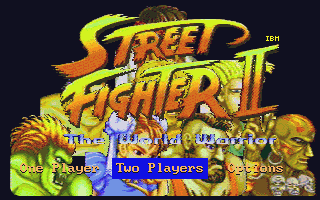
Every home port of Street Fighter II tells you something about the hardware it landed on, and the 1992 MS-DOS conversion, handled by US Gold with Capcom’s involvement, tells a story about how far PC hardware still had to stretch to keep up with arcade boards in the early 90s.
Bringing the Arcade Phenomenon Home
Capcom’s original 1991 arcade release didn’t just do well — it effectively invented the modern fighting game template, with special moves triggered by directional inputs and button combinations, a roster of internationally themed fighters, and one-on-one matches that turned arcades into spectator sports. The DOS port arrived a year later, tasked with translating that fast, precise combat to a platform that, in 1992, was nowhere near arcade-board performance for this kind of action.
It shows. The DOS version is generally regarded as less fluid than either the arcade original or the SNES port that most players actually remember fondly. But it introduced Street Fighter II to a wide swath of PC owners who didn’t have an arcade nearby or a console at home, and that alone makes it a meaningful piece of early-90s DOS gaming history, even if it isn’t the definitive way to experience the game today.
It’s worth remembering just how much cultural weight Street Fighter II was carrying by the time this port arrived. The arcade original had already reshaped how publishers thought about home conversions across every platform they could reach, PC included, and US Gold taking on the DOS port at all is a sign of how much demand there was to own a piece of the phenomenon on whatever hardware you happened to have at home.
Getting the Most Out of the DOS Version
- Use a joystick or gamepad configured through DOSBox rather than the keyboard — special move inputs are noticeably more consistent with an analog or digital directional input than with keys.
- Learn one character’s fireball-and-anti-air toolkit (Ryu or Ken are the most forgiving) before branching out to the cast’s more technical fighters like Chun-Li or Guile.
- Don’t judge your execution against the arcade or SNES versions — the DOS port’s input timing runs differently, so a combo you’ve mastered elsewhere may need retiming here.
- The four boss characters (Balrog, Vega, Sagat, M. Bison) are considerably tougher than the eight-character roster you fight first; expect a real difficulty spike at the end of single-player.
- Practice against the CPU in two-player mode’s setup before jumping into ranked-style matches with friends — the DOS control scheme has a learning curve that’s easy to underestimate if you’ve only played console versions.
The Roster and What Made Each Fighter Click
Part of what made Street Fighter II a genuine cultural phenomenon, rather than just a well-made arcade game, was how distinct each character felt to play. Ryu and Ken share a moveset but reward slightly different playstyles; Chun-Li’s speed and kicks favor an aggressive, close-range approach; Guile’s charge-based special moves ask for patience and spacing rather than quick reflexes; Zangief’s grapples turn the whole match into a game of getting past his range rather than trading blows directly.
That variety is exactly what turned the game into a genre template rather than a one-off hit — every fighting game that followed, on DOS or anywhere else, inherited some version of “give each character a genuinely different way to win.” Playing the DOS port today is a good way to feel that design principle in its earliest, most influential form, even filtered through a technically compromised conversion.
DOS Port vs. the Rest of the Field
Set next to Mortal Kombat’s own home computer conversions from the same era, Street Fighter II’s DOS port had a harder job: reproducing precise special-move inputs and tight frame timing is a much steeper technical ask than Mortal Kombat’s more digitized-sprite, button-combo-driven combat. That’s part of why the SNES and Genesis versions of Street Fighter II are remembered so much more fondly — dedicated console hardware was simply built for this kind of action in a way early-90s PCs weren’t.
I won’t pretend the DOS version is the best way to experience Street Fighter II today — it isn’t, and anyone who’s played the SNES port will feel the difference immediately. But as a piece of history showing how publishers scrambled to bring arcade hits to home computers before proper console ports became the default expectation, it’s a genuinely worthwhile curiosity.
What’s easy to lose sight of decades later is how few PC owners in 1992 had any other way to experience this specific cultural moment. Import arcade cabinets and console imports were real options for enthusiasts, but for the average PC household, this compromised DOS port was often the only Street Fighter II they’d ever touch, and that access is worth something even set against its technical shortcomings.
Getting Set Up
Street Fighter II is a commercial release and isn’t available as a legal free download, so look for official re-releases on GOG or Steam rather than shareware copies floating around online. First time using DOSBox? Our setup guide covers everything from mounting drives to configuring controllers.
Setting Up the DOS Port
Mount the game’s folder as a virtual drive with mount c [folder], switch to that drive using c:, and launch the EXE from the DOSBox prompt. For the smoothest experience, configure a joystick or gamepad through DOSBox rather than relying on keyboard input — our guide above covers the full setup process.
Arcade Combat on a Home PC
You might also like: