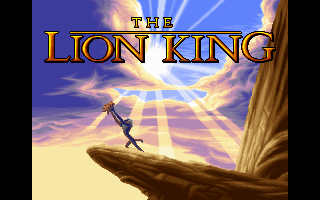
Say “The Lion King video game” to anyone who owned a DOS machine in the mid-90s and there’s a decent chance the first thing they mention is the stampede level. Westwood Studios’ 1994 platformer, published by Virgin Interactive, is a rare Disney tie-in that took its source film seriously — and then made one section of it brutally, memorably hard.
Following the film scene by scene
Released the same year as Disney’s animated film, the game follows Simba’s arc from playful cub in the Pride Lands to his eventual return to reclaim the throne, translated into a side-scrolling action-platformer. Westwood’s production polish shows throughout — the sprite work and level design closely track the film’s major set pieces, from the sunlit Pride Lands to the ash-covered Elephant Graveyard, at a time when licensed movie games didn’t always bother with that level of care or attention to the source material’s actual tone.
Growing up mid-game
Simba’s abilities and the challenges he faces shift as he grows from cub to adult lion over the course of the campaign, and the enemies and obstacles are pulled straight from the film’s cast and settings. The platforming leans on tight jumps and timed obstacle sequences rather than combat depth, and precision and memorization of level layouts matter more than fast reflexes in the trickier stages — which is exactly why the stampede sequence stands out as much as it does among the rest of the game’s more measured pacing.
That shift in ability set also changes how you have to think about each level. The cub sections favor caution and smaller, more careful jumps, while the adult Simba stages open up faster movement and different attack options, so the game is quietly teaching you two overlapping skill sets rather than just one consistent platforming rhythm.
Getting through the rough patches
- Treat the stampede sequence as a memorization level, not a reaction-time test. Learning the hazard order ahead of time makes it far more manageable than trying to react in real time.
- Cub-Simba levels favor caution over speed; several early hazards are easy to underestimate given how forgiving the opening stages feel at first.
- Save your progress at every opportunity the game gives you. Some later stages are long enough that losing your place costs real time and real frustration.
- Adult-Simba sections change the pacing noticeably, so don’t assume the habits that got you through the cub levels will carry over directly.
- Watch enemy patterns before engaging rather than charging straight in; several late-game hazards punish impatience far more than mistimed jumps do.
A high point for licensed platformers
The Lion King is frequently cited by players who grew up with it as one of the toughest single levels of the DOS era, specifically because of that stampede — a level design choice that’s become something of a legend in its own right among people who played it as kids. More broadly, the game is remembered as one of the better Disney movie tie-ins of its generation precisely because it didn’t cut corners on tone or presentation the way so many licensed games of the era did.
Where it stands now
It’s aged well as a piece of Disney-era platforming, though I won’t pretend the difficulty curve is entirely fair — the stampede level in particular can feel like a wall the rest of the game didn’t fully prepare you for. If you grew up with the film, though, the fidelity to its tone and imagery makes revisiting this one genuinely rewarding rather than just nostalgic filler.
Even setting nostalgia aside, the underlying platforming holds up as solid, well-built work. It’s not going to convert someone who bounced off the genre entirely, but for platformer fans specifically, this remains one of the better-executed licensed games the DOS era produced.
Sitting alongside Aladdin in Westwood and Virgin’s catalog
It’s worth mentioning this one alongside Disney’s Aladdin, released by the same publisher the same year, because the two games make an interesting study in contrasts despite sharing a release window and a source studio in Disney’s animation department. Where Aladdin leans on a flying-carpet sequence to break up its platforming rhythm, The Lion King leans on the stampede to spike its difficulty at a specific narrative beat. Both approaches work, but they say something different about how Westwood and whichever studio handled Aladdin’s DOS port each thought about translating a film’s biggest set piece into a platformer level.
If you play both back to back, The Lion King comes across as the more tonally faithful of the two, willing to let a genuinely tense, high-stakes film moment stay genuinely tense in game form rather than smoothing it over for the sake of consistent difficulty pacing.
That’s not a knock against Aladdin, which has its own strengths in animation quality and level variety. It’s more that the two games make different bets about what a licensed platformer owes its source film, and both bets paid off in their own way, which is part of why both are still worth playing today rather than just one or the other.
Setting it up
If you’re running an original copy rather than the modern re-release, mount your game folder with mount c [folder], switch to that drive using c:, and launch the EXE from the DOSBox prompt. Our complete DOSBox setup guide covers configuration tips if you need them.
Watch Gameplay
You might also like: