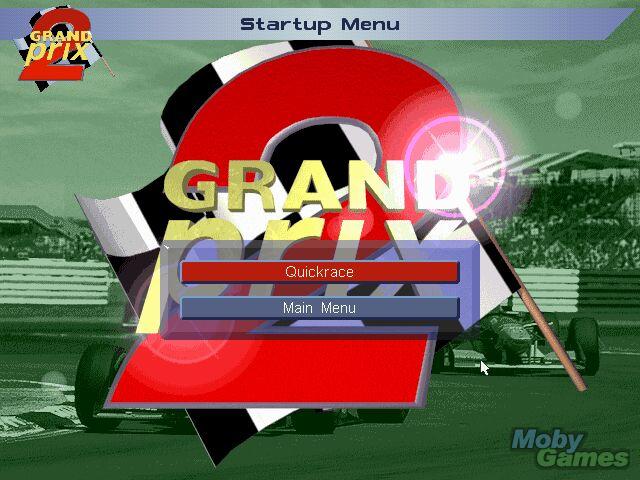
Geoff Crammond had already proven he could make a convincing Formula One simulation with 1991’s Formula One Grand Prix. Four years later, Grand Prix 2 proved he could make one that actually looked like the sport it was simulating, and the jump between the two games is still striking to see side by side.
From flat shading to texture-mapped circuits
Published by MicroProse in 1995, Grand Prix 2 pushed well past its predecessor with SVGA graphics and texture-mapped 3D tracks that were genuinely striking for the era, built around the 1994 Formula One season’s calendar of real circuits. Crammond’s uncompromising approach to simulation carried over directly from the first game, but the visual leap meant players could finally read a track’s elevation changes and racing lines with real clarity instead of guessing from a flat overhead view that made judging braking distances a matter of memorization more than visual feedback.
A full season, not just a lap
You take on a complete season, qualifying and racing across the calendar against an AI field, with every part of a race weekend represented — practice, qualifying, tire strategy, and pit stops all factor into the result, not just the checkered flag. The driving model asks for real commitment to braking points and racing lines on each circuit, and the game rewards players willing to actually learn a track rather than relying on instinct carried over from a different sim or a different racing game entirely.
What stands out even now is how differently each circuit demands to be driven. A track like Monaco punishes the slightest mistake in a way a high-speed circuit doesn’t, and Grand Prix 2 makes you feel that difference through the handling model itself rather than just labeling tracks as “hard” or “easy” on a menu screen.
Shaving seconds off your lap times
- Spend real time in practice sessions learning brake points for each circuit individually. The tracks are different enough that generic braking habits will cost you seconds per lap.
- Qualifying laps reward a clean, mistake-free run over an aggressive one; a single spun corner usually costs more than a slightly conservative lap would have.
- Manage tire wear across a race distance rather than treating every lap like a qualifying lap. Pushing too hard early leaves you with nothing in the closing laps.
- Use pit strategy deliberately. Track position lost in the pits is often recoverable if your tire choice is right for the remaining laps.
- Pay attention to weather changes during longer races; a shift in conditions mid-race can make an earlier tire choice suddenly wrong.
Where it sits in Crammond’s run of sims
This is the game most often cited as the high point of Crammond’s early Grand Prix series, and its influence carried straight into Grand Prix 3, released in 2000, which built on the same demanding driving model with another generational leap in graphics. For anyone tracing the lineage of modern F1 simulations, Grand Prix 2 is a genuinely essential chapter, not just a nostalgic footnote that gets mentioned and forgotten.
Worth the effort today?
If you have the patience for a sim that expects you to actually learn each circuit, yes, absolutely — few racing games from this era reward dedication this precisely. If you’re looking for something you can pick up and enjoy in ten minutes, this isn’t it; the demanding handling model that makes it satisfying long-term is the same thing that makes the first few sessions genuinely frustrating for anyone expecting an arcade racer.
My advice for a first attempt: pick one circuit and stay with it across several sessions before judging the game as a whole. Grand Prix 2 rarely feels fair on an unfamiliar track, but that same track can feel entirely conquerable once you’ve actually put in the laps to learn it properly.
Why the AI still impresses people
A recurring point of praise for Grand Prix 2, even decades on, is how convincingly its AI drivers race each other independent of what you’re doing. Watch a replay of the midfield battling for position and it doesn’t read as scripted filler the way AI traffic in a lot of period racing games does — cars defend lines, make genuine passing attempts, and occasionally make mistakes under pressure just like a human field would. That’s a harder problem to solve than raw physics accuracy, and it’s a big part of why the game earned the reputation it did among sim-racing enthusiasts who cared as much about the race itself as their own lap times.
It’s easy to take that kind of AI behavior for granted now that it’s more common, but in 1995 a full grid of cars that felt like they were actually racing each other, not just occupying track space, was a genuine step forward for the genre.
Even the sound design deserves a mention here, since engine notes and tire screech change meaningfully with car setup and surface, giving experienced players an extra layer of feedback beyond what’s on screen. It’s a small touch that a lot of racing games skipped entirely at this point in the ’90s.
DOSBox setup
Grand Prix 2 is a commercial title — look for it on GOG or Steam.
Mount your game folder with mount c [folder], switch to that drive using c:, and start the EXE from the DOSBox prompt. See our complete DOSBox setup guide for tips on getting SVGA graphics and sound configured correctly, and browse our free DOS games list if you want something more casual for afterward.
Watch Gameplay
You might also like: