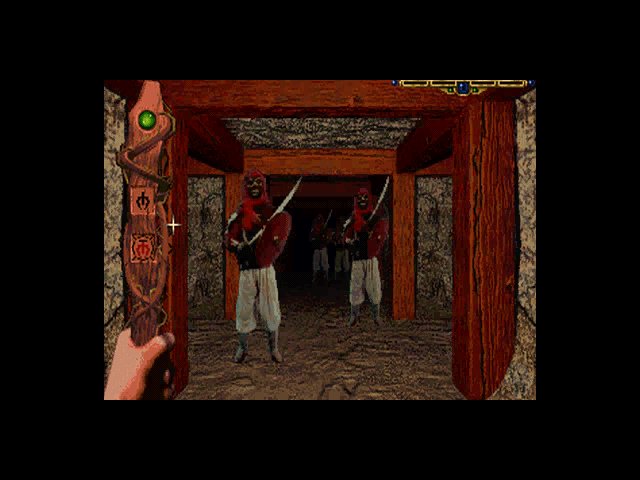
Not many DOS RPGs can say they spent years stuck in development limbo before release, but Stonekeep can. Interplay’s first-person dungeon crawler was one of the most hyped RPGs of the early 90s long before it actually shipped in 1995, and by the time it did, the genre it was designed to compete in had already moved on in some ways. That’s part of what makes it fascinating today: it’s a snapshot of a design frozen mid-decade, with all the ambition and all the compromises that implies.
A Troubled, Ambitious Production
Stonekeep spent an unusually long time in development for a mid-90s title, working through delays and design changes before Interplay finally got it out the door. What arrived was still remarkably ambitious for the format: a fully voiced cast of characters, richly detailed dungeon art, and FMV-driven creature animation at a time when most dungeon crawlers were still working with flat, static sprites. That ambition came at a cost. Stonekeep is often cited as a game whose scope outran its budget and schedule, and by release some of its technical choices already felt a step behind newer engines on the market. It’s a familiar story in games that spend too long in the oven, but it’s also exactly why Stonekeep still stands out today: nobody else built quite this game, or took quite this long doing it.
One Square at a Time: How Stonekeep Plays
You play Drake, returning home after ten years of exile to find it destroyed, and the game sends you underground to recover the essences of twelve gods so you can take down the Dark Lord Khuul-Kuum. The framing story unfolds gradually through notes, scrolls, and conversations with a cast of NPCs, some of whom join your party and fight alongside you.
Movement is where Stonekeep separates itself from its peers. It’s first-person and real-time, but you advance one grid square at a time rather than moving freely, and the whole screen snaps around cleanly when you turn. Combat runs off that same grid: enemies and objects stay locked to their square relative to you, which sounds minor until you’re trying to back off from a fight gone wrong and realize retreating isn’t as simple as it should be. Weapons swing with a recovery beat before you can strike again, so timing matters more than mashing the mouse button. Instead of grinding for experience points, Drake’s attributes and weapon skills improve from how you actually play: taking damage, moving around, fighting with a particular weapon type. An automatic journal keeps track of your stats, items, and map notes so you’re not scribbling everything on graph paper yourself.
Three Habits That Will Save Drake’s Life
- Use the grid to your advantage. Because you and everything around you are locked to squares, a one-tile corridor is a natural chokepoint. Back into one before a fight breaks out and you’ll only ever face one enemy at a time instead of getting surrounded.
- Don’t spam your attack. Weapons need a beat to recover before they’ll swing again, so clicking wildly just wastes clicks. Watch your character’s stance and time your hits instead.
- Talk to everyone more than once. Stonekeep’s dialogue often opens up new lines after you’ve picked up an item or advanced the plot, and it’s easy to assume you’ve heard everything an NPC has to say after a single pass through their conversation tree.
- Save constantly, and save in multiple slots. There’s no safety net here, and a bad encounter can turn fatal quickly enough that you’ll want more than one fallback point.
Stonekeep Next to Ultima Underworld and Eye of the Beholder
It’s worth placing Stonekeep next to the two dungeon crawlers it most invites comparison to. Ultima Underworld got there first, in 1992, with free-form movement and a genuinely simulated 3D space where you could look up, look down, and move at any angle, which made Stonekeep’s grid-locked movement feel like a step backward to some players even at release. Eye of the Beholder is the closer cousin: also grid-based, also first-person, but built around a full party of created characters rather than a single protagonist with recruitable companions along the way. Stonekeep sits in between the two, borrowing Eye of the Beholder’s movement grid while pushing much harder on narrative, voice acting, and one character’s personal journey. Whether that trade-off pays off for you depends a lot on whether you’re playing for tactical party management or a more cinematic, story-driven experience.
Running It in DOSBox
Getting Stonekeep going is straightforward once DOSBox is installed: mount the folder holding your game files as a virtual drive, switch to it, and run the executable from there. The tricky part is tuning it afterward. Stonekeep’s FMV creature animations and digitized sound assets are noticeably more sensitive to cycle counts and Sound Blaster configuration than most games from this era, and it’s one of the titles where getting the settings wrong shows up immediately as stutter or garbled audio. If you haven’t set DOSBox up before, our DOSBox configuration walkthrough covers exactly the cycle and sound adjustments that tend to fix it.
Does It Hold Up in 2026?
I still think Stonekeep is worth playing, but I won’t pretend it’s aged gracefully in every respect. The voice cast, the attribute-through-use progression, and the sheer density of its dungeon art give it a texture nothing else from the period quite matches, and there’s something charming about a game this committed to its own weirdness. On the other hand, the inventory management is genuinely tedious by modern standards, the pacing sags through the middle stretch, and a few puzzles lean on pixel-hunting that hasn’t aged well at all. If Stonekeep’s slower moments wear you down, our list of free DOS games worth trying has plenty of faster-paced picks to fall back on. Come into this one expecting a strange, overambitious relic of mid-90s RPG design rather than a polished classic, and there’s a lot here to like.
Watch Gameplay
You might also like: