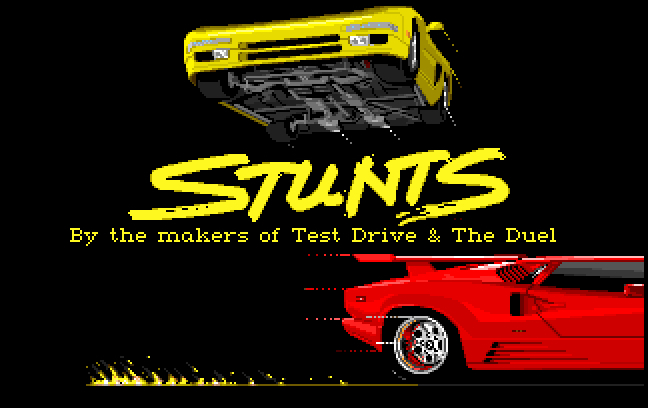
Long before TrackMania made track-building racers a genre of their own, Stunts was already letting players bolt loops, corkscrews, and broken bridges onto a racetrack and see what happened. Distinctive Software’s 1990 release, published by Broderbund and sold in some regions as 4D Sports Driving, was doing genuine 3D circuit racing years before it became the norm for the genre.
Real 3D when everyone else was faking it
Most PC racers of 1990 used flat, sprite-based tracks that could only fake a sense of depth. Stunts rendered its courses as actual three-dimensional polygon environments, letting you race over hills, through loops, and across broken bridges viewed from genuinely different angles rather than a fixed perspective trick. That technical leap arrived alongside an arcade-friendly feel rather than punishing realism, which made the whole package land as fun first and impressive second — a combination that a lot of more “serious” racing sims of the era never quite managed.
Racing, but also building
The core loop has you racing a roster of licensed-feeling cars against the clock or the computer across tracks loaded with jumps and tight chicanes, with handling tuned for power-slides and big air rather than strict physics accuracy. But the feature that actually defines Stunts is the track editor: full control over road pieces, scenery, and stunt elements, so you can build entire custom circuits from scratch. Pair that with an instant-replay camera for reviewing your best crashes and jumps, and Stunts gives you almost as much reason to tinker as to race, which was a genuinely unusual pitch for a racing game at the time.
The editor’s flexibility is really what set it apart from its contemporaries. You’re not just picking from a menu of pre-approved track pieces; you’re deciding exactly where a loop meets a straightaway and how tightly a corkscrew winds, which turns track design into its own little hobby within the game.
Building loops that don’t fall apart
- Give yourself a long straightaway before any loop. Cars need real speed built up or they’ll stall out at the top and drop straight down mid-loop.
- Broken bridges and big jumps need a clean, straight approach. A car that’s mid-turn when it hits a ramp tends to land badly or flip on impact.
- Ice sections drastically cut traction, so don’t chain them directly after a high-speed straight unless you want to test the game’s crash physics firsthand.
- Use the replay camera deliberately, not just for laughs. It’s genuinely useful for diagnosing why a particular jump or corner keeps wrecking your car.
- Test any custom track solo before racing it against AI opponents; some layouts look fine on paper but turn out to be nearly unraceable once you’re actually driving them.
The lineage it started
Stunts is routinely cited as one of the earliest fully 3D circuit racers on home computers, and the connection to later track-building racers like TrackMania is hard to miss once you’ve spent time in the editor. For anyone curious where that whole “build your own ridiculous track” genre actually began, this is close to the source, even if the presentation looks primitive by modern standards.
Does it hold up in 2026?
Better than you’d expect, honestly. The physics are goofy by design and the AI opponents aren’t going to challenge anyone, but the combination of a capable editor and genuinely funny crash physics still makes for an entertaining afternoon. My honest complaint is that the single-player racing itself gets thin fast — this is a game you keep around for the editor and the chaos, not for a deep competitive ladder, and treating it like a straight racing sim will leave you a little disappointed.
Approach it as a sandbox with a racing game bolted on, rather than the other way around, and it becomes a lot easier to appreciate for what it actually is. Once that expectation shifts, the goofy physics stop feeling like a limitation and start feeling like exactly the point.
The community that kept it alive
Stunts has had an unusually long tail for a 1990 racing game, largely thanks to a dedicated community that kept building and sharing custom tracks for years after the game’s commercial life ended. That grassroots track-sharing culture, happening well before anything like a modern online leaderboard existed, is a big part of why the game is remembered as fondly as it is by people who were never especially into racing games otherwise. The editor gave people a reason to keep coming back long after the default track list had been fully explored, and word-of-mouth track sharing did the rest.
It’s a good reminder that a strong creation toolset can extend a game’s relevance far beyond what its core content alone would justify, a lesson plenty of later games with far bigger budgets never quite learned as well as this scrappy little racer did.
Getting it running today
Stunts is a commercial title — look for official re-releases on GOG or Steam.
If you own a copy, mount the folder containing your game files with mount c [folder], switch to that drive with c:, and launch the EXE from the DOSBox prompt. New to DOSBox entirely? Our complete DOSBox setup guide covers getting the sound and speed dialed in correctly, and our free DOS games list is worth a browse if you want more to try afterward.
Watch Gameplay
You might also like: