Core Design Before Tomb Raider
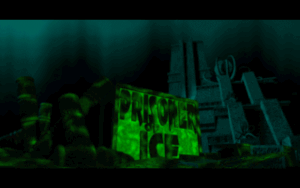
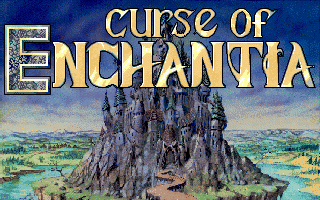
Long before Lara Croft, Core Design was a British studio trying to break into the adventure genre against two giants who already owned it. Curse of Enchantia is a 1992 graphic adventure developed and published by Core Design, released for MS-DOS and Amiga as the studio’s first attempt at the genre, made at a time when Core was explicitly trying to compete with LucasArts and Sierra On-Line. The game began development under the working title Zeloria before Core settled on its final name. The story follows Brad, a modern-day teenage boy magically abducted from Earth into the fantastical world of Enchantia by an evil witch-queen. Transformed and stranded in a strange land full of talking animals and bizarre magic, Brad has to find a way to reverse the witch’s spell and get home — a classic fish-out-of-water premise wrapped in Core’s distinctly quirky British sense of humor.
Competing head-on with LucasArts and Sierra in 1992 was a bold ambition for a studio with no prior adventure pedigree, and Core Design leaned into that underdog position rather than shying away from it, treating the genre’s two dominant houses as a direct challenge to beat on presentation rather than a wall too tall to climb.
A Game With (Almost) No Words
Curse of Enchantia took a number of unconventional swings for an early-90s adventure game. Most notably, it’s almost entirely without written text or spoken dialogue, communicating story and character purely through animation, sound, and icon-based interaction — an approach few other adventure games of the period attempted. The interface uses a set of contextual icons rather than a verb list, streamlining interaction with the game world at the cost of some clarity in trickier puzzles. The game also blends traditional inventory-based puzzle solving with several arcade-style action sequences, asking you to react in real time rather than simply point, click, and think.
Tips for the Action Sequences
- Expect a genre shift mid-puzzle. The arcade sequences arrive without much warning, so keep your reflexes ready even when you think you’re settled comfortably into pure point-and-click mode.
- Since there’s no text to lean on, pay extra attention to animation cues and sound effects — they’re carrying information a written hint would normally give you in almost any other adventure game.
- If an icon-based interaction seems ambiguous, try every relevant icon on an object before assuming it’s not the solution; the wordless interface sacrifices some clarity for its visual purity and consistency.
- Save before any sequence that feels action-oriented — the hybrid puzzle/arcade structure means a failed reflex challenge can cost you real progress you’d rather not repeat.
Curse of Enchantia vs. Sierra and LucasArts
Sierra and LucasArts both built their reputations on text- or dialogue-heavy adventures, whether through parser commands or witty verb-driven scripts. Curse of Enchantia deliberately goes the opposite direction, betting that animation and icon logic alone could carry an adventure game — a genuinely bold experiment against the two studios it was chasing. This hybrid of genres was polarizing on release: some critics and players loved the ambition, while others found the puzzle logic obscure and the action sequences frustrating without any text to fall back on.
Legacy: Core Design’s Adventure Detour
Within a few years of Curse of Enchantia, Core Design would pivot hard toward action and platforming, culminating in Tomb Raider and a completely different reputation than the one this game represents. That makes Curse of Enchantia something of a road not taken for the studio — a snapshot of Core trying to be a straight adventure developer before deciding its future was elsewhere entirely. Seen in that light, it’s a more interesting historical artifact than its middling contemporary reception might suggest, offering a genuine “what if” for anyone curious about paths a major studio didn’t end up following.
DOSBox Notes for the Animation-Heavy Scenes
Curse of Enchantia is a commercial title without a legal free-download option, so look for it through official re-releases where available. Owners of a legitimate copy can get it running in DOSBox with the standard setup: mount your game folder as the C: drive using mount c [folder], switch to it with c:, and run the executable. Since the game mixes animation-heavy cutscenes with action sequences, check our DOSBox guide for tips on adjusting cycle counts if you notice slowdown or timing issues during the arcade segments.
The Verdict
Curse of Enchantia matters as a snapshot of a major studio’s first, ambitious swing at the adventure genre, made at the exact moment the genre was at its commercial peak. Its willingness to abandon text and embrace pure visual storytelling, years before that became fashionable elsewhere, still feels bold, and its lush hand-drawn art holds up well against its contemporaries. The puzzle logic is genuinely obtuse in places, though, and without text to clarify intent, a few solutions rely on guessing rather than reasoning — a real frustration if you’re used to fairer clue design, and one that a walkthrough will save you real hours of trial and error on.
It’s best approached today by players with some patience for dated puzzle logic, but for adventure game historians and Core Design fans curious about the studio’s pre-Tomb Raider output, it’s a fascinating and frequently funny curiosity worth experiencing firsthand. Brad’s fish-out-of-water reactions to Enchantia still land more jokes than you’d expect from a game with no spoken dialogue at all.
Watch Gameplay
You might also like: