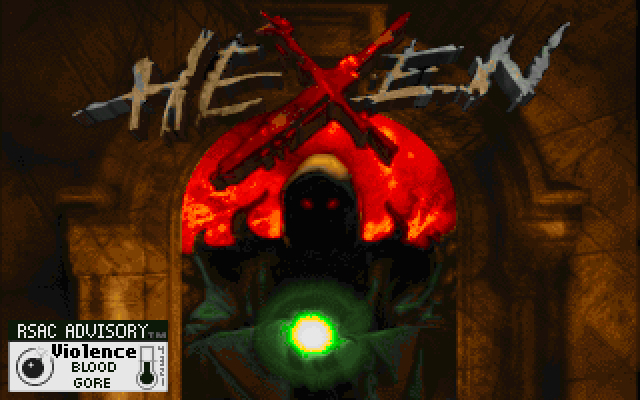
What happens when a shooter developer decides that backtracking and puzzle-solving matter as much as ammo counts? Raven Software answered that question in 1995 with Hexen: Beyond Heretic, a follow-up to their hit Heretic that introduced three distinct character classes and a hub-based world structure no other DOS shooter had attempted. A free demo is available if you want to try it before committing.
Raven’s Follow-Up to Heretic
The world of Cronos is dying. The Serpent Rider Korax has enslaved the gods and twisted the realm into a nightmare of itself, and three heroes rise to stop him: the Fighter, a powerful melee warrior; the Cleric, a healer turned combatant with holy weapons; and the Mage, a spellcaster who deals heavy damage from range. Pick one and fight through seven interconnected hub worlds to reach and destroy Korax. Raven built this on the same Doom engine they’d licensed from id for Heretic a year earlier, but pushed it much further structurally than either Doom or Heretic had.
Heretic had already proven Raven could take id’s technology somewhere id itself hadn’t gone, layering in an inventory system and item-based magic on top of the Doom formula. Hexen takes that same instinct and applies it at the level of structure itself, rather than just adding new items and monsters to an otherwise familiar shooter loop.
Three Classes, Seven Interconnected Hubs
What sets Hexen apart from every other DOS shooter of its era is the hub structure. Instead of strictly linear levels, Hexen groups its maps into hubs you travel between freely — pull a switch in one map and a door somewhere else in the hub might open. That design creates a sense of exploration and interdependence no other DOS shooter of the period attempted. Each class plays completely differently too: the Fighter relies on fists, a spiked gauntlet, and an axe; the Cleric wields a mace, a health-draining serpent staff, and a flame weapon; the Mage uses a wand, frost shards, and an arc-of-death lightning attack. Replaying the same hub sequence with a different class doesn’t just change your damage numbers — it changes which rooms feel dangerous and which feel trivial, since a Fighter can tank hits a Mage simply can’t survive.
Hunting Down the Quietus and Its Cousins
- Each class has a powerful fourth-tier weapon assembled from four pieces scattered across the hub worlds — the Fighter’s Quietus, the Cleric’s Wraithverge, and the Mage’s Bloodscourge. Finding all four pieces for your class is one of the most rewarding long-term goals in the game.
- Keep mental notes (or written ones) on switches and their effects, since a lever in one hub map frequently affects a completely different map you may not revisit for a while.
- The Mage feels genuinely underpowered in the early game, so don’t be discouraged if that class seems weak at first — it scales up considerably once you’ve found stronger weapons.
- Backtrack deliberately rather than randomly. When you hit a locked door or an inaccessible area, make a mental note of its location instead of forgetting about it — hub design means you’ll frequently need to return.
- The Fighter is the most forgiving class for a first playthrough, since melee combat and higher survivability make the hub-exploration learning curve less punishing while you’re still getting oriented.
Heretic’s Linearity vs Hexen’s Puzzle Box
Heretic played it straight: linear levels, one player character, a structure much closer to Doom’s. Hexen threw that out in favor of the hub system and class choice described above, trading straightforward pacing for genuine exploration and interdependency between levels. The direct sequel, Hexen II, carried the hub concept forward in 1997 on id’s Quake engine, proving Raven saw real long-term value in the structure they’d built here. Even outside Raven’s own output, the hub concept quietly became a reference point other developers cited when describing non-linear level design for years afterward.
First time with an emulator? The DOSBox guide on this site gets you from download to running game. Our roundup of free DOS games has plenty more where this came from.
Setting Up the Demo (or Full Game) in DOSBox
Hexen: Beyond Heretic is a commercial title. Look for official re-releases on GOG or Steam.
- Install DOSBox if you haven’t already.
- Extract the files to a folder like
C:HEXEN. - In DOSBox:
mount c C:HEXEN→c:→hexen.
Ambitious, Obtuse, and Still Worth It
Hexen is the thinking person’s DOS shooter, and the puzzle elements, class system, and hub-based exploration give it a depth pure action games from this era simply lack. My honest criticism: some of those puzzles are notoriously obtuse, relying on cues easy to miss or switches whose effects are hard to trace without a walkthrough, and the pacing is noticeably slower than Doom or Heretic as a result. For players who enjoy action and exploration in equal measure, though, it’s deeply rewarding, and the atmosphere and art design remain stunning for the era — the dark, gothic tone here still feels distinct from nearly everything else DOS gaming produced. Go in with a walkthrough on standby for the trickiest hub puzzles and you’ll spend a lot less time frustrated and a lot more time genuinely absorbed in Cronos’s decay. Few shooters from this window asked players to think this much between fights, and that alone makes it worth revisiting even for players who normally bounce off puzzle-heavy design in an action game.
Watch Gameplay
You might also like: