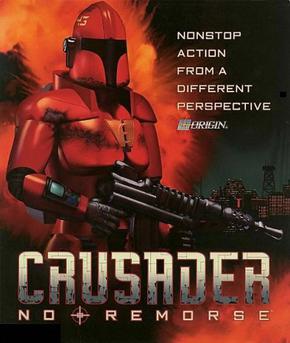
Ask a room of DOS gaming fans to name Origin Systems’ best 1995 release and most will say Ultima VIII. Ask which one is more fun to actually play today, and a surprising number will say Crusader: No Remorse instead.
Built on the Bones of Ultima VIII
Crusader: No Remorse, developed by Origin Systems and published by Electronic Arts in 1995, is an isometric action game set in a dystopian future where the World Economic Consortium controls Earth with an iron fist. You play as a Silencer — an elite soldier who defects to the rebellion after being ordered to massacre civilians. Origin built the game on the engine it had just finished for Ultima VIII: Pagan, repurposing a system designed for exploration and puzzle-solving into one of the most kinetic action games of the mid-90s. That reuse gave the team a head start on the technical side and freed them to pour their effort into something Ultima VIII never needed: genuinely satisfying, physics-driven destruction of nearly everything on screen. The setting itself was a deliberate departure for Origin too — instead of another fantasy world, the writers built a grim corporate dystopia where a single ruling conglomerate polices Earth through surveillance and enforced compliance, and where your character’s arc begins with a direct order to fire on unarmed civilians. It’s blunter and less subtle than Origin’s Ultima writing, but that bluntness suits the pace of an action game far better than a Serpent Isle-style plot would have.
Why the Destruction Feels So Good
Crusader uses a real-time isometric perspective for fast-paced combat spread across twelve missions. Your Silencer can roll, dive, and strafe while wielding an arsenal of futuristic weapons including plasma guns, rocket launchers, and remote-detonated drones. Enemy AI is smart enough to take cover and flank rather than walk straight into your line of fire, which was unusual for an action game of this vintage. What sets Crusader apart from its contemporaries, though, is environmental interaction — explosive barrels, live electrical cables, acid pools, and automated security turrets can all be turned against the enemies guarding them. Learning to read a room for hazards you can weaponize is both tactically smart and enormously satisfying, and it’s the mechanic that gives Crusader its identity.
Tactics Every Silencer Should Know
- Scan a room for explosive barrels and cable runs before engaging — triggering them from a distance often clears a room faster than direct fire.
- Use rolling and diving liberally; standing still against multiple WEC troopers is the fastest way to lose your shields.
- Save heavier ordnance like rockets and drones for armored enemies and mounted turrets rather than burning them on basic troopers.
- Keep moving between cover points — the isometric camera can hide incoming fire from off-screen enemies if you stay static too long.
- Check corners for security cameras before advancing; triggering an alarm early in a level tends to snowball into a much harder fight than approaching quietly.
No Remorse Next to Syndicate and Alien Virus
Bullfrog’s Syndicate is the obvious comparison point — both are isometric, both cast you as a lethal operative against a corporate dystopia — but Crusader trades Syndicate’s squad-based strategy for solo, run-and-gun momentum. It plays closer to a top-down action game than a tactics title. Compared to other mid-90s isometric shooters like Alien Virus, Crusader’s destruction physics and level of environmental detail were genuinely ahead of the curve; few games of the period let you demolish nearly the entire set dressing of a level on your way through it. It’s also worth setting Crusader next to Origin’s own Ultima VIII, since they share so much technical DNA — where Ultima VIII asked you to navigate precise jumping puzzles with a persnickety physics engine, Crusader repurposed that same engine for something far more forgiving and immediate, and the game is generally better remembered for it among players who bounced off Pagan’s difficulty spikes. It’s an unusual case of a troubled engine finding its true calling on its second outing rather than its first.
The Honest Verdict on Crusader Today
Crusader: No Remorse still feels like pure kinetic joy in short bursts — the combination of fast movement, spectacular destruction, and genuinely intelligent enemy AI holds up better than most 1995 action games. Origin pushed the hardware of the era to its limits, and Andrew Sega’s relentless industrial soundtrack still matches the action beat for beat. Where it shows its age is in mission length and checkpoint spacing; some later levels run long without a save point, which can turn a single mistake into a frustrating repeat of ten minutes of already-cleared combat. Paired with its excellent sequel, Crusader: No Regret, it forms one of the great overlooked action series of the 1990s, and it’s more than earned a spot next to Origin’s better-remembered Ultima output.
New to DOSBox? Our complete setup guide covers everything from mounting drives to configuring sound, and our list of the best free DOS games is worth a look once you’re done here.
Once you have the files from a legitimate copy, extract them, mount the folder as drive C in DOSBox, and run CRUSADER.EXE. The game can be demanding on period hardware settings, so if animation feels jerky, bump DOSBox’s cycles up a notch before touching anything else.
You might also like: