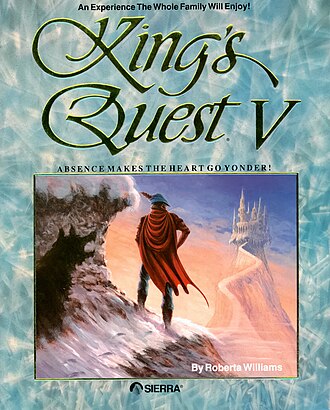
What happens when a text parser and EGA graphics both disappear from a Sierra game at once? King’s Quest V happened, and it changed what players expected from the whole genre.
Sierra’s VGA turning point
King’s Quest V: Absence Makes the Heart Go Yonder (1990) is an adventure game developed and published by Sierra On-Line, representing a watershed moment for the series and the genre. It was the first King’s Quest title to use VGA 256-color graphics and a point-and-click interface, replacing the text parser of earlier entries. You play as King Graham of Daventry, who returns home to find his castle stolen by the evil wizard Mordack. With only his wizard friend Cedric the Owl for company, Graham must traverse strange lands, solve puzzles, and rescue his family. Cedric isn’t just comic relief either — his ability to fly gives Graham a way to cross terrain and reach places that would otherwise be dead ends, which the game leans on more than once to gate progress. The game was enormous for its time, spread across dozens of distinct locations, from Daventry’s town square all the way out to a desert crossing and a snowy mountain pass with its own memorable Yeti encounter.
Point-and-click replaces the parser
King’s Quest V uses a simple icon-based interface where you select actions from a toolbar rather than typing commands. The world is presented in gorgeous VGA paintings, and exploration involves carefully examining every screen for interactive objects, characters to speak with, and paths to discover. It’s a much friendlier interface on paper than the old parser, though it trades one kind of frustration for another. What it doesn’t lose is Sierra’s sense of place — the fairy-tale geography here is dense enough that you gradually piece together how the map connects rather than just hopping between disconnected screens, and that sense of a real, walkable world is a big part of why the game is remembered so fondly. The later CD-ROM re-release went a step further and added full spoken narration and voice acting throughout, removing on-screen text entirely for players who preferred to just listen and watch.
The puzzles that catch people out
The game contains several puzzle solutions that require real lateral thinking, and a few mistakes are unrecoverable — the kind that force you to reload a much earlier save without warning you anything went wrong. My advice: keep several rotating save slots rather than one, and save before entering any new area rather than after something goes wrong. Click on every inch of a screen, not just the obviously interactive objects, since some of the worst pixel-hunt moments hide small items against busy VGA backgrounds. Talk to Cedric periodically; he won’t solve puzzles for you, but he occasionally nudges you in the right direction. The desert and mountain sequences in particular are notorious bottlenecks for first-time players, so budget some patience for them specifically. It’s also worth picking up and holding onto items you don’t immediately understand — King’s Quest V is a game that expects you to carry inventory across several unrelated-feeling areas before a use for it becomes obvious, and there’s no in-game hint system to bail you out when that happens.
Running King’s Quest V now
New to emulating old DOS software? Our complete DOSBox setup guide covers everything from installation to sound configuration, and our list of free DOS games is worth a browse once you’re done here. Once you have the game files from a legitimate copy, extract them and open DOSBox. Use mount c [folder] then c: to switch drives, and run KQ5.EXE to launch. Sound configuration is worth double-checking before you start — King’s Quest V’s VGA presentation is paired with a period-accurate music score, and getting the wrong sound device selected in the game’s own setup program is a common source of silent or garbled audio that has nothing to do with DOSBox itself.
Should you play it in 2026?
King’s Quest V is a visual landmark in gaming history. The leap from EGA to VGA was staggering, and Sierra’s artists made full use of the palette to create a fairytale world of genuine beauty; the CD-ROM version adds voice acting throughout for players who want it. My honest criticism: some of the puzzle solutions lean on trial-and-error pixel hunting and the unwinnable-state design that hasn’t aged gracefully by modern standards, so this is not the adventure to hand someone expecting fair, modern puzzle logic. Go in with reasonable expectations about the difficulty, and you’ll find a richly detailed fantasy world worth the frustration. Compared to what came right before it — King’s Quest IV’s EGA-then-VGA-patched presentation — the jump here feels less like an incremental update and more like Sierra finally building a game around hardware it no longer had to apologize for. It’s a genuine turning point for the studio, and everything Sierra made afterward, from later King’s Quest entries to its other adventure lines, inherited the VGA point-and-click template this game established. Looking back at it now, King’s Quest V reads almost like a hinge point in adventure game history: the last gasp of the unforgiving, trial-and-error school of design, delivered with a level of visual polish good enough to make players willing to put up with it. Not every game from that transitional moment aged as gracefully; this one mostly did.
Watch Gameplay
You might also like: