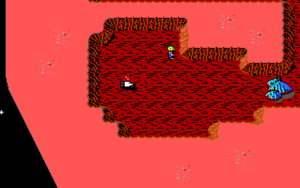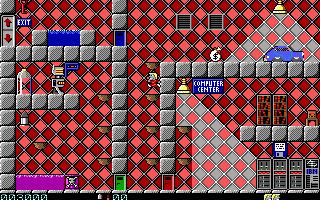
Combine James Bond spy aesthetics with classic Apogee platformer gameplay and you get Secret Agent — a charming, gadget-filled DOS platformer from 1992 that deserves far more recognition than it typically receives.
Reusing the Crystal Caves Engine for Espionage
Secret Agent reused the engine Apogee had already built for Crystal Caves, letting a small team ship a complete three-episode adventure without reinventing the underlying platforming and collision code from scratch. Programmer Peder Jungck handled the coding, while George Broussard and Jim Norwood — both fixtures of Apogee’s early lineup — supplied the artwork that gave Agent 006.9 his gadget-laden look. The game shipped on February 1, 1992, following Apogee’s trademark shareware formula: the first episode circulated freely on bulletin boards and shareware disks to hook players, while the second and third episodes were sold directly by mail order to those who wanted to see the mission through to the end. Broussard would go on to co-found 3D Realms and later produce Duke Nukem 3D, but Secret Agent remains one of the clearest examples of Apogee’s early-90s production approach: take a proven engine, swap in a fresh theme, and ship quickly while the shareware model was still finding its audience. Nearly three decades later, the game found new life again when Secret Agent HD, a remaster for modern Windows systems, was released in 2021 — a rare honor for a game from Apogee’s early, less-celebrated catalog, and a sign of how much affection the small but dedicated fanbase has kept for Agent 006.9’s adventures over the years.
Grappling Hooks and Radar Dishes
Secret Agent is a side-scrolling platformer with shooting mechanics. The agent can fire in multiple directions, use a grappling hook to reach high platforms, and collect various spy gadgets scattered through each level. Enemy types include guards, turrets, robots, and boss characters with distinct attack patterns that require learning rather than brute-forcing. The level design is more puzzle-oriented than pure action — many areas require finding keys, activating switches in the correct order, or navigating trap-filled corridors rather than just shooting your way to the exit. The spy theme is woven directly into the gameplay too, not just the art: you’re infiltrating bases and disarming installations, not just running from left to right shooting whatever’s in front of you. Levels are laid out with genuine verticality thanks to the grappling hook, which gives the game a sense of exploration that flatter contemporaries in the genre often lacked, and the spy gadgets scattered through each stage reward players who take the time to fully clear a level rather than beeline for the exit.
Mission Tips for Agent 006.9
- Each level hides a radar dish that must be destroyed before the exit charge can be triggered, so make locating it an early priority rather than an afterthought.
- The grappling hook is more than a novelty — use it to reach ledges and side passages holding extra treasure and bonus items inaccessible by jumping alone.
- Because Agent 006.9 can fire in several directions without changing position, it’s often safer to hold your ground and angle your shots than to walk straight into an enemy’s line of fire.
- Dynamite is limited in supply, so save it for blowing open the exit rather than experimenting with destructible scenery early in a level, and keep an eye on health pickups since later stages in each episode ramp up enemy density noticeably.
Secret Agent vs. Commander Keen
Secret Agent invites an obvious comparison to Commander Keen, since both are Apogee-era side-scrolling platformers built around exploration and collectibles. But where Keen leans into cartoon whimsy and pure platforming, Secret Agent’s spy framing pushes it toward puzzle-solving and objective-based level design — finding the radar dish, managing limited dynamite, navigating trap sequences — that gives it a more methodical pace than Keen’s momentum-driven jumping. If you enjoy the Commander Keen style of platforming but want something with more intrigue and puzzle design layered on top, Secret Agent delivers exactly that. It’s also a useful reminder of how much variety Apogee’s stable actually produced under the shareware banner — the same publishing model that gave the world Keen’s cartoon whimsy and Duke Nukem’s swagger also had room for a gadget-obsessed spy comedy, and none of them felt like they were competing for the same audience. That variety is easy to lose sight of in retrospectives that focus almost entirely on Apogee’s biggest hits, but a lot of the publisher’s lasting charm comes precisely from the fact that a title like Secret Agent could exist, find its audience, and quietly earn a devoted cult following without ever needing to be the company’s flagship release. It’s a game built by a small team clearly having fun with a genre they understood well, and that enthusiasm still comes through more than three decades later. If you’ve written off early-90s DOS platformers as interchangeable Commander Keen imitators, Secret Agent is a good corrective — the spy framing, the grappling hook, and the puzzle-first level design combine into something with a genuinely distinct identity rather than just another palette-swapped run-and-jump game.
DOSBox Setup
New to DOSBox? Our complete setup guide walks through everything you need, and our top free DOS games list is worth checking out for more of Apogee’s catalog.
See our DOSBox guide to get started, then run AGENT.EXE from the mounted folder.
You might also like: