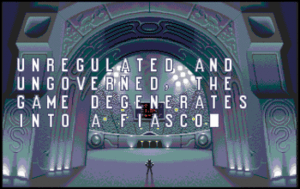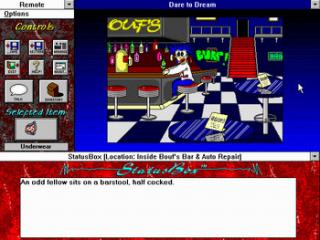
Before Cliff Bleszinski became a household name in game design circles for Unreal and Gears of War, he was a teenager making a surreal point-and-click adventure for Epic MegaGames. Dare to Dream, released in 1993, is that game — and it’s a genuinely interesting window into a career that would go on to shape two very different action franchises.
A Dream World, Made By a Teenager
This first volume, subtitled “In a Darkened Room,” sets up a surreal story where you venture into the dream world of a boy named Tyler to understand what’s troubling him. It’s part of the broader wave of shareware adventure titles that tried to bring the point-and-click formula popularized by LucasArts and Sierra to the budget-friendly, episodic shareware model — letting players sample a complete, self-contained story before deciding whether to chase down the sequels.
What’s remarkable in hindsight is just how young Bleszinski was when he made it. Long before Jazz Jackrabbit or Unreal, Dare to Dream is where his design instincts first got a public airing, on a shoestring budget and a shareware release schedule.
It’s also worth remembering how open the shareware model was to exactly this kind of debut. There was no formal barrier to entry beyond making something a publisher like Epic MegaGames thought was worth distributing, which meant a talented teenager with no industry connections could get a real, nationally distributed release years before he’d have had any realistic path into a traditional studio job.
Working Through Tyler’s Dream Logic
- Pay close attention to the imagery and room descriptions — the puzzles lean on dream logic rather than strict cause-and-effect, so literal-minded item combos won’t always be the answer.
- Progress is often gated by an earlier room; if a later obstacle won’t budge, backtrack and look for something you missed rather than assuming the puzzle is broken.
- The simple cursor-based interface keeps things brisk, so don’t overthink interactions the way you might with a verb-heavy LucasArts adventure — try the obvious action first.
- Explore fully before moving on. Because it’s a short, self-contained volume, missing a symbolic detail early can leave a later puzzle feeling unfair.
- Treat the surreal, dreamlike setting as a hint system in itself — the tone and imagery of a room is often telling you what kind of solution to look for, even when a literal walkthrough isn’t obvious.
From Shareware Adventure to AAA Design
It’s worth sitting with just how different Dare to Dream is from what Bleszinski would go on to make. A slow, symbolic, dream-logic adventure game shares almost nothing mechanically with the fast, aggressive shooters he’d later help define. What does carry through, if you squint, is a willingness to commit fully to a particular tone and mood rather than playing it safe — something you can see in the surreal atmosphere here just as much as in the exaggerated, confident tone of his later, much bigger releases.
That makes Dare to Dream more than a historical footnote. It’s a rare chance to see a major industry figure’s design sensibility in a genuinely unfamiliar genre, made under none of the resource or expectation pressure that came with his later, much higher-profile projects.
A Career Seen in Miniature
It’s tempting to read too much design DNA backward from a famous developer’s early work, but Dare to Dream really does show an instinct for atmosphere and world-building that shows up again, in very different genres, later in Bleszinski’s career. Compare its dreamlike, symbolic environments to the more grounded adventures Sierra and LucasArts were putting out at the same time, and it’s clear a teenager working alone was willing to take stranger creative swings than bigger studios were.
As a game on its own terms, it’s short and rough around the edges — a handful of the dream-logic puzzles rely more on trial and error than the best genre entries do. But as a historical curiosity, watching a soon-to-be-major developer’s first public work is genuinely worth the hour or two it takes to finish.
My honest advice for a first playthrough: treat it as a quick, atmospheric detour rather than a puzzle box to be solved rigorously. Trying to brute-force every dream-logic puzzle the way you might a LucasArts adventure will frustrate you far more than just soaking in the strange imagery and letting the solutions come naturally as the story reveals more of Tyler’s troubles.
Given how short and self-contained this first volume is, it’s also a low-risk way to sample the broader Dare to Dream series before committing to the later volumes. If the tone and pacing click for you here, the sequels are a natural next step; if they don’t, you’ve lost nothing more than an hour finding that out.
It’s worth going in with curiosity about the developer rather than sky-high expectations for the game itself. Viewed that way, Dare to Dream rewards you either way — either as a quietly charming little dream adventure, or as a genuinely fascinating first data point in a much bigger design career.
Downloading Dare to Dream
Never used DOSBox before? Our step-by-step DOSBox guide covers installation and configuration. And if you want more games like this, our free DOS games list is the place to browse.
Getting the Dream Running
Extract the download to its own folder, such as C:\GAMES\DARE2DRM. Open DOSBox and run mount c C:\GAMES\DARE2DRM, then c:, and launch the EXE from there. Adventure games like this are generally forgiving of DOSBox’s default settings, but if the mouse cursor feels sluggish, check your DOSBox mouse sensitivity settings — our DOSBox guide covers configuration basics for point-and-click titles.
Watch the Dream Unfold
You might also like: