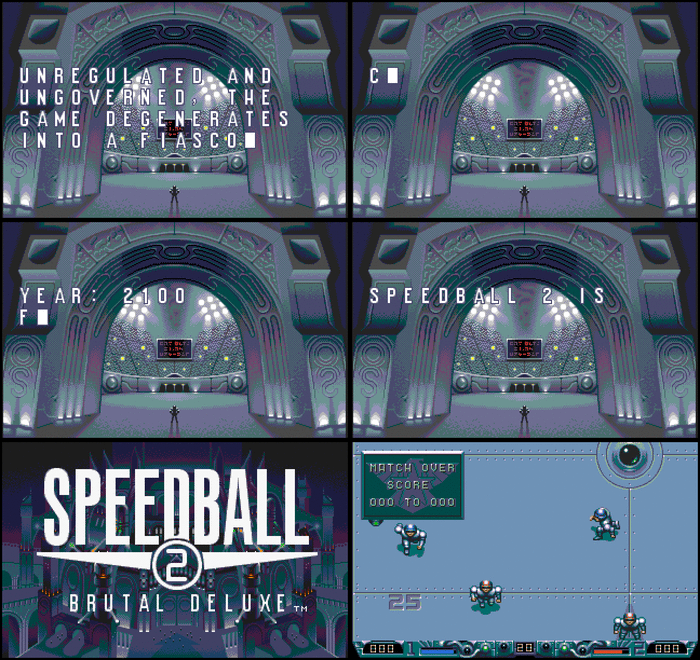
Take away the ball for a second and Speedball 2 is basically hockey played inside a steel cage where body-checking isn’t a penalty, it’s the point. The Bitmap Brothers had already made a name for stylish, arcade-inspired games on the Amiga and Atari ST, and their 1991 MS-DOS port of Speedball 2: Brutal Deluxe brought that reputation to PC in one of the tightest sports-action hybrids of the era.
Managing the Worst Team in the League
The setup casts you as team manager for Brutal Deluxe, the league’s worst team, tasked with building them up into champions over a season. Speedball 2 refines the ideas from the original Speedball into something tighter and more strategic, layering genuine team-building depth — training points, player trading — on top of what could easily have just been a violent arcade minigame.
The pitch itself is a steel-walled arena where two teams fight for possession of a metal ball, scoring by launching it into the opponent’s goal. Body-checking and outright violence aren’t just tolerated, they’re rewarded, which gives Speedball 2 a different texture than almost any other sports game from the period.
The MS-DOS port arrived after the game had already built a strong reputation on the Amiga and Atari ST, meaning PC owners in 1991 were getting a version of Speedball 2 that had already been proven and refined on other platforms rather than a first attempt at the design. That’s part of why the PC release feels so tightly tuned right out of the gate — it’s a mature, iterated-on version of the concept rather than an experimental first draft.
Winning Matches, Not Just Surviving Them
- Matches run in two 90-second halves, so don’t play cautiously early — there isn’t enough time in a half to fully claw back a slow start.
- Bonus targets scattered around the arena are worth chasing even mid-possession; hitting them can permanently improve a player stat, which compounds over a full season.
- Knocking out opposing players scores points independently of goals, so don’t treat physicality as a side activity — it’s a legitimate scoring strategy in its own right.
- Spend your training points deliberately between matches rather than spreading them evenly across the roster; a few genuinely elite players often outperform a balanced but mediocre team.
- Don’t neglect goalkeeping and defensive positioning in the excitement of chasing bonus targets — a match can swing fast once possession changes hands in a cramped arena.
The Bitmap Brothers’ House Style
Speedball 2 is a good showcase for what made the Bitmap Brothers such a recognizable studio in the first place: sharp, stylized visual design paired with tight, arcade-friendly mechanics that don’t waste the player’s time getting to the fun part. Their catalog across the Amiga and Atari ST era shares a certain confidence — games that know exactly what they want you to feel within the first few minutes of play, rather than easing you in slowly.
That house style is why Speedball 2 still feels distinct decades later next to other sports-action hybrids. It’s not trying to be a realistic sports sim wearing a violent coat of paint; it’s a Bitmap Brothers game first, built around fast, readable action and a strong visual identity, with the sports framing as the vehicle for that rather than the point of it.
Bitmap Brothers Style, Sports Edition
Set next to the Bitmap Brothers’ other big hits, Xenon 2 and The Chaos Engine, Speedball 2 shares that same commitment to tight arcade action wrapped in strong visual style, just aimed at the sports genre instead of shoot-em-ups or action-adventure. What sets it apart from other sports titles of the early 90s is how seriously it takes the management layer — most arcade sports games of the period didn’t bother with season-long team building at all, and Speedball 2’s willingness to combine frantic 90-second matches with genuine roster strategy is a big part of why its influence is still visible in later arcade sports titles.
If I have a real criticism, it’s that the violence-as-strategy mechanics can feel like they overshadow the actual ball-handling skill once you’ve played enough matches — brute-force tackling sometimes outperforms careful passing plays more than I’d like. It doesn’t ruin the experience, but it’s worth knowing going in.
The other thing worth flagging honestly: the management layer, while genuinely deep for an arcade sports game, is still fairly shallow next to a dedicated sports management sim. Don’t come to Speedball 2 expecting deep front-office simulation — the roster management here exists to support the on-pitch chaos, not to stand entirely on its own as the main attraction.
What ultimately makes the whole package work is how well the two halves reinforce each other. Training points earned from a good match feed directly back into making the next match more winnable, and that feedback loop is tight enough that even players who’d normally skip a sports game’s management layer entirely tend to get pulled into it here.
Where to Buy It Today
Speedball 2: Brutal Deluxe is a commercial release without a legal free download option, so official GOG or Steam re-releases are the way to go. First time with DOSBox? Our setup guide walks through everything you need, and our roundup of free DOS games is worth a look too.
Getting the Match Running
Mount the game’s folder as a virtual drive with mount c [folder], switch to that drive using c:, and launch the EXE from the DOSBox prompt. A joystick or gamepad mapped through DOSBox is recommended for quicker tackles and passes — our DOSBox guide covers the full setup.
Watch the Chaos Unfold
You might also like: