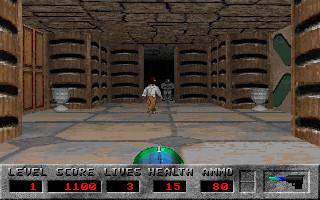
By 1994, the Doom-inspired shooter wave had settled into a fairly predictable visual language: sci-fi corridors, hell dimensions, industrial complexes. Depth Dwellers, built on the Corridor 7 engine by developer and publisher TriSoft, took the same underlying technology somewhere different — a flooded, submerged facility — and quietly pushed the engine further than most of its contemporaries in the process.
An Underwater Facility, Ahead of Its Engine’s Time
You explore a maze of flooded corridors and chambers, fighting off mutated creatures and hostile machinery while searching for keys, ammunition, and health pickups. What sets Depth Dwellers apart technically is that it allowed players to look up and down and jump — features that were still uncommon in first-person shooters at the time, and that predated similar additions in some better-known titles of the same era.
That free-look and jump capability isn’t just a technical footnote either; it genuinely changes how the levels play. Verticality that flatter engines of the period couldn’t offer means enemies and hazards can come from above or below your position, not just from around a corner, which the flooded, chamber-heavy level design leans into directly.
The underwater theme also lets Depth Dwellers justify its verticality in a way that felt natural rather than forced. Flooded shafts, sunken chambers, and multi-level facility architecture all make sense in a submerged setting, giving the level designers a built-in excuse to build up and down instead of just forward, unlike a lot of contemporaries that were still thinking almost entirely in flat, corridor-based terms.
Staying Alive in the Flooded Corridors
- Use the free-look actively, not just for show — scanning upward and downward before advancing into a new chamber catches ambushes that a flatter shooter’s camera would miss entirely.
- The claustrophobic layouts mean enemies can approach from multiple angles at once; back into a corner deliberately during firefights rather than getting caught in an open chamber.
- Ration ammunition for close-quarters encounters specifically — the tight corridors favor weapons suited to short range over anything meant for open engagements.
- Treat the underwater setting’s environmental hazards as seriously as the enemies; they’re not just decoration; unlike the space-station or hell-themed shooters of the era, hazards here are baked into the traversal itself.
- Use jump deliberately to check chambers below you before dropping in blind — the vertical layout means a room’s floor isn’t always its lowest point.
The Corridor 7 Engine’s Quiet Influence
The Corridor 7 engine that Depth Dwellers is built on came out of Capstone Software’s earlier Corridor 7: Alien Invasion, and TriSoft’s decision to build a second game on the same underlying technology says something about how much untapped potential was left in it. Rather than treating the engine as a one-off product, Depth Dwellers pushes it into territory — free-look, jumping, an entirely different environmental theme — that the original title never explored.
It’s a reminder that a lot of mid-90s FPS engines had more headroom than the games that debuted them actually used. Depth Dwellers is a good example of a smaller studio squeezing genuinely forward-looking features out of technology that wasn’t originally built with them in mind.
A Technical Footnote Worth Remembering
It’s easy to lose Depth Dwellers in the flood of Doom-inspired shooters that came out in 1994, but its early implementation of free-look and jumping deserves more credit than it usually gets. Features that would become genre standard within a year or two of this release were already present here, wrapped in a setting — underwater, rather than another space station or hell dimension — that gave the game its own visual identity in a crowded field.
The honest downside: the underlying Corridor 7 engine shows its age in ways the mechanical ambition can’t fully paper over, and the claustrophobic level design that makes combat tense can also make navigation genuinely disorienting without careful attention. It’s a fascinating technical snapshot more than a game I’d point a newcomer to the genre toward first.
I’d also flag that enemy variety leans fairly narrow compared to the genre’s bigger releases, with mutated creatures and hostile machinery covering most of what you’ll face across the whole game. It’s a small studio’s budget showing through, but the underwater atmosphere and the free-look novelty do a lot to keep the moment-to-moment action feeling fresh despite that limited roster.
Play it specifically for the mechanical curiosity value and the atmosphere does the rest of the work. Few shareware shooters from 1994 committed this fully to a single unusual setting, and that commitment is what separates Depth Dwellers from the dozens of interchangeable space-station shooters crowding the same shelves that year.
Go in expecting a short, focused campaign rather than a sprawling epic, and it delivers exactly what it sets out to — a tense, claustrophobic shooter with a couple of genuinely forward-looking mechanical ideas that most of its contemporaries hadn’t caught up to yet.
Downloading Depth Dwellers
First time with DOSBox? Our complete setup guide walks through everything you need, and our roundup of free DOS games has plenty more shareware-era shooters to try.
Diving In With DOSBox
Extract the archive to a folder such as C:\GAMES\DEPTH. In DOSBox, run mount c C:\GAMES\DEPTH, then c:, and start the EXE from that directory. Early Build Engine-style shooters like this one can be sensitive to CPU cycle settings, so if movement feels too fast or too slow, adjust DOSBox’s cycles until it feels right — our DOSBox guide walks through these settings step by step.
Watch It Underwater
You might also like: