Casting a real horror-movie host as the star of a dungeon crawler sounds like a marketing gimmick on paper. In 1990 it turned into one of the more distinctive RPG/adventure hybrids of the decade.
Cassandra Peterson Sells the Concept
Elvira: Mistress of the Dark was developed by Horror Soft and published by Accolade in 1990, appearing on the Amiga, Atari ST, Commodore 64, and MS-DOS. Actress Cassandra Peterson lends her horror-hostess persona to the game as Elvira, who hires the player to help renovate a haunted castle she’s inherited. It was Horror Soft’s second release after 1989’s Personal Nightmare, and it set the template the studio would follow for the rest of its Elvira-era output: dungeon-crawling mechanics wrapped around tongue-in-cheek horror-movie humor. The game did well enough commercially to spawn a direct sequel, Elvira II: The Jaws of Cerberus, and later the spiritual successor Waxworks.
It’s worth noting how unusual the licensing deal itself was for 1990. Movie and TV tie-in games of the era were mostly rushed cash-ins, but Horror Soft actually built a game around Peterson’s persona rather than just stamping her likeness on a generic dungeon crawler, and Accolade’s willingness to fund that level of care paid off in a title that still reads as a genuine collaboration rather than a licensing formality.
Dungeon Crawling With a Sense of Humor
Mechanically, Elvira mixes first-person, grid-based dungeon exploration in the Dungeon Master mold with point-and-click adventure puzzle-solving layered on top. You move through the castle’s corridors in real time, fighting monsters, managing a small party’s health and equipment, and solving puzzles scattered through the building’s many rooms. Elvira herself narrates a lot of the action, and death shows up often, usually with a dark joke attached. Combat is simple in mechanical terms but unforgiving toward careless players, and the game rewards mapping the castle as much as it rewards puzzle logic.
Beginner Mistakes That Will Get You Killed
- Don’t wander into unmapped territory without tracking your route. The castle’s layout is dense enough that backtracking blind wastes real time and resources, and there’s no in-game auto-map to bail you out.
- Manage your party’s food and light sources proactively rather than reactively — running out mid-dungeon in a real-time game like this one punishes you immediately, not on your next turn, so restock well before you’re actually desperate.
- Pick fights selectively early on. The combat is real-time and simple, but low-level characters die fast if you charge every monster you see instead of retreating to heal and returning better equipped.
- Talk to and examine everything Elvira comments on. Her asides aren’t just flavor text; they occasionally nudge you toward a puzzle solution, and it’s easy to tune her out as pure comic relief when she’s sometimes doing double duty as your hint system.
How It Compares to Dungeon Master and Its Own Sequel
Dungeon Master gets credit for popularizing the first-person, real-time grid-crawler format, and Elvira borrows that structure wholesale, but it’s a much chattier, funnier game than its inspiration — Dungeon Master plays it straight, Elvira never does. Compared to its own sequel, Elvira II, the original feels smaller in scope: fewer spells, a narrower monster roster, and a single castle instead of a sprawling movie-studio backlot. That makes it a gentler introduction to the format if you’re planning to work through the whole trilogy in order.
Legacy: The Blueprint for a Trilogy
It’s easy to undersell Elvira’s importance because the sequel and Waxworks are both, mechanically, better games — but neither would exist without the original proving the concept worked commercially. Horror Soft’s willingness to lean fully into a licensed personality rather than treating Cassandra Peterson’s Elvira as a marketing afterthought set a tone that a lot of licensed games from the era never bothered with. You can also see its fingerprints on the studio’s later Simon the Sorcerer games as Adventure Soft, even though the genre shifted from real-time dungeon crawling to pure point-and-click — the commitment to voice and personality carried straight through.
Setting Up DOSBox for Elvira
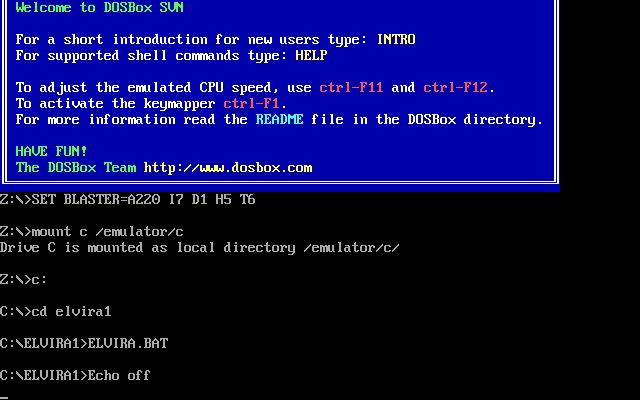
Standard setup applies here: mount your game folder with mount c [folder], switch to it with c:, and launch the executable. Because combat and movement run in real time, it’s worth checking your DOSBox cycles setting if things feel sluggish or too fast — our DOSBox guide walks through cycle tuning along with the rest of the basic setup, and it’s a genuinely useful read if this is your first real-time DOS RPG rather than a point-and-click adventure.
The Verdict
Elvira remains a notable early example of a licensed character carrying real personality into a game rather than just slapping a face on the box. Horror Soft’s blend of first-person exploration and adventure-style puzzles set up everything the studio did afterward, including Waxworks. Where it shows its age is in the mapping-heavy pacing — without an in-game auto-map, a few sections turn into tedious grid-paper exercises that modern players may find more frustrating than fun. The difficulty curve is also uneven; some encounters feel tuned for a party that’s stronger than anything you could reasonably have built by that point, which leads to a fair amount of trial-and-error retreating.
Even so, if you have any fondness for retro dungeon crawlers or eighties horror-host culture, there’s a lot of charm packed into this haunted castle, and it’s a solid starting point before moving on to the sequel. I still think Peterson’s performance carries more of the game than it gets credit for — pull her commentary out and Elvira becomes a much more forgettable dungeon crawler.
Watch Gameplay
You might also like: