
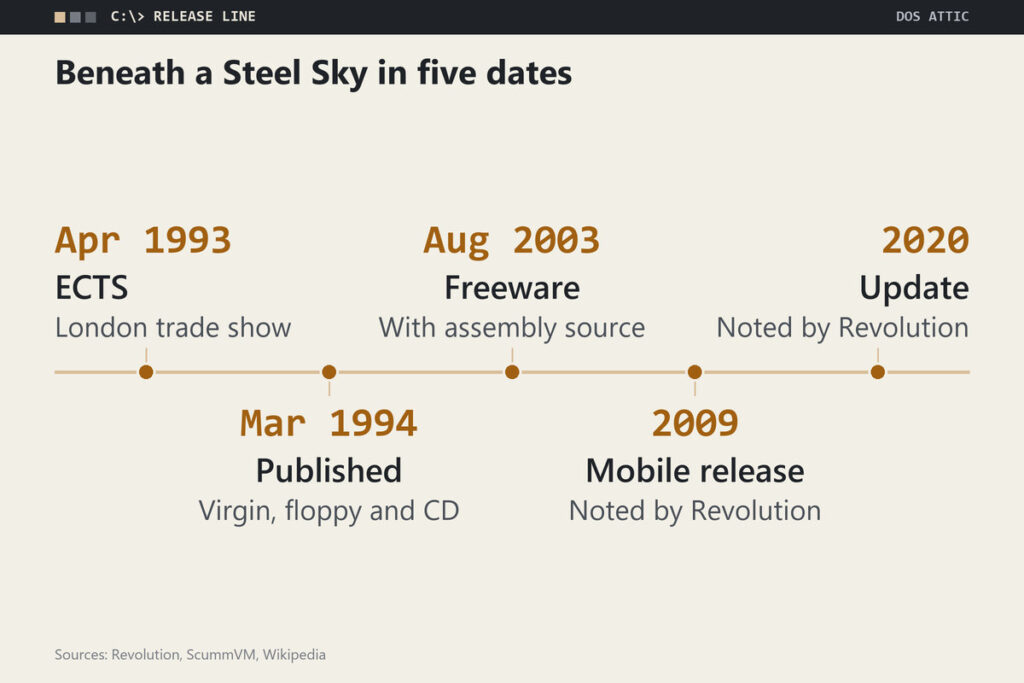
In April 1993 Revolution Software showed its second adventure at the European Computer Trade Show in London, and two months later at the Consumer Electronics Show in Chicago. By the time Computer Gaming World previewed it, its publisher Virgin was billing it as the world’s first computer-based animated comic book adventure.
The game was Beneath a Steel Sky, and the billing was fair in one respect. A working comic artist drew its screens, which gave it a look closer to a graphic novel than to the pixel-art adventures around it. What follows traces how those drawings became pixels, how the engine behind the city worked, and why the game can be played for nothing today.
Gibbons Draws the Backgrounds
Charles Cecil, Revolution’s co-founder, admired Watchmen and had floated the idea of working with its artist, Dave Gibbons, while he was still at Activision. That plan lapsed, and Cecil came back to Gibbons for Revolution’s second game. Gibbons had watched his son play video games and saw a use for his skills in drawing, writing and conceptualising. He received a rough outline and answered with a longer story, new characters and new scenarios under the working title Underworld, which Revolution’s page credits to Gibbons himself and says was dropped once Ultima Underworld was released.
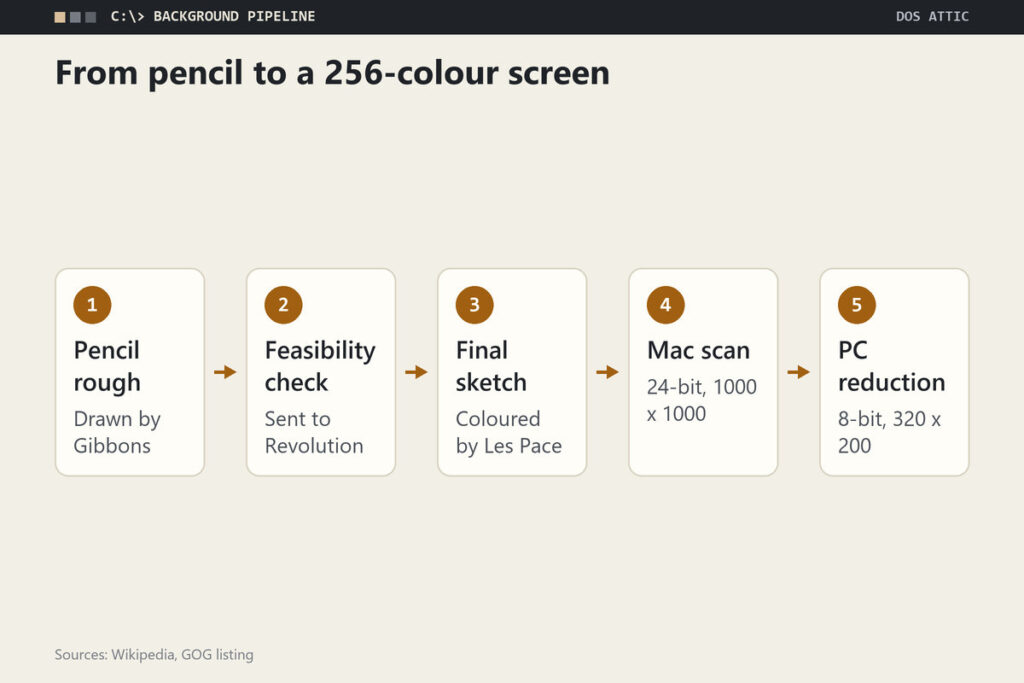
The method was close to a comic’s own. Gibbons penciled each background, beginning with roughs that Revolution vetted for technical feasibility and following with a finished sketch that Les Pace coloured. Each picture was scanned on a Macintosh at 24-bit colour and 1000 by 1000 pixels, then cut down to 8-bit colour at 320 by 200 for the PC. Revolution’s page still lists a free comic beside the game.
Faces seven pixels wide
People were the hardest case: a face had room for roughly seven pixels across and nine down. Gibbons built the sprites in Deluxe Paint on an Amiga, each animated across about 20 positions. He would have liked figures nearer to those of Prince of Persia or Flashback, while Revolution wanted more detail than he did, so the faces ended as a compromise between the two wishes.
Virtual Theatre Lets the City Live
Beneath a Steel Sky was the second game on Revolution’s Virtual Theatre engine, after Lure of the Temptress. The idea was that characters go about their own business whatever the player does, performing everyday actions, which no earlier game had attempted. Revolution’s own description credits the engine to Charles Cecil and Tony Warriner and calls it the first to let non-player characters wander about independently and have a life of their own.
Revolution did not simply reuse it. Cecil said the first engine, built around giving characters commands, fitted a story with several threads badly, and the version for this game was revised by the co-founders Tony Warriner and David Sykes as part of the Virgin deal.
Why every door in Lure looked alike
Warriner’s example is a door. In the first engine the system managed everything on screen, so any door was handed to the same door routine and every door looked and behaved alike. The second version was object oriented and no longer separated a door from a key, so a designer could make one door behave differently without special-casing it.
Union City Seen From the Gap
A Computer Gaming World preview ahead of the release describes the setting in two sentences: a cyberpunk world where a handful of vast corporations dominate and control all aspects of life, and a hero, Robert Foster, who has lived all his life in the Gap, a harsh wasteland. Armed security officers carry Foster to Union City, where he uncovers a conspiracy tied to the city’s all-powerful computer, LINC.
His best friend is a robot called Joey, whose personality sits on a circuit board that can be moved between bodies, a running gag in the game. The protagonist can also die, after which play resumes from the last save, a choice unusual at the time. The tone sits between the earnestness of Sierra’s stories and the slapstick of LucasArts’, and Sierra’s own approach in King’s Quest I shows the first half of that contrast.
Billed as a Comic Book Adventure
The Computer Gaming World preview reports Virgin’s claim that this was the world’s first computer-based animated comic book adventure, a billing the magazine attributes to the publisher, and says the game was presented as a graphic novel. It also counts the game as Revolution’s second on Virtual Theatre and notes that it develops Lure of the Temptress. The trade press was selling a format as much as a title.
The schedule slipped. The game reached shops in March 1994 from Virgin, on floppy disks and on CD-ROM, and the floppy edition ran to 15 disks against four for Lure of the Temptress. The Amiga version dropped a few animations because not every Amiga owner had a hard drive, the sort of version difference that the Amiga and DOS differences in Another World also raise. A comic by Gibbons, which became the game’s introduction, shipped in the box.
Counting the Places in Union City
The same preview put numbers on the world. It lists over 100 different locations, over four times the size of Lure of the Temptress, and says the non-player characters react according to the player’s approach. It credits the strong, aggressive graphics to Dave Gibbons, whose earlier work it names as Watchmen and Give Me Liberty, and adds a throbbing sound track and a much smoother version of the Lure engine to the pitch.
The producer’s line, quoted there, is that Revolution’s second Virtual Theatre engine and Gibbons’s comic-book graphics would make an adventure of a completely new style and level of interactivity. That is a Virgin producer talking, so it is a promise and not a finding, and a count of places is easy to print and hard for a reader to check before buying. The preview also fixes the plan for formats: PC and Amiga versions as it went to press, with a CD edition called definite and an Amiga 1200 edition possible.
Revolution’s page today describes the shipped game in plainer terms, as an adventure set in a dynamic world of wilful characters whose motivations the player can subvert, with a hacking tool that lets a puzzle have more than one solution. Set beside the preview, the promise about independent characters survives in the studio’s own wording, while the location count appears nowhere on the page.
Voices Only on the CD
Speech exists only in the CD-ROM release. Revolution first hired actors from the Royal Shakespeare Company and recorded over five thousand lines in two days, was not pleased with the results, and recorded again with voice actors instead of stage actors. Dave Cummins, who wrote the dialogue, also composed the score.
Why the speech and the text differ
One consequence is that spoken lines do not always match the on-screen text, and English terms were Americanised in places. Anyone who reads subtitles while listening will notice. ScummVM lists the floppy and CD editions separately, so the choice between them is partly a choice between a text-only game and a voiced one. The list does not say what fills the extra 59 MiB of the CD version; speech existing only on the CD makes voices the obvious candidate, though that is an inference and not a statement.
Reading Revolution’s Catalogue Entry Closely
Revolution’s page for the game is short, and it says more than its Buy It Now heading suggests. It dates the game to 1994, a mobile release to 2009 and its most recent version to 2020, and it names four games built on Virtual Theatre: Lure of the Temptress in 1992, this game in 1994, and the two Broken Sword adventures of 1996 and 1997. On the engine itself the page is blunt: it calls independent characters ground-breaking at the time and says the studio is still quite proud of them.
The page explains how the game runs today as well. It says ScummVM replaces the executable files shipped with old adventures, gives system requirements for Windows, Linux and macOS that all end with the note Powered by ScummVM, says the Linux and macOS versions come only through GOG, and sends iOS players to the App Store.
Two cautions follow. The buttons sit under a generic Buy It Now heading while Steam lists the game as Free To Play, so the studio’s page and the store’s price line do not use the same words, and the store’s line on the day is the one to read. And the requirements describe the ScummVM-powered release sold now, not the 1994 floppies, which is why the editions in the next section are taken from ScummVM’s list and not from Revolution’s page.
Floppy and CD Editions, Free in Both
ScummVM’s list offers two PC editions as freeware: a CD version of 66.2 MiB, last updated in October 2005, and a floppy version of 7.3 MiB, last updated in February 2008. Steam lists the game at no price with a release date of 4 March 1994, and GOG’s page, which also shows it at no price and says it runs on ScummVM, gives a date in April 1994, so the exact day is unsettled and the year is the safe unit. Who else offers games on these terms is set out in the roundup of DOS games offered at no cost.
Source Code Without a Free Licence
In August 2003 Revolution released the game as freeware together with its assembly-language source code. The release mattered because it let the ScummVM project support the game, which is why it runs on Windows, OS X, Linux and other systems today.
What the 2003 release did and did not hand over
The source code is available, but its licence does not qualify as a free-software licence. For a reader the distinction is practical. What the owner granted is permission to play the game without paying, and that is a narrower thing than freedom to rebuild or redistribute it.
Which Version of Beneath a Steel Sky Is the Free One?
The original 1994 game in its PC editions, as listed by ScummVM, Steam and GOG. Revolution’s 2009 mobile release is a separate product. For the shortest route, take the 7.3 MiB floppy version; for voices, take the CD version, and accept that the speech and text differ in places. Read the store’s price line and ScummVM’s file dates on the day you collect anything, because both can change.