Six years before id Software’s shooter existed, a different game called Castle Wolfenstein was already teaching Apple II owners to fear footsteps outside a locked door. Understanding that older game is the fastest way to understand what id actually did in 1992 — because Wolfenstein 3D isn’t really an original concept reskinned as a shooter. It’s a stealth game’s name and setting, deliberately gutted of stealth, rebuilt as something almost opposite.
The Game id Borrowed a Name From
In 1981, Muse Software published Castle Wolfenstein, an Apple II action-stealth game designed by Silas Warner in which the player sneaks through a Nazi prison disguised in stolen uniforms, avoiding guards rather than mowing them down. A 1984 sequel, Beyond Castle Wolfenstein, continued the same top-down, disguise-and-evade formula. Both were genuinely influential stealth designs in their own right, years before “stealth game” was a phrase anyone used.
Muse Software closed in 1987, and the Wolfenstein name and setting sat unused until id Software — a four-person Texas studio not yet a year old — sought and received permission from Silas Warner to reuse it. What id built in 1992 kept the castle, the Nazi prison, and the name, and discarded almost everything else about how the original played.
What id Built Instead
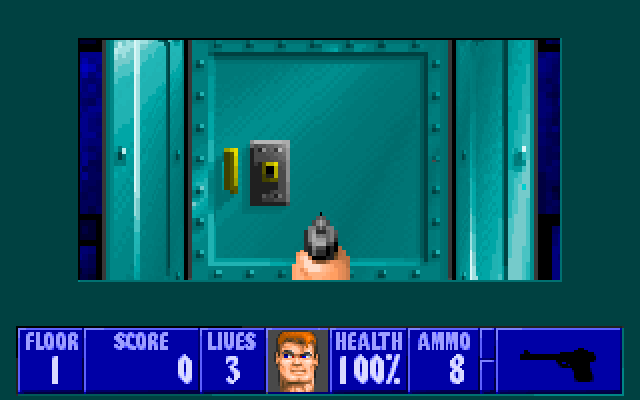
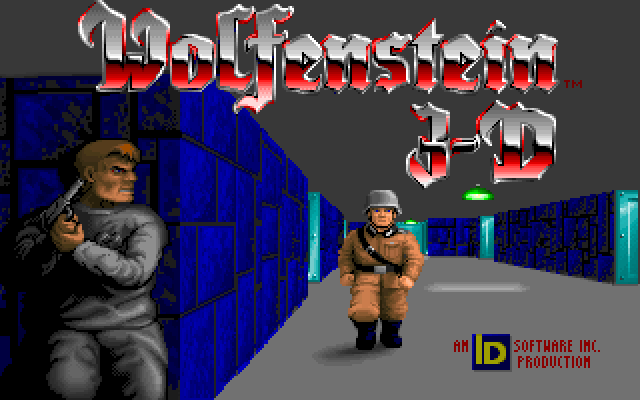
Wolfenstein 3D casts you as B.J. Blazkowicz, an Allied spy who, rather than sneaking past Castle Wolfenstein’s guards the way Muse Software’s 1981 protagonist did, shoots through floor after floor of them toward a series of increasingly absurd bosses, culminating in the Mecha-Hitler encounter. Where the original rewarded patience and disguise, id’s version rewards speed and aggression — arrow keys to move, Ctrl to fire, and a weapon roster that climbs from a starting pistol and knife up to a room-clearing chaingun. Enemies scale in the same direction: regular soldiers give way to SS guards, attack dogs, and armored mutants as the episodes progress.
The result established, in one release, most of what “first-person shooter” would mean for the next several years: maze-like corridors rendered from a first-person view, secret walls hiding treasure and ammo, keycards gating progress, and a core loop of shoot-search-advance that Doom would inherit almost unchanged a year later.
How Much of It Is Actually Free
id split the full release into three six-level episodes sold to paying customers, later followed by three more in the separate Nocturnal Missions pack, and then a standalone prequel, Spear of Destiny, with its own additional episodes. What costs nothing, and is legally free to download today, is the original shareware episode — Escape from Wolfenstein — which alone runs ten full levels.
| Release | Content | Cost model |
|---|---|---|
| Escape from Wolfenstein (Episode 1) | 10 levels | Free shareware — still free today |
| Episodes 2–3 (original registered set) | 18 levels | Originally sold by mail order |
| Nocturnal Missions (Episodes 4–6) | 18 levels | Sold separately as an expansion |
| Spear of Destiny | Standalone prequel, multiple episodes | Sold as its own retail release |
Storming the Castle: Systems and Combat
The moment-to-moment design is simpler than Doom’s would be a year later, and that simplicity is part of why it still plays cleanly: every level is a single height, every wall is either solid or a secret, and the only real tactical variable is ammo management against how many soldiers you’re willing to wake up at once. Guard dogs close distance fast and alert nearby soldiers the instant they spot you, which makes them more dangerous, level for level, than the human enemies standing next to them.
Levels also lean heavily on sound as an early-warning system in a way later, more visually noisy shooters would move away from. A guard who spots you barks an alert line before he actually starts shooting, which gives an alert player a half-second window to duck around a corner or open fire first — useful information the flat, repetitive corridor layouts don’t otherwise give you. Combined with the game’s habit of hiding entire rooms behind secret push-walls, the result is a game that rewards listening and probing walls nearly as much as it rewards reflexes.
Two Sound Cards, Two Very Different Experiences
How Wolfenstein 3D sounds depends heavily on which card DOSBox — or the original hardware — is emulating. Configured for AdLib’s FM synthesis, the soundtrack and effects come through as sharper, more synthetic tones, closer to how most players actually experienced the game on period-accurate 1992 hardware, since AdLib cards were far more common than Sound Blaster’s early models at launch. Configured for Sound Blaster, digitized effects like gunfire and enemy death barks are noticeably clearer and more sample-based, at the cost of some of the AdLib version’s distinctive edge. Neither is objectively correct; the in-game setup utility lets you switch between them freely, and it’s worth trying both once rather than assuming your first configuration is the intended one.
From the Old Castle to the New One: What Carried Over
It’s worth being specific about the lineage rather than treating it as trivia. Muse Software’s original contributed the setting, the villain’s castle, and arguably the idea that a WWII prison escape could carry an entire game. What it did not contribute is the genre id is actually remembered for inventing — the 1981 game is closer in spirit to Metal Gear than to Doom. id’s real innovation was recognizing that the same premise, told through a gun instead of a disguise kit, was a better fit for the fast 3D rendering technology John Carmack had just built.
Playing Smart: Six Things That Help
- Push on walls that look even slightly different from their surroundings — a subtle texture or color shift is almost always the tell for a secret door hiding treasure, ammo, or health.
- Deal with guard dogs the instant you spot them rather than trying to outrun them; they close distance quickly and alert soldiers nearby.
- Save the knife for isolated, weak soldiers when ammo is tight — it’s slow, but it costs nothing to use.
- Pick fights selectively. Ammo runs out faster than health does on most difficulty settings, so don’t shoot every soldier the moment you see them.
- Boss fights reward finding a chokepoint and using it, rather than standing in the open trading shots.
- Collecting every secret and treasure item in a level gives the game real replay value even after you’ve already cleared it once for the exit.
Setting Up the Escape in DOSBox
Wolfenstein 3D runs in DOSBox with essentially no configuration. Install DOSBox, extract the shareware release into a folder such as C:\WOLF3D, then from the DOSBox prompt run mount c C:\WOLF3D, followed by c:, then wolf3d. The game predates any dependency on cycle-heavy CPU emulation settings, so DOSBox’s default cycle count is more than sufficient — you shouldn’t need to touch cycles= at all unless your specific build runs unusually slow. If sound doesn’t trigger automatically, the in-game setup utility (run setup from the same folder) lets you select Sound Blaster or AdLib output manually.
Debriefing: Questions About the Mission
Is Wolfenstein 3D related to the 1981 Castle Wolfenstein?
Only by name, setting, and licensing history. id Software obtained permission from Castle Wolfenstein creator Silas Warner to reuse the Wolfenstein name after Muse Software, the original publisher, closed in 1987. The gameplay is unrelated — the 1981 original is a stealth game, not a shooter.
Is Wolfenstein 3D actually free?
The first episode, Escape from Wolfenstein, was released as shareware and remains free and legal to download. The additional episodes and Spear of Destiny were sold commercially.
How does it compare to Doom?
Wolfenstein 3D uses single-height, perpendicular-walled levels, while Doom, released a year later, added variable heights, diagonal walls, and more sophisticated lighting. The core loop of shooting, searching for secrets, and advancing is shared between both.
What DOSBox settings do I need?
None beyond the defaults for most systems. The game is old enough that it doesn’t require raising the emulated CPU cycle count.
Who is B.J. Blazkowicz?
The player character: an Allied spy imprisoned in Castle Wolfenstein during World War II who fights through the castle’s floors toward its final boss.
Should I use AdLib or Sound Blaster settings?
Either is period-accurate. AdLib’s FM synthesis is closer to how most players actually heard the game in 1992, given how much more common AdLib cards were at launch, while Sound Blaster produces clearer, more sample-based effects. Try both in DOSBox’s setup utility and pick whichever you prefer — there’s no wrong answer.
Legacy: What This Game Handed to Doom
id spent the two years after Wolfenstein 3D building on the same core idea rather than abandoning it. Doom, released in December 1993, kept the shoot-search-advance loop intact and added variable room heights, diagonal geometry, and dramatically better lighting — but the weapon-and-secret rhythm underneath all of it was already fully formed here first. Other studios picked up the template too: Rise of the Triad pushed the flat-corridor formula toward faster, more chaotic combat in 1994, while id’s own later engine work led directly to Quake‘s jump into true 3D in 1996. For the broader arc of how the FPS and other DOS-era genres developed side by side, see our history of DOS gaming timeline.
You might also like: