Three goblins share one brain cell between them
French studio Coktel Vision spent the early 90s building a reputation for distinctive, visually inventive puzzle games, and Gobliiins, released in 1992, is where that reputation really took shape. It’s a puzzle-adventure that puts you in charge of a trio of bumbling goblins tasked with helping a king, and each goblin has exactly one fixed ability that has to be deployed cleverly, at the right moment, to get anywhere.
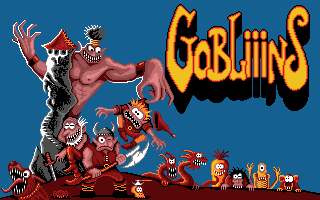
Much of the game’s visual personality comes down to artist Pierre Gilhodes, whose hand-drawn, slightly grotesque character designs give Gobliiins a look unlike almost anything else on the platform at the time. The game’s screen-by-screen structure, where each room is essentially a self-contained puzzle box, helped define a small but memorable subgenre of puzzle-adventure hybrids that valued trial-and-error problem solving over traditional inventory-based adventuring.
Fight, carry, cast: a puzzle built on three abilities
You control three goblins simultaneously, each with a single fixed ability: one can fight, one can carry objects, and one can cast unpredictable magic spells. Progressing through each single-screen puzzle room requires switching between the goblins and using their abilities in the right combination and order, which sounds simple until the game starts layering timing and sequencing on top of it.
The puzzles lean heavily on experimentation, encouraging you to try different actions and see what happens, often to comedic effect thanks to the magician’s wildly unpredictable spells – you genuinely never know if a given cast is going to solve the room or blow something up in your goblins’ faces. An energy meter that persists across levels adds a layer of tension, punishing repeated wrong guesses, which makes careful observation just as important as creative thinking.
The presentation leans into that same unpredictable energy. Character animation is exaggerated and cartoonish, sound effects are gleefully silly, and the whole game has an anarchic sense of humor baked into its visual design, not just its writing, since there’s very little actual dialogue to speak of. It’s a game that gets a surprising amount of personality out of pantomime and slapstick alone.
Before your energy meter runs dry
- Scan the whole screen before acting with any goblin – Gobliiins rooms are usually solvable in a specific order, and acting too early with the wrong goblin burns energy for nothing.
- Don’t spam the magician’s spell hoping for a lucky outcome; its unpredictability is a puzzle element, not a random-chance shortcut, and repeated blind casting drains your energy meter fast.
- Switch goblins the moment one gets stuck rather than repeating the same failed action; a different goblin’s ability is very often the actual solution to what’s blocking you.
- Treat the energy meter as a resource to budget across the whole level, not just the current room – running it out partway through a stage is one of the most common ways new players get stuck.
- Watch what happens when a wrong action fails rather than immediately retrying – the game often shows a visual clue about why it didn’t work, which is more useful than blind repetition.
Where the goblins trilogy goes from here
Gobliiins remains a fascinating entry in adventure game history for its unusual multi-character puzzle structure, a format that few other games attempted with the same charm and consistency. Coktel Vision would go on to soften this format considerably in its sequels – Gobliins 2 drops the three-character structure almost entirely in favor of a single controllable hero, and Goblins Quest 3 pushes further into traditional adventure territory again. Played today, the original stands out precisely because it’s the strangest and least compromising entry in the series.
My honest opinion: the three-goblin puzzle format is genuinely clever and I wish more games had tried it, but the energy meter can turn an already tricky puzzle into a frustrating one if you’re experimenting the way the game seems to want you to. It’s a great starting point for exploring the rest of the series, which continued to build on its offbeat foundation in the sequels that followed, even if those sequels ultimately moved away from what makes this first entry so distinct. If you’ve only ever heard of the Gobliiins series through its later, gentler entries, going back to the original is worth it just to see how uncompromising the format started out, and how much of the series’ identity was already fully formed right from this very first entry, energy meter and all. It’s a short enough game that the frustration never gets a chance to outstay its welcome, which is part of why it’s held up so well as a cult favorite instead of fading into obscurity the way a lot of shorter, harder puzzle games from the period eventually did.
Where to get Gobliiins
Grab DOSBox first if you have not already — our setup guide shows exactly how. For more downloads, check the best free DOS games we have covered.
Running it in DOSBox, or ScummVM
Once installed, mount the game’s folder as your C drive in DOSBox, switch to that drive, and run the EXE. If you’d rather skip DOSBox configuration entirely, Gobliiins is also supported by ScummVM’s Gob engine, which handles Coktel Vision’s whole puzzle-adventure catalog and can be a simpler option for just picking up and playing. Check our DOSBox setup guide linked above for help configuring graphics and sound for early-90s DOS titles either way.
The Goblins in Motion
You might also like: