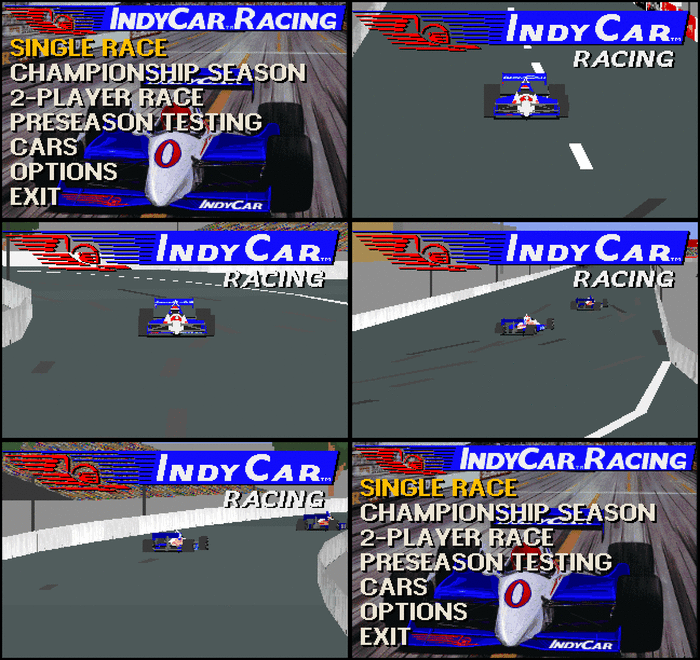
If you’ve ever spent hours tuning suspension and gearing in a racing simulator, you owe part of that habit to a 1993 Papyrus Design Group release that most modern sim racers have never heard of. IndyCar Racing is where the studio that would eventually make NASCAR Racing and Grand Prix Legends first proved that physics-first racing could work on MS-DOS.
Setting a New Bar for PC Racing
IndyCar Racing puts you in the cockpit of an open-wheel car, competing across a slate of real-world ovals and road courses in pursuit of a championship season. What separated it from the arcade racers crowding PC shelves in 1993 was Papyrus’s insistence on a genuinely detailed physics model — tire grip, aerodynamics, car damage — instead of the simplified handling most of the competition relied on. Licensed tracks, sponsors, and car liveries added a layer of authenticity that few DOS racing games had attempted before.
This wasn’t a one-off experiment either. IndyCar Racing set the technical and design template Papyrus would keep refining for the rest of the decade, eventually leading to some of the most respected racing simulations PC gaming ever produced.
The choice to focus on IndyCar specifically, rather than a more broadly recognizable series like Formula One, also says something about Papyrus’s priorities. Open-wheel oval racing demanded a physics model that could handle sustained high speeds and drafting in a way road-course-only games didn’t have to worry about, and building that engine first gave the studio a technical foundation that transferred directly into their later oval-heavy NASCAR work.
Getting the Setup Right
- Spend time in the garage mode before your first race. Suspension, gearing, and other setup options genuinely change how the car behaves, and running default settings on a technical road course will cost you lap time.
- Brake earlier than feels natural at first — the tire and aerodynamics model punishes late braking far more harshly than arcade racers do.
- Ovals and road courses call for noticeably different setups; don’t carry a road-course configuration onto a high-speed oval without adjusting it.
- Use the instant replay feature to review mistakes from multiple camera angles — it’s a genuinely useful learning tool the game offers that many contemporaries didn’t.
- Treat qualifying laps seriously rather than as a formality; starting position matters more in a physics-heavy sim like this than it does in a forgiving arcade racer.
Papyrus’s Reputation for Physics-First Racing
It’s worth understanding why Papyrus specifically was the studio to make this leap. Founded by developers who cared deeply about simulating real racing rather than just gesturing at the fantasy of it, the studio built its entire identity around the idea that accurate handling and setup depth could be genuinely fun rather than just technically impressive. IndyCar Racing is the proof of concept for that philosophy on MS-DOS hardware, and the studio’s reputation only grew from here.
That commitment to authenticity is exactly what carried through to NASCAR Racing and, later, Grand Prix Legends — both of which are still cited by sim racing veterans as genre landmarks. Understanding IndyCar Racing means understanding the starting point of a design philosophy that shaped an entire corner of PC gaming for years afterward.
The Foundation for Everything Papyrus Built Next
Play IndyCar Racing today and you can feel the DNA of NASCAR Racing and Grand Prix Legends already in place — the emphasis on setup tuning, the respect for real physics over arcade shortcuts, the licensed-track authenticity. It’s genuinely a foundational title for anyone trying to understand how PC racing simulation grew up on DOS, not just a curiosity to be skipped in favor of the more famous later games.
That said, it demands patience in a way arcade racers don’t. The learning curve on the handling model is real, and if you go in expecting Test Drive-style accessibility, the early hours will feel punishing rather than fun. Stick with the setup options and it clicks, but it asks more of new players than most racing games from the same era.
My honest verdict: it’s more valuable historically than it is immediately fun for a modern player used to contemporary sim-racing conveniences. The lack of hand-holding that made it groundbreaking in 1993 can feel like a lack of polish today, and newcomers should go in expecting a game that demands real study rather than instant gratification behind the wheel.
Give it the time it asks for, though, and there’s a real satisfaction in feeling the physics model reward a properly tuned setup and a clean, patient lap. That payoff is exactly what Papyrus would spend the rest of the decade refining, and it’s genuinely present here in its earliest, roughest form if you’re willing to meet the game halfway.
Start with a short oval race rather than a technical road course on your first attempt. Ovals give you a more forgiving introduction to the tire and aerodynamics model before you’re asked to juggle braking points, apex lines, and setup tuning all at once on a tighter, more demanding circuit.
Picking Up IndyCar Racing
IndyCar Racing is a commercial release and isn’t available as a legal free download, so check GOG or Steam for official re-releases. New to DOSBox? Our setup guide walks through the whole process.
DOSBox Configuration
Mount the game’s folder as a virtual drive with mount c [folder], switch to that drive using c:, and launch the EXE from the DOSBox prompt. A joystick or wheel configured through DOSBox will make the most of the detailed handling model — our DOSBox guide covers the full process.
Watch a Season in Motion
You might also like: