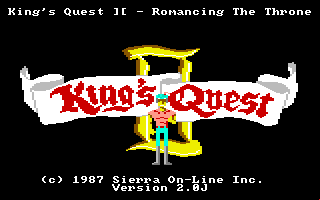
Having spent an entire game recovering Daventry’s three stolen treasures, King Graham’s reward in the sequel is basically a paperwork problem: a kingdom needs a queen, and he doesn’t have one. It’s a small, oddly domestic hook for a fairy-tale adventure, and it works better than it has any right to.
Roberta Williams doubles down on the AGI engine
King’s Quest II: Romancing the Throne is the second installment in Sierra On-Line’s landmark King’s Quest series, released in 1985 and developed under Roberta Williams’ direction. It expanded on the pioneering AGI (Adventure Game Interpreter) engine introduced in the first game, letting players walk an animated character around the world instead of reading static text descriptions the way older interactive fiction demanded.
The setup picks up directly after the original: Graham consults the magic mirror in search of a suitable companion, and it reveals a maiden named Valanice locked away in a tower in the distant land of Kolyma. What follows is a fascinating snapshot of graphic adventure design in its earliest, most experimental years, before the genre had settled on many of its now-familiar conventions.
It’s worth remembering just how new this whole format still was in 1985. The idea of walking an animated character through a persistent world rather than parsing pure text descriptions had barely existed for a couple of years by this point, and Sierra was essentially inventing conventions as it went, borrowing pacing ideas from fairy tales and folklore because there wasn’t yet an established grammar for “graphic adventure” the way there would be a decade later.
Three keys, one impatient king
Players guide King Graham with the arrow keys while typing commands into a text parser to interact with the world, actions like “open door” or “get key” drive the story forward. Kolyma is a large, cyclical world made up of interconnected screens, and the game encourages exploration to uncover the keys needed to reach Valanice’s tower.
The puzzles frequently draw on fairy tale logic and folklore references, rewarding players who recognize the sources being reimagined. Clever solutions tend to score higher than brute-force ones, and, true to Sierra’s reputation of the era, careless exploration can end with Graham’s untimely death, so frequent saving isn’t optional so much as required.
Puzzle tips, learned the hard way
- Save before every screen transition, not just before obviously dangerous moments. AGI-era Sierra hides threats in places that look completely safe.
- Explore Kolyma’s cyclical layout fully before assuming you’ve hit a dead end; the world loops in ways that aren’t obvious from a single pass.
- Type short, direct commands rather than full sentences. The parser handles two or three words far more reliably than a complete phrase.
- Pay attention to fairy tale references in the environment. Puzzle solutions often hinge on recognizing what story is being parodied.
- Don’t assume an item is useless just because you can’t see an obvious purpose for it yet. Kolyma’s cyclical map means an item picked up early often matters far later.
Where King’s Quest II sits between its neighbors
Next to the original King’s Quest, this sequel is more ambitious in scope but arguably less polished in fairness, since some of its puzzle logic leans on player mind-reading more than the first game did. Compared to King’s Quest III, which would follow it with a much bolder structural swap, King’s Quest II feels transitional: confident in its engine, still finding its footing in puzzle design.
It’s also a shorter, more compact experience than either of its neighbors, which cuts both ways. There’s less filler here than in some later, more sprawling Sierra titles, but there’s also less room for the world to breathe; Kolyma never gets the chance to feel as lived-in as Llewdor or Tamir would in the games that followed it.
Buying your copy
If DOSBox is new territory for you, start with our DOSBox setup guide before going further. More legally free classics live in our free DOS games roundup.
Running it with DOSBox or ScummVM
Once installed, mount the game’s folder as drive C in DOSBox with a command like mount c c:\games\kingsquest2, switch to that drive with c:, and launch the EXE from the prompt. Our DOSBox setup guide linked above covers the most common fixes for AGI-era Sierra titles. If you’d rather skip manual configuration entirely, ScummVM’s AGI engine also supports King’s Quest II directly.
Aged like fine wine, or aged like milk?
A bit of both, honestly. The fairy-tale atmosphere and Valanice’s introduction still land, and there’s real charm in seeing the series take its earliest confident steps. What’s aged badly is the puzzle logic in a few spots, where the solution requires a leap most modern players won’t make without a walkthrough, and the parser occasionally rejects perfectly reasonable phrasing out of pure stubbornness.
Fans of the series will appreciate seeing Valanice’s first appearance, since she becomes a mainstay for the rest of the franchise, and it’s a solid entry point for anyone curious about the AGI engine and how far adventure games have come since.
My honest advice: play it after the original King’s Quest, not as your very first Sierra game. It assumes a working familiarity with the parser and the studio’s death-happy design instincts that the first game spends more time easing you into, and jumping straight into Kolyma cold is a rougher welcome than the series needs to give a first-time player.
Watch Gameplay
You might also like: