
The video buffer on IBM’s first color card held 16 KB. The one on a 1987 PS/2 Model 80 held 256 KB, sixteen times as much, and both numbers come straight from IBM’s own technical manuals. Everything people call the look of DOS graphics sits between those two figures, so this article follows the manuals rather than the legends: what each document says the hardware could put on screen, and where the popular shorthand drifts away from it.
A Color Card With Sixteen Kilobytes
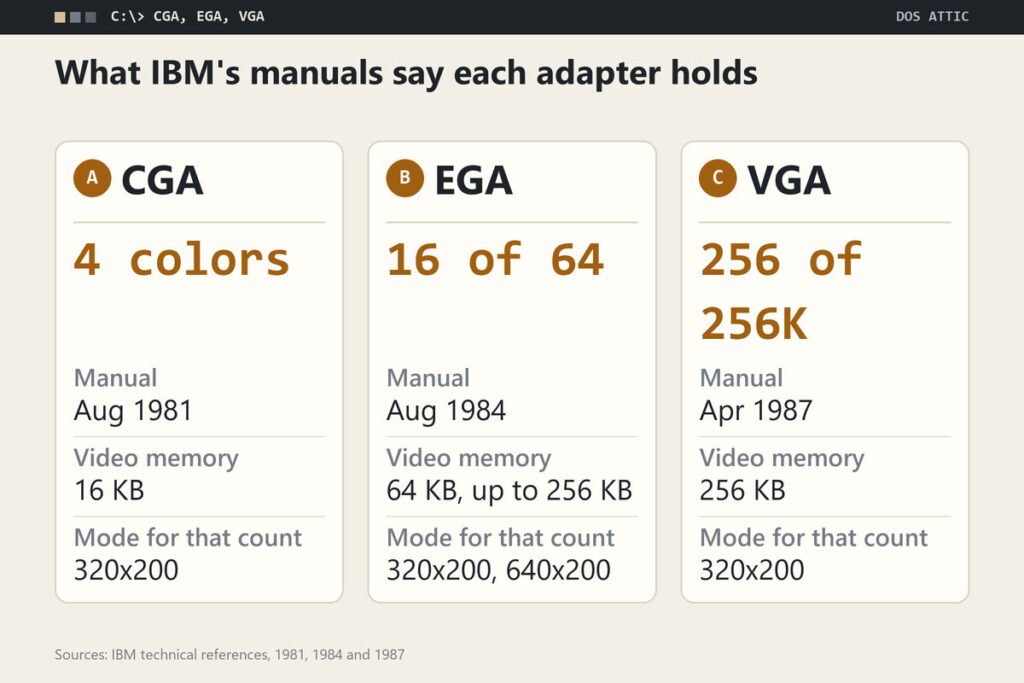
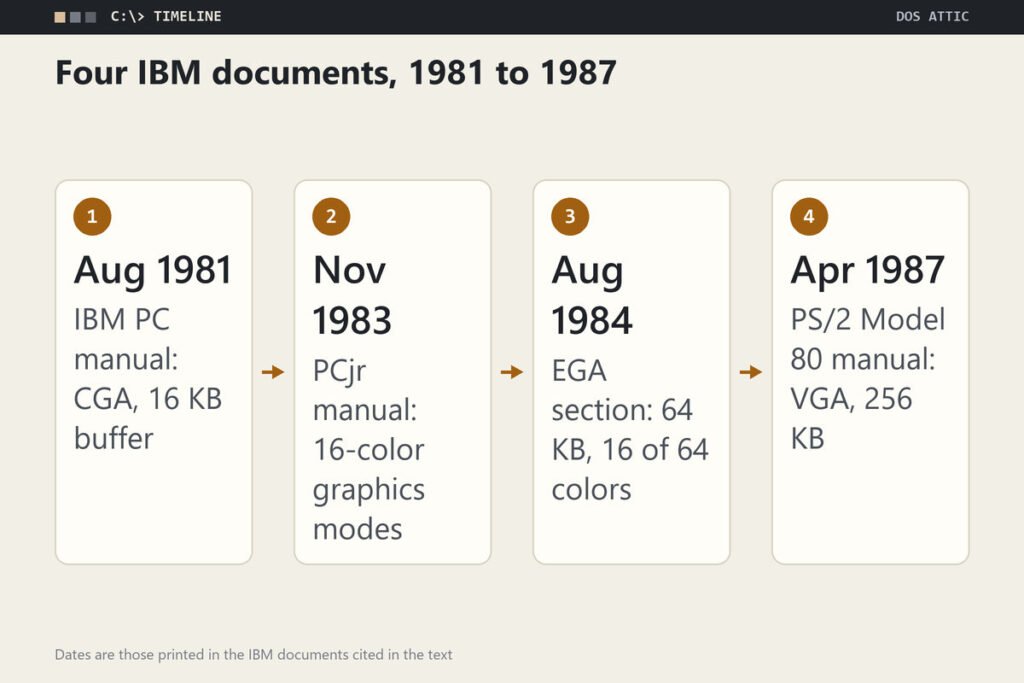
The card IBM sold with the original PC is documented in the first edition of the PC Technical Reference, dated August 1981. It is called the Color/Graphics Monitor Adapter, which later gets shortened to CGA. Its display buffer is 16 KB of memory that both the processor and the display circuitry can reach, and the whole card is built around a Motorola 6845 controller.
The manual describes three video outputs: a composite video port, a direct-drive port for RGB monitors, and a connection for a user-supplied RF modulator so the card can drive a television. That detail explains much of CGA’s reputation. The same card had to work with a cheap TV and with a dedicated monitor, so its modes were compromises from the start.
Text got the generous treatment. The card offers 40 or 80 columns by 25 lines from a 256-character set, and the manual’s color table lists sixteen named colors, built from one bit each for red, green and blue plus an intensity bit, running from black, blue, green and cyan through the grays to the light variants. A text screen in 1981 could therefore show more colors than a graphics screen, which is the first hint that CGA’s famous four were a budget decision and not a limit of the card’s palette.
Four Colors, Chosen Three at a Time
In graphics mode the manual lists two resolutions. At 320 by 200, each pixel can be one of four colors. The background, called color 0, may be any of the 16 colors the card knows. The other three come from one of two software-selectable palettes: red, green and brown, or cyan, magenta and white.
That is the whole story behind the cyan and magenta screens that now stand for CGA. A programmer could pick the second palette, or the first, but could not mix them. The arithmetic shows why the limit existed. Two bits per pixel across 320 by 200 pixels is 16,000 bytes, which fills the 16 KB buffer almost exactly. The 640 by 200 mode needs one bit per pixel, uses the same 16,000 bytes, and, as the manual puts it, is available only in black and white because the full 16 KB is spent on on-or-off dots.
The PCjr Reaches for Sixteen
IBM’s PCjr technical reference, in a revised first edition dated November 1983, shows the company stepping beyond its own card. A table separates modes shared with the PC from modes only the PCjr offers: 320 by 200 in 16 colors, 160 by 200 in 16 colors, and 640 by 200 in four colors. A note beside those modes says the machine needs the 64 KB Memory and Display Expansion.
The same chapter carries a warning. The PCjr uses the same 6845 controller as the PC, but the hardware interface is not identical, and two register addresses, hex 3D8 and 3D9, are not supported at all. Software written for the PC’s color card could therefore fail on the PCjr even though both said “color graphics” on the box. For one game written in that period, the story of the game IBM commissioned to show off PCjr graphics covers how the hardware generation shaped it.
EGA Brings Its Own Memory Budget
The Enhanced Graphics Adapter is described in a section of IBM’s Options and Adapters technical reference dated August 2, 1984, with later sheets stamped 1986. The card ships with 64 KB organized as four 16 KB bit planes, and expansion options raise that to 128 KB or 256 KB. Four planes mean four bits per pixel, which is where 16 simultaneous colors come from. Those 16 are chosen from a palette of 64.
The manual also records what the card inherited. It supports every mode of the monochrome adapter and the Color/Graphics adapter, and it adds full 16-color support at 320 by 200 and 640 by 200 on the IBM Color Display, plus 640 by 350 on the new Enhanced Color Display. The advanced features IBM lists include bit-mapped graphics in four planes and a RAM-loadable character generator, so software could replace the font. Memory mattered beyond color, too: the attribute bit that switches between two character sets, giving 512 characters at once, is valid only when memory has been expanded to 128 KB or more. A year-by-year account of DOS gaming places these cards among the years they shaped.
VGA: One Mode, 256 Colors, a Flat Buffer
The VGA arrives in the April 1987 technical reference for the PS/2 Model 80. IBM’s description says the video subsystem has 256 KB of memory, built as four 64K-by-8 maps, and a digital-to-analog converter that supplies the colors. The color table inside that converter is 256 entries of 18 bits each, six bits for red, six for green and six for blue. Eighteen bits give 2 to the 18th power, or 262,144 possible colors, and any 256 of them can be loaded at once. On the monochrome analog display, the same entries are shown as shades of gray. The new modes listed include 640 by 480 in 2 and 16 colors, two new text formats, and 320 by 200 with 256 colors.
That last one is mode 13h. The manual calls it a graphics mode that can show 256 colors on screen at once, with a linear display buffer starting at address hex A0000 and 64,000 bytes long, one byte for each of the 64,000 pixels. No planes to juggle and no palette split: a program could write a byte and a pixel changed. Every earlier IBM video mode is still supported, and the 200-line modes are double-scanned to appear as 400 lines on the new analog displays.
| Adapter | Manual | Video memory | Colors on screen in graphics | Palette |
|---|---|---|---|---|
| CGA | August 1981 | 16 KB | 4 at 320×200 | 16 background choices, two fixed sets of three |
| EGA | August 1984 | 64 KB, expandable to 256 KB | 16 | 64 |
| VGA | April 1987 | 256 KB | 16, or 256 in mode 13h | 256K |
Games From These Years Sold Legitimately
The earliest hardware in this article has a legal way in. GOG sells King’s Quest 1+2+3, and its page says the bundle includes the original King’s Quest: Quest for the Crown, King’s Quest II and King’s Quest III, with a 1984 to 1986 copyright line, and that the release is powered by ScummVM. The page does not say which graphics modes the edition offers, so it is a way to see games from the CGA and PCjr years and not a test of the modes described above.
For the 256-color mode, GOG sells Hocus Pocus, whose page describes over 6 megs of 256-color VGA animated graphics and says the release is powered by DOSBox. What that requirement meant in 1994 is the subject of the 256-color Hocus Pocus.
Where the Numbers Disagree
IBM’s manuals keep two questions apart: how many colors appear on screen at once, and how many the palette holds. Each disagreement below is a place where a number that answers one question gets quoted as the answer to the other.
The first split is CGA’s four colors against its sixteen. Both are correct. The 16 refers to text colors, the border, and the choice of background. The 4 refers to graphics pixels at 320 by 200. A table that says “CGA, 16 colors” is quoting the text-mode figure, not the graphics one.
The PCjr belongs on this list too. Its 16-color 320 by 200 mode appears in IBM’s table with a note that the 64 KB Memory and Display Expansion is required, so a claim that the PCjr displays 16 colors is true only for a machine fitted with that add-on, and the same table gives its 640 by 200 mode just four colors. Treat any single color count for this machine as incomplete.
The second is EGA’s headline of 16 colors out of 64. The manual’s own mode chart shows that its 640 by 350 graphics mode gives four colors from a palette of 16 when only 64 KB is installed, and 16 colors from 64 when more memory is present. The famous number depends on the memory option the buyer paid for.
The third is VGA. Sources quote 256 colors, 262,144 colors, or 256K colors for the same card. IBM’s manual supports all three readings: the converter can produce 256K colors, defined with K meaning 1,024, which is 262,144, but a screen shows 16 of them in most modes and 256 only in mode 13h.
The more trustworthy reading is the one tied to a mode number. A figure without a mode, such as “VGA has 256 colors”, is shorthand, and the manual is clear that it holds in only one of the modes the card offers. When a source gives a color count for one of these cards, three questions settle most disputes: which mode, how much memory is installed, and whether the figure means the screen or the palette.