Few mid-90s action-adventures managed to feel this warm-hearted while also being genuinely inventive under the hood.
Adeline Software’s Breakout Hit
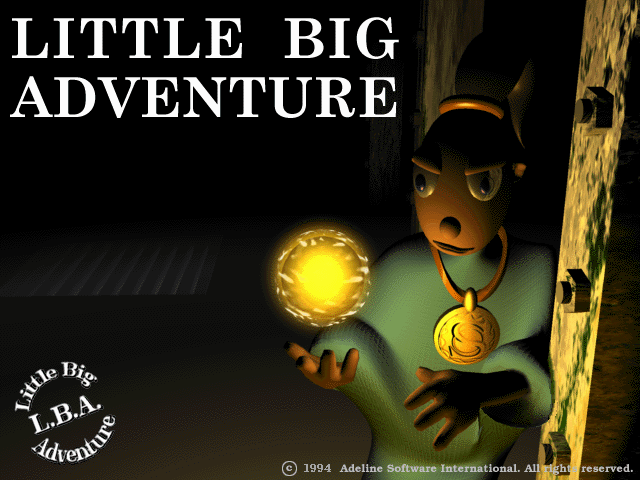
Little Big Adventure was developed by Adeline Software International and published by Electronic Arts in Europe and by Activision in North America, where it was retitled Relentless: Twinsen’s Adventure, for MS-DOS in 1994. It follows Twinsen, a young man on the planet Twinsun who sets out to overthrow the tyrannical Dr. FunFrock after a prophetic dream marks him for a heroic destiny. The CD-ROM version added full voice acting and orchestral music, while a floppy disk release substituted MIDI music and still images for the video sequences.
Exploring Twinsun in Real Time
Players guide Twinsen through towns, forests, and dungeons across Twinsun, talking to NPCs, solving puzzles, and fighting Dr. FunFrock’s forces in real time. The game blends adventure-style exploration and dialogue with action-RPG elements, including an inventory system and a magic ball that can be upgraded with different throwing effects as the story progresses. Twinsen also picks up a small cast of companions and allies along the way, and side conversations with Twinsun’s various inhabitants regularly hand out lore, jokes, or small side-quests that reward players who talk to everyone rather than beelining for the main objective.
Making the Most of the Behavior System
The feature that still sets Little Big Adventure apart is its “behavior” mechanic, letting players switch Twinsen between Normal, Athletic, Aggressive, and Discreet modes depending on the situation. A few tips for getting the most out of it:
- Switch to Athletic before jumping sequences or platforming — Twinsen’s movement options change noticeably in this mode, and trying to platform in Normal mode is a common source of frustration.
- Discreet mode isn’t just flavor — certain guards and enemies react differently to a sneaking Twinsen than an obviously wandering one, so use it around hostile NPCs before assuming a fight is unavoidable.
- Save the magic ball’s upgraded throwing modes for the situations they were clearly designed for; the wind and fire variants in particular solve specific puzzles that the default throw can’t.
- Don’t neglect the holomap — Twinsun’s world is large enough that skipping it leads to a lot of avoidable backtracking.
A High Point of Its Genre
Little Big Adventure is widely regarded as one of the finest action-adventure games of the 1990s, and it was named the 38th best computer game ever by PC Gamer UK in 1997. Its isometric 3D world with 2D character sprites gave it a distinct visual identity that’s aged more gracefully than the fully polygonal look many of its contemporaries chased.
Part of what makes Twinsun so memorable is how lived-in it feels for a fantasy sci-fi setting built on mid-90s hardware. Citadel Island alone packs in a bustling town, a beach, and a fortress with genuinely distinct moods, and the game trusts players to wander and talk to NPCs who mostly just go about their lives rather than existing solely to hand out quests. That sense of a world that continues whether or not you’re paying attention to it was unusual for 1994 and remains a big part of the game’s charm.
The North American retitling to Relentless: Twinsen’s Adventure is a small but telling detail about mid-90s localization practices — publishers often assumed American audiences needed punchier, more action-forward titles than the original European branding, even for a game whose actual tone leans warm and whimsical rather than aggressive.
Electronic Arts’ European publishing arm gave the game strong distribution across the continent from launch, while the more scattered North American marketing under the Relentless branding likely contributed to it being somewhat less immediately recognized by American players in the years right after release, despite the strong critical reception it eventually earned worldwide.
Where to Buy Little Big Adventure Today
Getting DOSBox running for the first time? Our complete setup guide covers what you need, and our roundup of the best free DOS games is worth exploring once you’re done with Twinsun.
The floppy disk release is worth mentioning too, since not every player in 1994 had a CD-ROM drive yet. That version trades the voice acting and orchestral score for MIDI music and static images in place of animated cutscenes, which makes for a noticeably different first impression — if you have the choice, the CD-ROM edition is the fuller experience, but the floppy version is still a complete game in its own right.
Enabling Voice and Music in DOSBox
If you’re playing an original DOS copy rather than the modern GOG release, mount the folder containing the game files as your C: drive, switch to it, and launch the EXE from the DOSBox command line. Getting CD-ROM mounting and sound card settings right matters here specifically to unlock the CD version’s voice acting and music, which is a meaningful step up from the floppy release’s MIDI score.
The Verdict on Twinsun’s Adventure
Little Big Adventure holds up remarkably well, and its blend of heartfelt storytelling, an inventive behavior system, and a genuinely charming world explains why it’s endured as a beloved classic. Where it shows its age is in the camera and movement controls during combat — the fixed isometric perspective occasionally makes it hard to judge distances against fast enemies, and a few platforming sections ask for more precision than the control scheme comfortably delivers. None of that undercuts what the game gets right, though, and thirty years on it’s still one of the easiest classic action-adventures to recommend to someone who’s never played anything from this era.
Watch a 4K Longplay
You might also like: