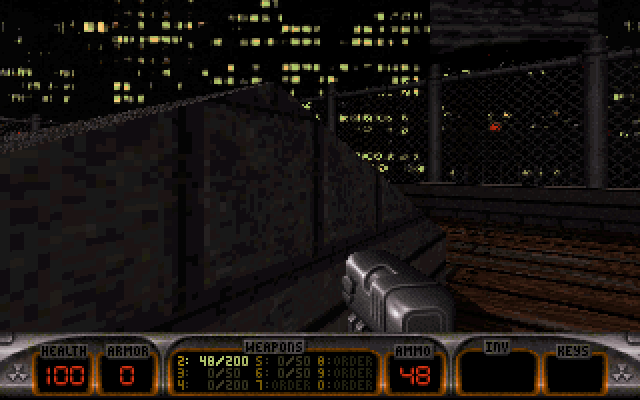
Doom taught players to fear the dark. Duke Nukem 3D, released three years later, taught them to enjoy blowing up a strip club and flushing a toilet just to see what would happen. Same genre, completely different attitude — and that attitude is a big part of why people still talk about it thirty years on.
Aliens Take Los Angeles, Duke Takes It Personally
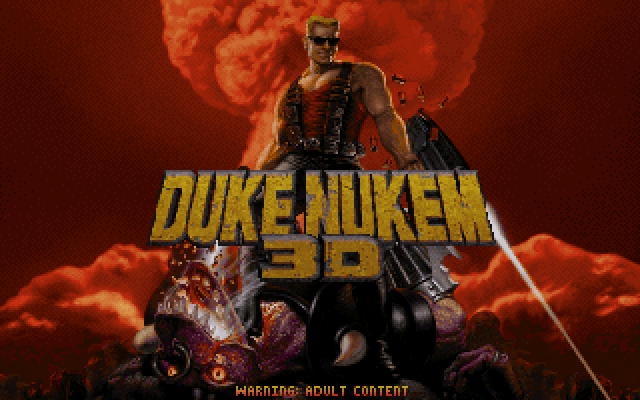
Few DOS games had as much personality as Duke Nukem 3D. Released in 1996 by 3D Realms, this first-person shooter put players in the shoes of the wisecracking, sunglasses-wearing Duke Nukem and set him loose in interactive, detailed environments unlike anything seen before. Aliens have invaded Los Angeles, and only Duke can stop them — a thin premise, deliberately so, built mainly to string together a series of increasingly outrageous set pieces.
What the Build Engine Let You Actually Do
What sets Duke Nukem 3D apart from its contemporaries isn’t just the combat, it’s the world. Duke Nukem 3D runs on the Build engine, which allowed for interactive environments that were revolutionary at the time — you can blow up walls, flush toilets, flip light switches, and interact with the environment in dozens of small ways that competing engines simply didn’t support. The environments feel real and lived-in: you fight through a movie theater, a strip club, a sewer system, and a military base, all rendered with impressive detail for 1996. This level of interactivity made the game feel alive in a way its competitors, however good their combat, never quite matched.
None of that interactivity is required to finish the game — you can walk past a working toilet or an intact vending machine without ever touching it — but the fact that it’s there at all, purely for the player’s amusement, says a lot about the design philosophy driving the whole project. 3D Realms was building a playground as much as a shooter.
An Arsenal Built for Personality, Not Just Damage
The weapons are memorable: a pistol, a shotgun, a chaingun cannon, RPG rockets, pipe bombs you can detonate remotely, a shrink ray that miniaturizes enemies, and the devastator, a rapid-fire rocket launcher. The Freeze Thrower freezes enemies solid so you can shatter them with a kick, which is exactly the kind of over-the-top touch that separates Duke’s arsenal from Doom’s more utilitarian one. Each weapon is genuinely useful and fun to use in its own right, not just a reskin of the last one.
Enemies Worth Knowing Before You Meet Them
The enemy design is inventive: pig cops, police officers mutated by aliens, Enforcers with jetpacks and chainguns, Assault Troopers that teleport and strafe, and the massive Battlelord boss that serves as the climax of the shareware episode. Assault Troopers in particular are worth learning early — their teleport-and-strafe pattern punishes players who stand still and return fire predictably, so treat them as a cue to keep moving rather than trade shots head-on.
Doom and Quake Never Tried This
Set against Doom, Duke Nukem 3D trades atmosphere and dread for humor and spectacle — Duke constantly delivers one-liners ripped from action movies, giving the game a swagger that Doom and Quake never attempted. Where Doom and Quake are about survival horror pacing, Duke Nukem 3D is closer to an action-movie parody you get to control, and the interactive environments give it a sense of place neither of id’s shooters was going for.
Does It Still Hold Up in 2026?
Duke Nukem 3D remains one of the most entertaining shooters of the DOS era. The humor, the interactive environments, and the sheer variety of the levels make it stand out even decades later. It is a product of its time in some uncomfortable ways too — a few of the jokes and environments haven’t aged gracefully, and modern players should go in aware of that. As a piece of gaming history, and as a genuinely fun game to actually play, it holds up remarkably well regardless. The three free shareware levels are also a genuinely fair sample of the full game’s identity, unlike some shareware episodes that hold back a game’s best ideas for the paid content — you get the humor, the interactivity, and a real boss fight without spending anything. It’s the kind of shareware episode that functions as a genuine advertisement for the full game rather than a truncated tease, which was exactly the point of the model in the first place — give players enough of the real thing that they want to pay for the rest, rather than a stripped-down preview that leaves them guessing at what the full game is actually like. Three levels sounds thin on paper, but they’re dense enough with content, secrets, and set pieces that the promise never feels hollow the way some shareware teasers do, and that generosity is part of why the shareware episode is still circulated, discussed, and played on its own merits today, decades after the full game became easy to buy outright.
If DOSBox is new territory for you, start with our DOSBox setup guide before going further. More legally free classics live in our free DOS games roundup.
Download the Shareware Episode
How to Run with DOSBox
- Install DOSBox if you haven’t already.
- Extract the files to a folder like
C:DUKE3D. - In DOSBox:
mount c C:DUKE3D→c:→duke3d.
Watch Gameplay
You might also like: