Two small Wisconsin brothers with a $40,000 Amiga role-playing game convinced John Carmack to hand over his engine. That sentence alone explains more about Heretic than any plot summary could. It isn’t just “Doom with a wizard hat” — it’s the game that proved id Software’s technology could be licensed out, remade, and improved by someone else’s team, and it set the template for how the entire genre would grow an inventory a year later.
If you’ve only heard Heretic described as a reskinned Doom, that undersells it. Corvus, the elven warrior-wizard you play, can look up and down, fly across chasms, swim through flooded corridors, and pull a healing potion out of his pack mid-fight — none of which Doom‘s marine could do. This piece covers where the game came from, what it actually changed, how to get it running cleanly today, and why it’s worth your time beyond nostalgia.
Raven Software’s unlikely path to id’s engine
Raven Software wasn’t an id Software spin-off or a hired contractor — it was an independent studio founded in Madison, Wisconsin in 1990 by brothers Brian and Steve Raffel. Their first game, the Amiga dungeon-crawler Black Crypt, was built on a shoestring budget and didn’t sell especially well. But it was well-reviewed, and it caught the attention of id Software co-founder John Romero.
Romero brought Raven in to build ShadowCaster (1993) using a modified Wolfenstein 3D engine that John Carmack had adapted for them. ShadowCaster did well enough — for Raven and for Strategic Simulations, its publisher — that id was willing to go further the next time. When Romero pitched a medieval, Dungeons & Dragons-flavored take on the still-unreleased Doom engine in late 1993, Raven was the team he had in mind to build it.
What id actually handed over
The deal wasn’t a simple license-and-walk-away arrangement. Raven got direct access to id Tech 1 — the Doom engine — while it was still being finished, plus real creative input from id’s own people. Carmack reportedly gave the project’s whole design brief in one line: build it like Doom, and add the fantasy flavor. Romero stayed the primary point of contact between the two studios throughout development, and by Raven’s own account the relationship was informal enough that Romero’s contributions included stocking their office with its first proper refrigerator. It’s a small detail, but it says something about how close-knit the id/Raven partnership actually was — this wasn’t an arm’s-length licensing contract, it was two teams that liked working together.
Brian Raffel has since pushed back on the idea that Heretic was conceived as “Doom reskinned.” His account is that the Dungeons & Dragons instincts came first, and the Doom engine was simply the best available tool to build the fantasy shooter Raven already wanted to make.
Timeline: the id–Raven collaboration
| Year | Milestone |
|---|---|
| 1990 | Raven Software founded by Brian and Steve Raffel in Madison, Wisconsin. |
| 1992 | Black Crypt ships on Amiga; well-reviewed, catches John Romero’s attention. |
| 1993 | ShadowCaster ships, built on a Carmack-modified Wolfenstein 3D engine licensed from id. |
| Late 1993 | Romero proposes a medieval-fantasy Doom-engine project to id; Raven is chosen to build it. |
| Dec 1994 | Heretic‘s shareware episode, “The City of the Damned,” ships. |
| 1995 | Hexen: Beyond Heretic follows, deepening the engine’s fantasy toolkit further. |
| Mar 1996 | Retail compilation Heretic: Shadow of the Serpent Riders adds two new episodes. |
| 1999 / 2008 | Source code released, later relicensed under GPL-2.0 — the reason modern ports exist. |
What Heretic actually changed from Doom
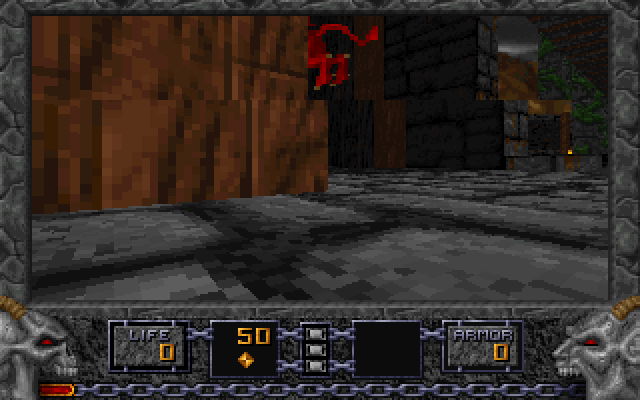
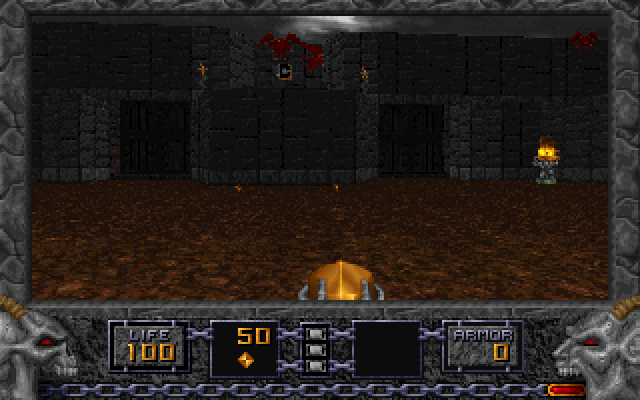
Play Heretic right after Doom and the differences are immediate, not cosmetic. The most important one barely gets mentioned in most write-ups: Heretic gave first-person shooters a real-time inventory, something the genre had never had to think about before. You pick up items in the world, cycle through them with a keypress, and use them on the fly without pausing the action — the direct ancestor of every “hotbar” you’ve used in a shooter since.
- Look up and down — Doom‘s auto-aim meant you never needed to; Heretic‘s flying enemies and vertical level geometry mean you do.
- Flight — the Wings of Wrath item lets you soar over lava, chasms, and enemy fire for a limited time.
- Swimming — several levels flood entire sections, and Corvus can dive and swim rather than just wade.
- Mana instead of bullets — two mana pools (blue and green) fuel your weapons, forcing you to balance which arsenal you lean on.
- Tome of Power — a consumable that temporarily upgrades whichever weapon you’re holding into a stronger secondary form, well before “alt-fire” was standard.
- Morph Ovum and Chaos Device — offense and escape tools with no Doom equivalent: one turns an enemy into a harmless chicken, the other teleports you to safety.
Heretic vs Doom, side by side
| Feature | Doom (1993) | Heretic (1994) |
|---|---|---|
| Vertical aiming | Auto-aim, no look up/down | Manual look up/down |
| Traversal | Ground movement only | Flight and swimming |
| Item use | Picked up automatically, passive | Real-time inventory, used on demand |
| Ammo model | Per-weapon ammo types | Shared mana pools (blue/green) |
| Weapon upgrades | None | Tome of Power secondary modes |
| Setting | Sci-fi/horror, Mars and Hell | Dark fantasy, Serpent Riders’ realms |
The world: dark fantasy, not just re-textured Mars
Corvus’s story sits inside the “Serpent Riders” trilogy that continues in Hexen and Hexen II. Your target is D’Sparil, one of the three Serpent Riders, and the original release spans three episodes, opening with “The City of the Damned.” The 1996 retail compilation, Shadow of the Serpent Riders, adds two further episodes — The Ossuary and The Stagnant Demesne — plus three bonus levels that were originally hidden behind cheat codes.
Level design leans harder into verticality than Doom ever did — flooded crypts, floating platforms, and windswept ossuaries replace Doom‘s tech-base corridors and lava caverns. Because Corvus can fly and swim, Raven’s level designers built maps that actually punish a player who ignores the third dimension, which is a meaningfully different design problem than anything id’s own levels were solving at the time.
Setting Up Corvus’s Flight and Swim Physics in DOSBox
If you’re running the original DOS executable rather than a source port, a few settings matter more for Heretic than for a generic DOS game:
- Give it real conventional memory. Like Doom, Heretic is picky about free base memory; a clean DOSBox config with minimal loaded drivers avoids “not enough memory” errors on startup.
- Set CPU cycles generously. The engine handles flight and swimming with extra physics checks per frame, so a cycle count that feels fine for flatter DOS games can still chug during vertical combat. Push cycles up if you see slowdown near water or open shafts.
- Configure sound explicitly. Heretic supports Sound Blaster digital effects and General MIDI/OPL music separately — make sure both are set in the in-game setup menu, not just DOSBox’s default Sound Blaster emulation, or you’ll get effects with no score.
- Mouse look isn’t native. The original DOS version binds looking up/down to keys, not the mouse’s Y-axis — don’t assume mouse-look works out of the box the way it might in a modern port.
- Save often, and outside of combat. The inventory-and-mana balancing act means a bad Tome of Power timing can chain into a death spiral fast; frequent saves protect you from having to replay a whole level over a single item misuse.
Early-game tips for new players
- Hoard your Tomes of Power for real threats. Using one on a trash mob wastes a limited resource — save it for Disciples of D’Sparil or tight corridors full of Gargoyles.
- Learn to read the two mana bars. Blue and green mana feed different weapons; running one dry mid-fight forces a weapon swap you didn’t plan for, so keep an eye on both, not just your current gun’s pool.
- Don’t ignore the Elven Wand. It’s your starting weapon and feels weak, but it never runs out of ammo — it’s your fallback when both mana pools are empty, not a weapon to abandon entirely.
- Use flight to scout, not just to cross gaps. Wings of Wrath let you fly over a level layout before committing to a route, which matters a lot in the more maze-like later episodes.
- Keep a Chaos Device in reserve at all times. It’s your emergency escape from an ambush — treat it like a fire extinguisher, not a convenience item.
- Check corners and pools for hidden mana and items. The vertical, water-heavy level design hides more secrets off the main path than Doom‘s levels typically did.
Questions About Raven’s Doom-Engine Detour
Is Heretic the same engine as Doom?
Yes — it’s a licensed and modified version of id Tech 1, the engine id Software built for Doom. Raven Software added the inventory system, look up/down, flight, and swimming on top of it.
Who developed and published Heretic?
Raven Software developed it; id Software published it, with GT Interactive handling distribution for the DOS, Mac OS, and RISC OS versions.
Is Heretic a prequel or sequel to Hexen?
Heretic comes first. Hexen: Beyond Heretic (1995) is the direct follow-up, and both belong to the “Serpent Riders” storyline that concludes with Hexen II.
Can I still play Heretic on a modern PC?
Yes, through source ports like Chocolate Heretic, Crispy Heretic, or GZDoom, through DOSBox running the original executable, or via Bethesda’s official 2025 re-release with the Faith Renewed expansion.
Was Heretic just a Doom clone?
Not really — it shared engine code with Doom but introduced mechanics (real-time inventory, vertical aiming, flight, mana-based weapon upgrades) that Doom never had, several of which became genre standards afterward.
Legacy: what Heretic’s engine work led to
The inventory system and the id/Raven working relationship didn’t end with one game. Hexen: Beyond Heretic (1995) built directly on Heretic‘s engine work, adding hub-based level structures and character classes. Hexen II later moved the series onto the Quake engine, extending the same id-Raven partnership into 3D. On the business side, Heretic sold over 500,000 copies on its own, and combined sales with Hexen reportedly approached a million units within a few years — proof that licensing id’s technology to an outside studio was a commercial success, not just a favor between friends.
id released Heretic‘s source code in 1999 and later relicensed it under GPL-2.0, which is why the game is still actively playable today through community source ports rather than just DOSBox. Chocolate Heretic aims to reproduce the original DOS executable’s behavior as closely as possible, Crispy Heretic builds on that with higher resolutions and quality-of-life fixes while staying faithful, and GZDoom goes further still with hardware-accelerated rendering and mod support. Bethesda also put out an official re-release with a new expansion in 2025, which is a reasonable sign that the “Doom but fantasy” idea Romero pitched in 1993 still has an audience worth serving.
For more on the engine Heretic was built from, see our look back at Doom (1993). If you’re setting this up for the first time, our DOSBox setup guide covers the general configuration this article builds on. And if fantasy shooters from this era are your thing, Rise of the Triad (1994) is worth a look for a very different take on the same period.
You might also like: