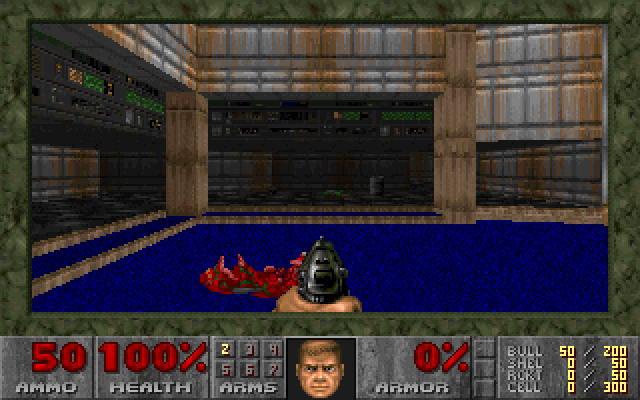
Nobody at id Software expected to change how software got sold. In December 1993, a four-person Texas studio uploaded a free first episode of its new game to a handful of FTP servers and let strangers copy it for each other — no ad budget, no retail shelf space, no publisher marketing push. Within weeks, Doom had spread across college networks and workplace hard drives faster than any IT department could stop it, and the company that gave away a third of its own product for free ended up defining the shooter genre for the next thirty years. The real story of Doom isn’t just the demons and the shotgun — it’s a case study in distribution, engineering, and what happens when you hand players the tools to take a game apart.
From Wolfenstein to Something Faster
id Software was founded on February 1, 1991, by programmers John Carmack and John Romero, designer Tom Hall, and artist Adrian Carmack. The studio had already reshaped PC gaming once, with 1992’s Wolfenstein 3D proving that fast, first-person action was viable on consumer DOS hardware. Doom was meant to go further. Design credit on the finished game went to Romero and Hall, with Sandy Petersen brought on midway through development to help finish level design after Hall’s original “Doom Bible” design document was scrapped for something more chaotic and fast-paced. Kevin Cloud worked alongside Adrian Carmack on art, and composer Bobby Prince built a heavy-metal-inflected soundtrack that matched the game’s aggression far better than anything typical of the adventure and strategy titles dominating shareware catalogs at the time.
The Engine: Why Doom Wasn’t Just a Faster Wolfenstein
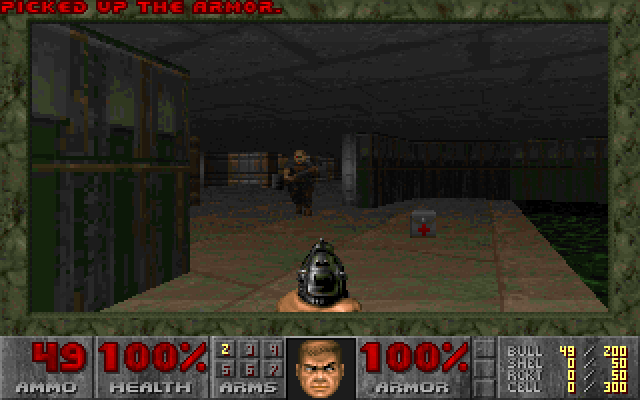
Wolfenstein 3D rendered a world of uniform-height walls on a rigid grid — impressive for 1992, but geometrically simple. John Carmack’s engine for Doom used binary space partitioning (BSP), a technique that pre-processed level geometry into a tree structure so the game could quickly determine what was visible from any given viewpoint without wastefully rendering hidden areas. That single change unlocked things Wolfenstein’s engine couldn’t do: rooms with varying floor and ceiling heights, diagonal and irregular walls instead of grid-locked ones, and dynamic lighting that could flicker, pulse, or dim by sector. Because it still used 2D level data to fake a 3D-looking world rather than true 3D geometry, the industry settled on calling this approach “2.5D” — a term that stuck specifically because of Doom’s influence, even though later id titles like Quake moved to genuine 3D. The practical result for players in 1993 was a game that felt architecturally alive in a way nothing on DOS had before: tight corridors opened into vast, oddly-shaped caverns, and elevation itself became a gameplay element instead of a flat backdrop.
Giving Away Nine Levels: The Shareware Gamble
The commercial strategy is arguably as historically significant as the engine. Doom’s full release consisted of three nine-level episodes, but only the first — “Knee-Deep in the Dead,” set on the Phobos moon base — was distributed as shareware, completely free, with explicit permission (even encouragement) for people to copy it and pass it along to friends, BBSs, and each other’s floppy disks. The other two episodes were sold directly by id via mail order, cutting traditional publishers and retail out of the transaction almost entirely. This wasn’t charity; it was a calculated bet that a genuinely excellent free product would sell itself better than any box on a store shelf could, and it paid off spectacularly — Doom is widely credited with pushing shareware from a niche budget-software gimmick into a mainstream distribution model that other studios scrambled to copy for the rest of the decade. Because Knee-Deep in the Dead is the episode nearly everyone who played Doom in the ’90s actually experienced, its specific level design vocabulary — tech-base corridors, secret rooms behind unmarked walls, the slow reveal of the Phobos base’s true horror — became the template most people still picture when they think of “classic Doom,” even though two more episodes existed.
Playing It Today: Weapons, Difficulty, and Feel
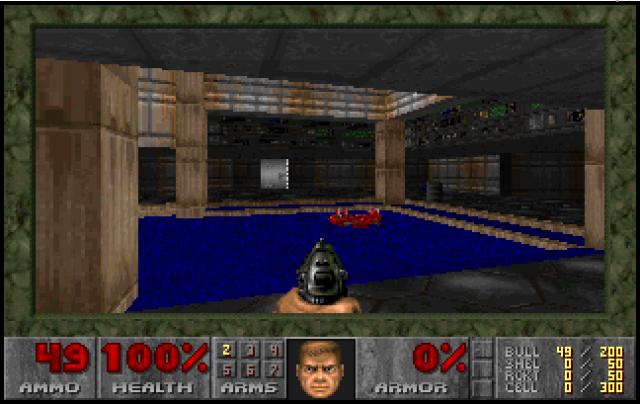
Doom’s arsenal is deliberately a ladder of escalating satisfaction: the starting pistol is intentionally weak to make every subsequent pickup feel like a real upgrade, the shotgun remains the game’s signature crowd-control tool at close range, and the chaingun trades accuracy for sustained damage against tougher enemies. The rocket launcher introduces splash damage and the very real risk of hurting yourself in tight corridors, and the BFG9000 is reserved for the game’s most dangerous encounters. Difficulty selection at the start of a session meaningfully changes enemy count and aggression rather than just adjusting damage numbers, so newcomers should not assume the default setting is the “real” experience — Doom was built with a spread of skill levels in mind from the outset. Movement itself is faster and looser than most players expect from a game this old; Doom rewards constant motion (strafing around enemy fire rather than trading hits head-on) far more than it resembles the slower, cover-based shooters that followed a decade later.
Making Sure You’re Actually Running Knee-Deep in the Dead
Doom is CPU-hungry by 1993 shareware standards, so a cycles setting around 15,000–20,000 (or DOSBox’s “max” auto-detect) is typically needed for smooth movement, especially in open areas with long sightlines where the BSP engine has more geometry to render. For audio, configure DOSBox’s Sound Blaster emulation (Sound Blaster 16 at the standard I/O address 220, IRQ 7, DMA 1) before launching Doom’s setup utility, then run the in-game or bundled DOOM setup program to select Sound Blaster for both sound effects and music rather than leaving it on the default PC speaker or AdLib, both of which strip out most of Bobby Prince’s score. Players running the shareware version specifically should point DOSBox at the correct DOOM1.WAD file, since later commercial or freeware “Doom” releases substitute the full DOOM.WAD and will not play Knee-Deep in the Dead’s specific shareware level order without the right data file.
Five Tips for New and Returning Players
- Strafe-run rather than walk into open rooms. Doom’s monsters have limited turning and reaction windows compared to modern shooters; constant lateral movement avoids far more damage than standing still and shooting.
- Save before opening unmarked doors. Several of Knee-Deep in the Dead’s rooms are ambushes triggered by walking into specific trigger zones — quicksaving liberally costs nothing and prevents unfair deaths.
- Conserve the rocket launcher for open spaces. Its splash damage can kill the player at close range; save it for corridors and large rooms rather than tight closets.
- Search walls that look slightly different in texture. Secret areas are usually telegraphed by a subtly misaligned or discolored wall panel rather than being completely invisible.
- Don’t ignore the automap. Doom’s levels branch and loop in ways that are easy to lose track of; the automap key reveals explored areas and is essential for finding the last locked door or switch.
The WAD Revolution: How Players Rebuilt the Game Themselves
What separates Doom from most other hit games of its era is what happened after release. Doom stored its levels, textures, and sounds in a container format called a WAD file (an acronym fans have long joked stands for “Where’s All the Data?”), and Carmack — an outspoken advocate of letting people build on each other’s work — deliberately kept the format simple enough to reverse-engineer. Barely six weeks after the shareware release, on January 26, 1994, Brendon Wyber published the first version of the Doom Editing Utility (DEU), a level editor built by fans from a specification independently reverse-engineered by Matt Fell, with Raphaël Quinet leading development. That tool made it possible for anyone with patience to build entirely new Doom levels, and a fan named Jeffrey Bird is generally credited with releasing the first fully custom WAD, “Origwad,” in March 1994. Because so much of Doom’s actual combat behavior — weapon damage, enemy stats — was hard-coded into the executable rather than stored in the WAD, a separate tool called DeHackEd, created by Greg Lewis, later let modders patch the executable itself for total conversions that changed gameplay, not just level layouts. The result was a modding ecosystem that predates the word “modding” as we use it today, distributed first through bulletin board systems and shareware CD compilations, then through early internet FTP archives — and it never really stopped. Community-made WADs are still released regularly more than three decades later.
Legacy: What Doom Actually Changed
It’s tempting to credit Doom simply with popularizing first-person shooters, but Wolfenstein 3D already did that a year earlier. Doom’s more specific legacy is threefold: it proved BSP-based engines could render far more complex, vertically interesting spaces than a grid-based one; it proved shareware distribution could carry a premium product to mainstream success without traditional retail; and it proved that giving players real editing tools created a self-sustaining community that would keep a game commercially and culturally relevant decades past its original release window. Its multiplayer deathmatch mode, while not the first competitive multiplayer game ever made, is widely credited as the moment competitive PC gaming became a mainstream expectation rather than a novelty. Fans of the genre’s other early landmarks can trace direct lines from Doom’s engine and design choices to later id titles and competitors alike; the shareware boom it helped ignite is visible across the era’s catalog, including studios like Apogee and their catalog of freeware and shareware hits, as well as spiritual successors like Rise of the Triad, which shipped from a studio closely tied to id’s own history.
You might also like: