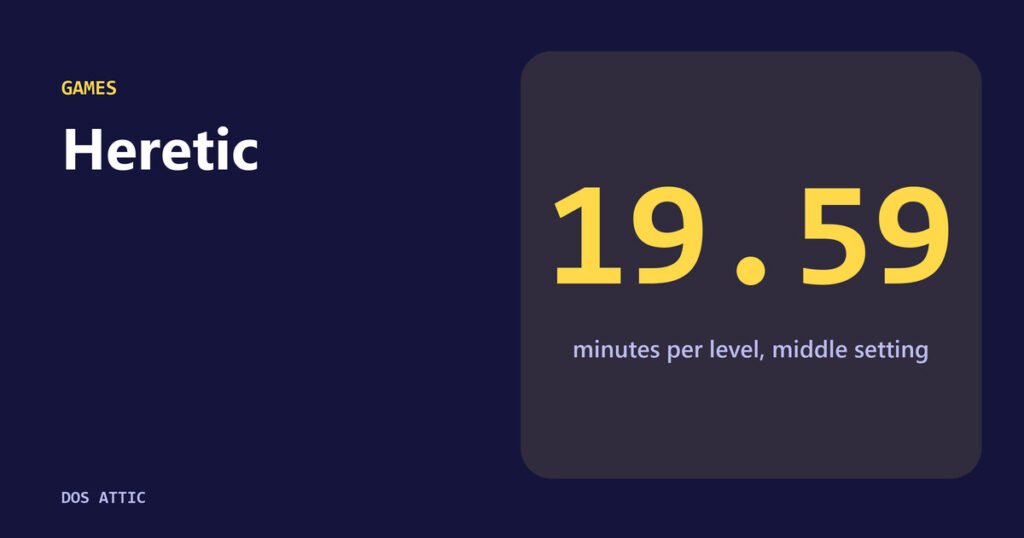
Computer Gaming World’s reviewer timed it. On the middle difficulty setting, a level of Heretic took an average of 19.59 minutes to clear, which the March 1995 review called quite a bit longer than a level of Doom or Doom II. That number says more about Raven Software’s game than its reputation as Doom in a wizard’s hat. Heretic kept id’s engine and changed the pace of play with bigger levels, a hero who could fly and look up and down, and an inventory you used in the middle of a fight.
You can buy the game today. Steam sells it inside Heretic + Hexen, a 2025 re-release, and the store footnote says the original DOS versions of Heretic: Shadow of the Serpent Riders, Hexen: Beyond Heretic and Hexen: Deathkings of the Dark Citadel are included. GOG’s listing carries the same bundle and the same footnote,.
Who built it, and on what
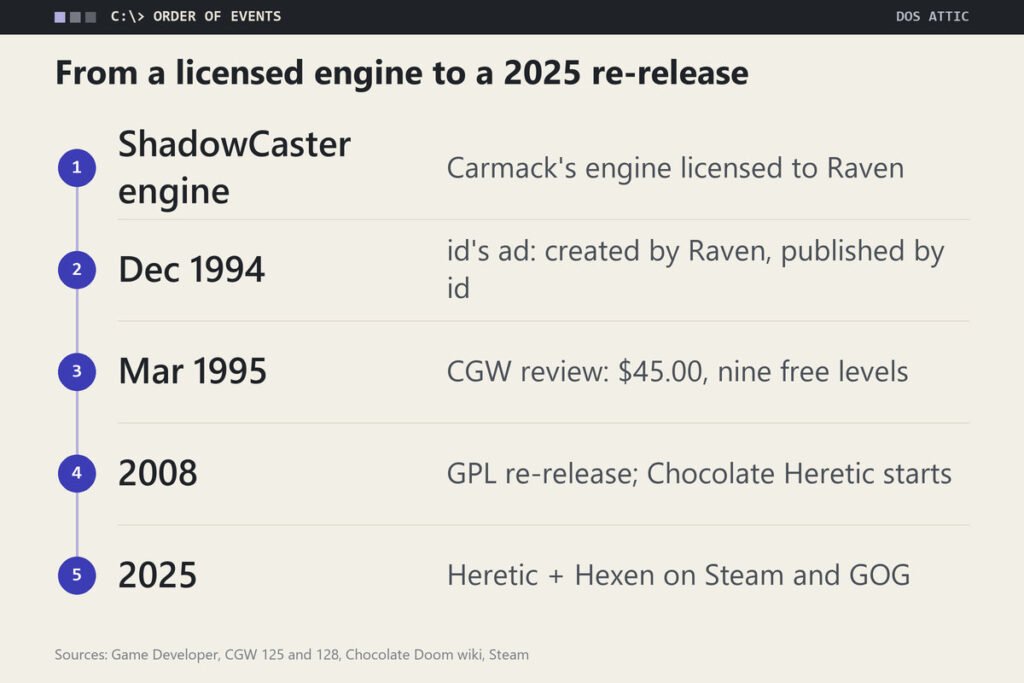
The magazine coverage is clear about the division of labor. CGW’s December 1994 buyer’s guide, which previewed Heretic as a Raven game, says it was designed in consultation with id Software and uses the actual Doom engine. id’s ad in the same issue says the game was created by Raven and published by id, and it sold the box under the line “First there was DOOM. Now comes HERETIC.” The March 1995 review makes the same point from the other side: it would be easy to dismiss Heretic as another Doom game from id that id did not even create, but by turning over its 3D engine to Raven, id had produced an exemplary heir to the name.
The engine had a history of being shared. Game Developer’s January 1994 feature reports that John Carmack wrote an engine that id would license to Raven for the game that became ShadowCaster, one that allowed objects taller than the player, sloping floors and walls at angles other than 90 degrees. The same piece says id’s next engine would have true three-dimensional perspective, the subject of Quake’s jump to full 3D.
The feature also states id’s business plan outright: its growth would come from working with other small developers and licensors. Heretic fits that plan: an outside team, id’s technology and id’s name on the box.
What the Sidhe elf could do that Doom’s marine could not
CGW’s reviewer sets the scene: you are the last of the Sidhe, a magic-wielding elf sworn to destroy D’Sparil, the Serpent Rider of the Abyss, whose magic burned the Elders of your people and let his demonic creatures devour them. The review counts that cohesive storyline as the first of Heretic’s improvements over its forebears: Doom was supposedly science fiction, but its futuristic feel never convinced next to the Dante-like levels, while Heretic is fantasy from start to finish, down to a poster by the fantasy artist Brom on the back of the fold-up manual. The Steam page for the 2025 re-release credits Heretic and Hexen with introducing inventory systems and vertical aiming, and the review of the first game lists the same tricks. Three of them changed how a level was played.
Looking up and down
The review says the Wings of Wrath show how id’s engine was improved, because you can not only fly but also switch your viewing angle to look up and down. id’s ad promised the same in a few words, “Look all around, even up and down!” The reviewer called floating silently above and behind a deathmatch opponent a dark ecstasy.
Flight, for a limited time
The Wings of Wrath let you take flight for a spell, and the review adds that you cannot carry them into the next level. The review adds that the Wings come in handy when crossing the huge canyons and waterfalls of the game’s world, so flight works as a resource to spend on a level, not a permanent way of moving.
An inventory you use mid-fight
Apart from Crystal Vials, which add to your health instantly, the review counts 14 artifacts to be collected and used when you deem the moment right. Tomes of Power dramatically increase the firepower of your weapons, Quartz Flasks and Mystic Urns restore health, Silver Shields and Spirit Shields give armor for one level only, and the Shadowsphere provides near-invisibility. The Chaos Device teleports you back to the start of the level in an emergency, and the Morph Ovum turns opponents into chickens.
Weapons that echo Doom’s and weapons that do not
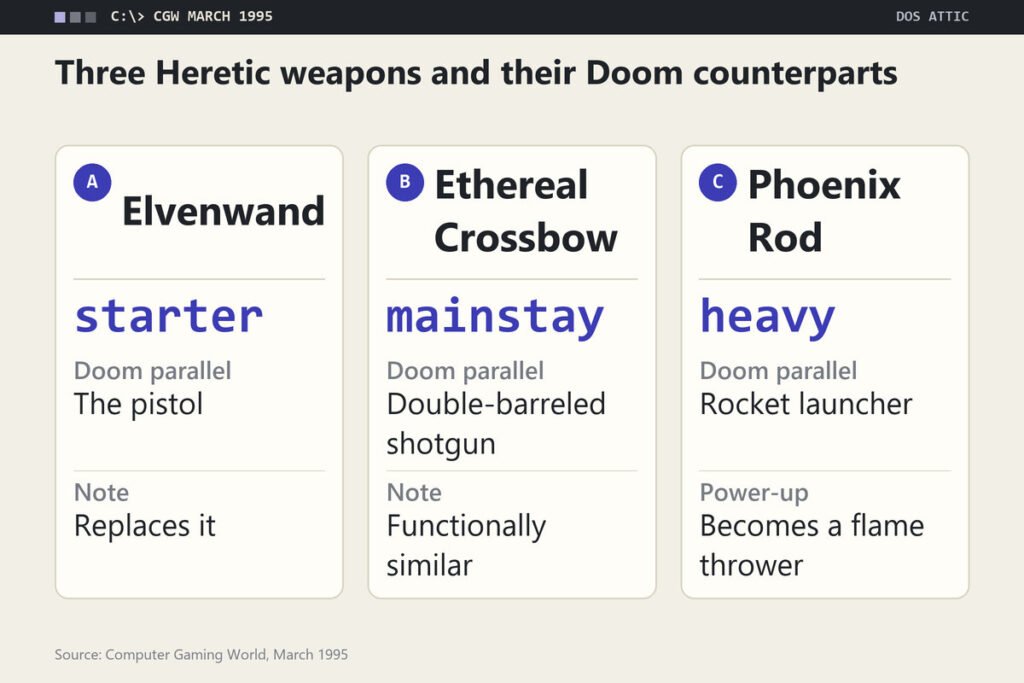
The review maps the seven weapons onto the ones Doom players knew, with the caveat that the correspondence is general, not exact.
| Heretic weapon | What CGW compared it to |
|---|---|
| Elvenwand | Replaces the pistol |
| Ethereal Crossbow | Functionally similar to Doom II’s double-barreled shotgun; probably your mainstay |
| Dragon Claw | No equivalent |
| Gauntlets of the Necromancer | No equivalent; a close-range electrical storm |
| Firemace | A magical machine gun, found only rarely |
| Hellstaff | Very much like the plasma gun |
| Phoenix Rod | Basically a rocket launcher; a flame thrower in power-up mode |
Power-up mode is the part with no Doom counterpart. A Tome of Power changes what a weapon does, and a caption in the review notes that the Firemace with a Tome will kill almost anything with a single shot. The review adds that the solo game plays very differently, perhaps because the monsters have no rapid-fire weapons, so charging ahead, which meant suicide in Doom, is sometimes exactly right.
Levels built to be crossed more slowly
Heretic’s levels are big, in the reviewer’s words much more like Doom II than the original, with less of the tricks-and-traps design that seemed contrived in the sequel. The medieval castles of the first nine levels are full of windows and openings that look out over wide spaces, which the review thought made wonderful killing zones in deathmatch.
The monsters teach the same lesson, and the reviewer’s advice reads like a field guide. Gargoyles fly, so look up when you enter a room with a high ceiling. Sabreclaws are quick but fight only hand to hand, so the crossbow’s knock-back works against them. Weredragons breathe fire but are slow, so fight them in the open where you can sidestep. Ophidians fire a delayed second shot, so dodging only the first attack gets you burned. Disciples of D’Sparil float and cast three missiles in a spread, and the reviewer learned to cast the Tome of Power the moment he heard their chanting. Iron Liches throw a variety of attacks, including tornadoes that pick you up and toss you around, and the reviewer found the Maulotaurs more overwhelming than any monster since the first Hell Barons. Holding down the fire button with the Hellstaff is tempting, but you cannot see incoming projectiles while you do.
Ice, a cathedral and a slow average
The review singles out the Cathedral (E1L6) and the Ice Grotto (E2L4) for their looks. The ice slows your movement, so you must sidestep sooner than you are used to. Stopping to catch your breath after running past a brigade of Disciples and Undead Warriors is part of the pace, and the 19.59-minute average on the middle setting is the measured result.
Nine levels free, the rest by phone
The shareware version contains the first nine levels, the reviewer wrote, and was probably floating around a bulletin board near you. The registered episodes, Hell’s Maw and The Dome of D’Sparil, required calling id. Three more levels are hidden, one in each episode, and the review says they are listed as the ninth level of each episode for players who warp there with cheat keys.
Deathmatch with a chicken factor
Network play was still limited to four players. The review says it was more fun than ever because of what it calls the Chicken factor: it does not matter if you have 100 percent health, the Phoenix Rod and a 200 percent Spirit Shield once you have been turned into a chicken. Deathmatch 2.0 rules applied, so suicides counted against your frag total and objects reappeared after being collected.
Pricing set by id
id’s ad in the December 1994 issue asked $40 plus $5 for shipping, on CD-ROM or 3.5-inch disks, with a toll-free number. The review’s box lists the price as $45.00 on floppy, the two figures agreeing once shipping is added. The box calls for a 486 or better with 4 MB of RAM, VGA and 14 MB of free disk space, supports most major sound cards, allows one to four players by modem and network, and carries no copy protection. The review’s verdict was that it was an excellent game and a candidate for the top ten of 1995, though a player already worn out on Doom might see more of the same, and it noted that the game crashes occasionally on various systems.
Source ports, and what they changed
The code outlived the box. The Chocolate Doom project’s wiki says work on Chocolate Heretic began in 2008, immediately after the Raven source code licensing issue was resolved by the re-release of the Heretic and Hexen sources under the GNU GPL, and that it is unique in supporting the HHE patch format, the Heretic equivalent of Dehacked. The 2025 Steam and GOG release adds widescreen support, a toggle between original and enhanced game balance, engine fixes for bugs in the original versions and two new episodes, according to the store page, while keeping the original DOS versions alongside. The page counts 117 campaign maps and 120 deathmatch maps across Heretic and Hexen. Where CGW noted four-player deathmatch, it lists online play for up to 16 players and local split screen for up to 8.
Between the two, the way to play depends on what you want. A source port gives you the 1994 behavior on a modern system, and the store release gives you the original files plus conveniences. The engine all of them descend from belongs to Doom and the free episode that carried it.
Do you need Doom to play Heretic?
No. CGW listed Heretic as its own product, $45.00 on floppy with its own requirements, and id’s ad sold it as a separate purchase on CD-ROM or disks. It uses the Doom engine, not Doom’s files. The 2025 Steam and GOG bundles list Heretic, Hexen and their expansions among the included games and mention no Doom product, so the original DOS versions inside them stand on their own. What the two games share is the way the engine works, which is why the controls and the deathmatch rules feel familiar.