What if a platformer never let you jump?
By 1993, Commander Keen and its imitators had more or less standardized what a DOS platformer looked like: run, jump, dodge, repeat. Jetpack, developed by Adam Pedersen and published as shareware by Software Creations, throws that template out. There’s no jumping here at all – you strap on a jetpack and fly freely around each level, and that single change gives the whole game a completely different rhythm from its run-and-jump contemporaries.
Software Creations released Jetpack as part of its growing early-90s shareware catalog, and while it never reached Commander Keen levels of fame, it built a genuinely dedicated following. A lot of that staying power came down to one feature that a lot of shareware games of the era didn’t bother with: a real level editor, deep enough that players kept designing and trading their own boards long after they’d cleared the ones that shipped with the game.
Fuel, gems, and razor-thin corridors
Each level asks you to collect every gem scattered across a grid of rooms while avoiding patrolling monsters and environmental hazards, then reach the exit before your fuel runs dry. Your jetpack can fly in any direction, but fuel is a hard limit, not a soft inconvenience – you’re constantly weighing the efficient route against the route that happens to pass fuel canisters, and the two rarely line up perfectly.
Precision matters just as much as speed. Corridors are often only a pixel or two wider than your character, and monster patrol patterns are timed tightly enough that careless flying gets punished immediately. It’s a game that rewards planning a route in your head before committing to it, closer to a puzzle game wearing a platformer’s clothes than a straightforward action title.
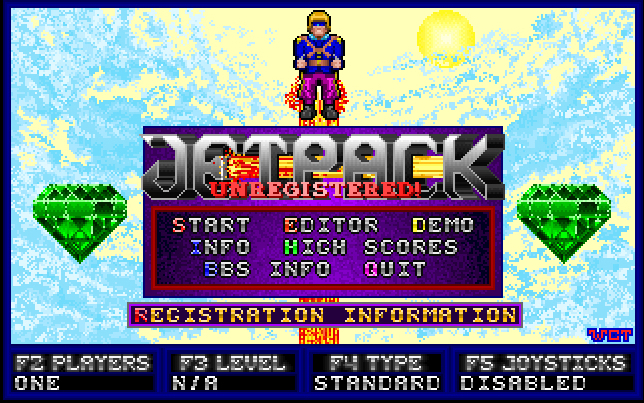
The presentation is simple, blocky VGA tile graphics with a straightforward interface, but it does its job without getting in the way. Jetpack was never trying to be a visual showcase; the appeal is entirely in the moment-to-moment decision-making of route planning under a ticking fuel clock, and the game is confident enough in that loop not to dress it up with much else.
Before you burn through your fuel
- Scout a level’s layout before collecting anything if you can afford to – knowing where every fuel canister sits changes which gems are actually safe to grab first.
- Hug walls when flying through monster patrol zones; most patrol patterns have a predictable blind spot near the edges of a room.
- Don’t panic-fly when fuel gets low. A slow, deliberate glide toward the nearest canister burns less fuel than a frantic dash.
- Save custom or harder levels for after you’ve built up a feel for the base fuel economy – user-made boards are often far less forgiving about wasted fuel than the original shareware set.
A different kind of platformer
Set next to Commander Keen or Duke Nukum’s early platforming outings, both of which lean on precise jump timing and enemy patterns you memorize through repetition, Jetpack’s free-flight movement is the clear differentiator – those games are about momentum and timing jumps, while Jetpack is about managing a resource in three dimensions of movement instead of two. It scratches a different itch, closer at times to a resource-management puzzle than to a straightforward action platformer, and it’s aged into something of a hidden gem because of that difference rather than in spite of it.
The level editor is genuinely the game’s best feature and the reason it’s worth downloading today over just watching a video of it. My honest criticism: the base campaign is fairly short and the difficulty curve is uneven, spiking hard in a few specific levels before leveling back out. But between the community-made boards still floating around online and the satisfaction of nailing a tight fuel-efficient route, there’s more here than the shareware episode alone suggests.
It’s also worth noting how well the core idea has aged compared to some of its run-and-jump peers. A lot of early-90s shareware platformers lean on twitch reflexes that feel dated today; Jetpack leans on spatial reasoning and resource planning instead, and that kind of puzzle-first design tends to hold up much better decades later than pure reflex challenges do. If you enjoy the fuel-and-route puzzle of it, it’s genuinely worth seeking out some of the fan-made level packs once you’ve cleared the shareware set, since the difficulty and creativity in the community boards can go well beyond anything Pedersen shipped in the original release.
Grabbing the shareware release
Jetpack is free to download and doesn’t require any digging through sketchy mirrors. If you haven’t set up DOSBox before, our setup guide walks through the basics, and our roundup of free DOS games has more shareware picks in a similar spirit.
Tuning DOSBox for free-flight movement
Extract the archive into a folder such as C:\GAMES\JETPACK, then in DOSBox run mount c C:\GAMES\JETPACK, switch to the drive with c:, and start the EXE. Flight-based movement is particularly sensitive to DOSBox’s cycles setting – too high and the jetpack feels twitchy and overshoots every turn, too low and it feels sluggish and unresponsive. It’s worth spending a few minutes nudging the cycle count up and down in a low-stakes early level until the handling feels natural; our DOSBox setup guide covers exactly how to do that before you spend an evening blaming the level design for what’s actually a cycles problem.
See the Jetpack in Action
You might also like: