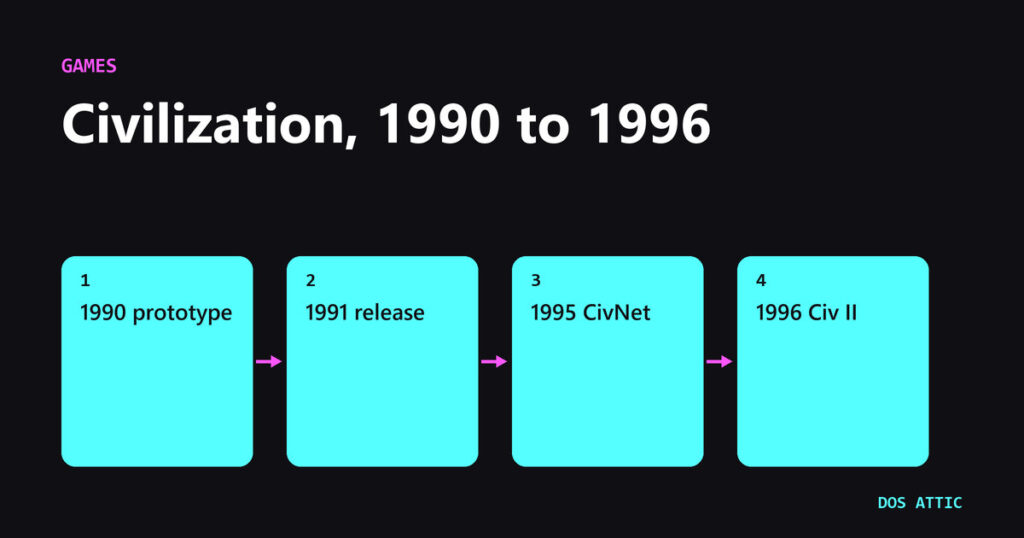
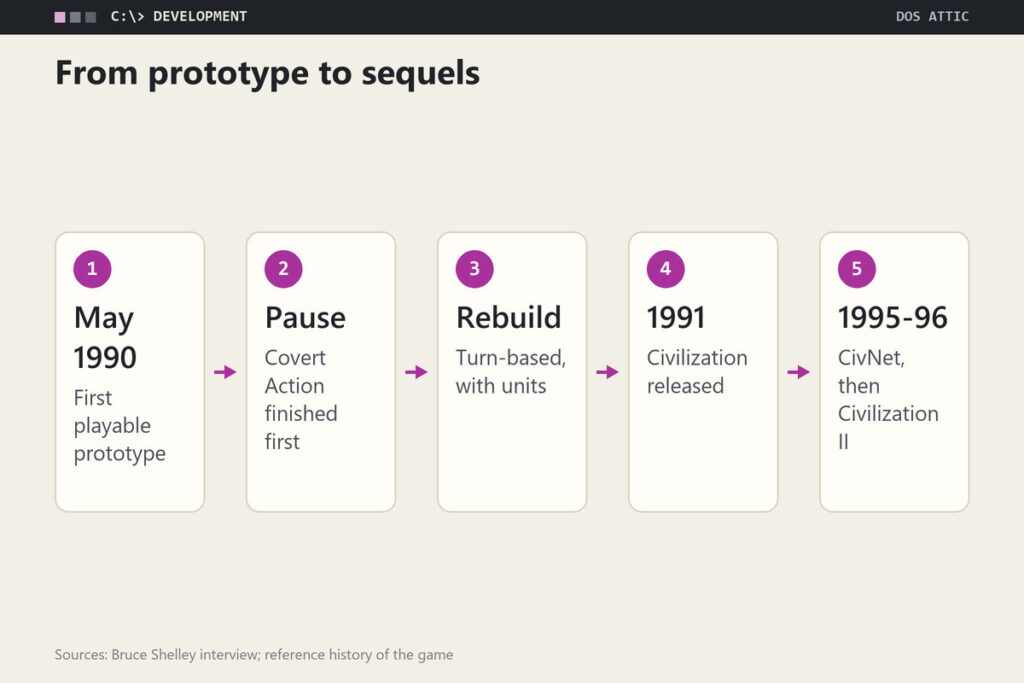
In May 1990, Sid Meier handed his design partner Bruce Shelley a 5¼-inch floppy disk. Shelley recalls it as the first playable prototype of what became Civilization, and he believes he was the second person ever to play it, after Meier himself (Shelley’s interview in the Civilization Chronicles). A year and a half later, Computer Gaming World was describing a beta of the finished game as the kind of title you stay up until four in the morning playing. Most accounts of Civilization begin with the board game of the same name. This one starts with the floppy disk, because the two sources closest to the work, a designer’s recollection and a magazine preview, say more about how the game works than its title does.
More Than a Name: Cards Became a Tree
The Strong National Museum of Play, which inducted the game into its World Video Game Hall of Fame in 2022, describes it as steeped in the tradition of strategy board games from companies such as Avalon Hill, including one called Civilization from 1980 (The Strong’s entry). The reference history of the game adds the specifics: British designer Francis Tresham released that board game in 1980 through his company Hartland Trefoil, and Avalon Hill obtained US rights in 1981 (development history). At least two designers tried to computerize it before 1990. Danielle Bunten Berry planned to after M.U.L.E. in 1983 and again after The Seven Cities of Gold in 1985, and Don Daglow began a version in 1987 before leaving for an executive job. Neither finished.
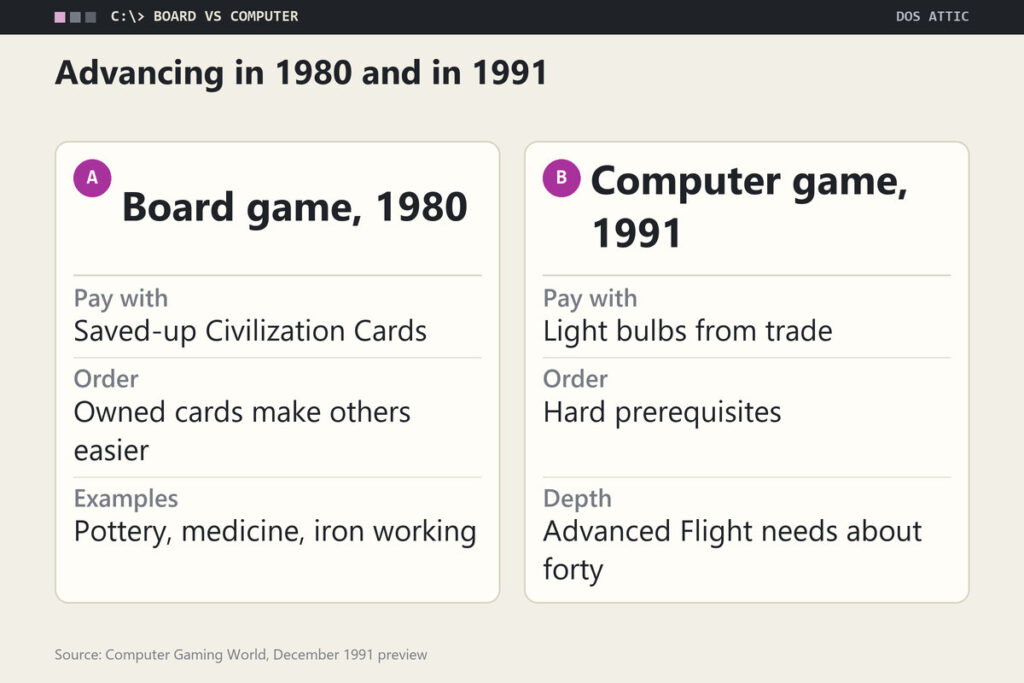
The most useful comparison comes from the time. The December 1991 preview in Computer Gaming World says that advancing one’s civilization is one of the few ways the computer game compares to the Avalon Hill board game, and it spells out how the two systems differ (CGW issue 89).
| What advancing means | Board game (1980) | Computer game (1991) |
|---|---|---|
| How you pay | Save up to buy Civilization Cards such as pottery, medicine and iron working | Spend light bulbs, the research share of a city’s trade |
| Ordering | Owning some cards makes acquiring others easier | Specific prerequisites must be met before higher technologies open |
| Cost and depth | No cost curve described | Each discovery costs more than the last; Advanced Flight needs about forty earlier discoveries |
Read side by side, the board game supplies a vocabulary and the computer game supplies a rule set. Cards that merely make later purchases easier became a hard tree with prerequisites and a rising price. That change is the biggest design step between the two, and it shows the board game’s influence ran deeper than the title: its card ladder survived, and the computer game made it strict.
Four Games Behind One Disk
Shelley’s interview gives the influences as he remembers them. Before Civilization appeared on his radar, Meier asked him to list ten things about the game Empire that he would change or add, research Shelley understood to feed Meier’s thinking. The big influences, in his recollection, were the experience of making Railroad Tycoon, SimCity, Empire and perhaps Populous. The reference history records a wrinkle in that anecdote: Meier asked for ten and Shelley gave him twelve.
Shelley adds that many elements of the final game were already in the May 1990 prototype and that he and Meier used the same iterative method of designing by playing that they had used on Railroad Tycoon and Covert Action. That method explains the game’s reputation for feeling tuned. It was built by playing it until the friction went away.
Real Time First, Turns Second
Shelley notes that Meier’s games before Civilization were real time, flight simulators, Railroad Tycoon and Covert Action. It is no surprise, then, that the reference history says the first prototype was a real-time simulation in which the player defined zones for the population to grow, much like SimCity. The two went back and forth on it, with Shelley producing suggestions and Meier recoding, until a few months in, when MicroProse’s Bill Stealey asked them to put the project on hold and finish Covert Action.
When they came back, the time away had shown that the real-time part was not working. They dropped the zoning, made the game turn-based, and brought in city management and individual military and settler units, the latter replacing what zoning had done. Meier added a technology tree to open up non-linear play, and he insisted on military conflict as well, in a line quoted on the same page: the game is not really about being civilized, because competition is what makes it fun.
The map cut in half, a branch trimmed
Late changes follow the same logic. Meier cut the map in half less than a month before release after playtesting showed the larger version produced boring, repetitive play, and a secondary branch of the technology tree was eliminated. Both decisions removed content rather than adding it, which is easy to overlook in a game remembered for its size.
Reading the 1991 City Screen
The December 1991 preview, written by Alan Emrich, is the best contemporary account of how a city worked, and it describes a beta, so details may have changed by the final release. Each player starts with a single caravan of settlers and founds cities, and Emrich calls urban management the game within the game. The player allots a city’s labor to the land or pulls people off it, and the land yields three things: food, resources and trade.
Food in surplus accumulates in a food box. When the box fills, the city grows by one point, and each new point needs more food than the last, though discovering pottery and building a granary means the box is only half emptied at each step. Resources, drawn as shields, are production, and a city can buy an improvement to shortcut the wait at a cost the preview puts at two coins for every missing shield. Trade splits three ways at rates the player sets: coins, luxuries that keep citizens content, and light bulbs for research. Because improvements cost money each turn and luxuries prevent unrest, the player is always trading long-term research against short-term order.
The preview also describes elite citizens, people pulled off the land to act as taxmen, Einsteins or Elvises, each producing coins, research or contentment. They give immediate rewards at a cost to a city’s long-term growth. On top of that, a government type causes some trade to be lost to corruption, depending on a city’s distance from the capital.
Revolts as a Second Game
Five difficulty levels, from Chieftain to Emperor, change computer hostility and also the tolerance of the populace. The easier the game, the more people a city can hold before new citizens are born unhappy. When unhappy people outnumber the wealthy, the city revolts, and Emrich says dealing with revolts becomes a continuing part of play. His list of remedies is a good picture of the game’s toolbox: raise the luxury rate at a cost in light bulbs, build temples, cathedrals, courthouses or coliseums, create entertainers, build settlers to remove a point of unhappy population, switch government, or find a wonder that helps.
His conclusion is the line most worth keeping: every tool in the toolbox will be required to keep a lid on unrest. In other words, the 1991 design already made empire-building a problem of managing contentment, and the later 4X games inherited that emphasis along with the tech tree.
Two Rules Players Keep Asking About
How long is one turn in the 1991 game?
It changes. Emrich’s preview says each turn represents 20 years early on, later reduced to 10, then 5, 3 and 2, and finally 1 year per turn. He notes the compression gives the millennia the right feel and admits it is hard to imagine all of the Second World War lasting fewer than ten turns. As a result wars in the game tend toward the long, drawn-out kind instead of the quick ones.
Does the game end with the space race?
It can, but the sources disagree about the calendar. The preview says the game runs from 4000 BC to the colonizing of Alpha Centauri, roughly 2000 AD, while The Strong gives the span as 4000 BC to AD 2100. Emrich also observes that the winning criteria in the beta favored the world conqueror over the stellar colonizer. This article follows the museum for the end year, since it describes the finished product, and the magazine for the beta’s bias, since it observed it directly.
Wonders as Long Bets
According to the preview there are seven ancient, seven medieval and seven modern wonders. Building one raises the final score by an impressive amount and gives a lasting special advantage. The Colossus raises trade in its city, and the cure for cancer helps keep everybody happy. Older wonders can go obsolete. Shakespeare’s Theater stops making people happy once electricity is discovered. Emrich’s advice is that the strategy lies in knowing each wonder’s special power and building it in the right place at the right time. A wonder, in effect, was a bet that your city would still matter when the technology that obsoleted it arrived.
Diplomacy as War by Other Means
Emrich is blunt about the diplomatic layer in the beta: the diplomat units are used primarily for military value, with intelligence gathering, bribery, treachery and sabotage as their main jobs. Computer leaders have fixed personalities, to be bullied like Ramses of the Egyptians, bribed like Lincoln of the Americans or fought like Genghis of the Mongols. Because the beta had no option for random personalities, he notes, a player’s diplomatic style becomes fixed after only a few games. He also observes that key events reach the player through newspaper-style headline graphics of the kind Railroad Tycoon used.
Strategy Splits Into Two Branches
The Strong calls the game the archetype of the 4X sub-genre, though it notes that the term was not coined until a 1993 review of Master of Orion. Real-time strategy took a different route, and the two branches are told in the Dune II article and in the Warcraft II article. The wider context sits in the DOS gaming timeline.
Getting an official copy
There is currently no official sale of the 1991 original to point to. A search of Steam’s store and of GOG’s catalog on October 17, 2026 returned other titles with Civilization in the name, such as the later sequels on Steam and Galactic Civilizations on GOG, but no standalone first game. Check those catalogs again before assuming that has not changed, and treat any site offering the old DOS files as outside what this site recommends.
Civilization, CivNet and Civilization II Compared
| Civilization (1991) | CivNet (1995) | Civilization II (early 1996) | |
|---|---|---|---|
| What it was | The original single-player game, played against computer rivals | A multiplayer remake of the first game | A single-player sequel led by Brian Reynolds with Jeff Briggs and Douglas Kaufman |
| What it added | Cities, tech tree, wonders, revolts | Up to seven players in turn-based or simultaneous mode, LAN, modem and serial play, a map editor | New ideas the team could try because the project was seen as a low-risk side effort |
| How the company saw it | A project MicroProse’s management was uneasy about | Expected to be the more important product | Treated as secondary at first |
| How it turned out | Won the Origins Award for best military or strategy computer game of 1991 | Generally overshadowed by the sequel | Released the following year and overshadowed CivNet |
The table is more interesting for its middle column than its ends. According to Reynolds, MicroProse sincerely believed that CivNet would be a much more important product than the next single-player game, and the sequel he and Briggs were building was treated as a side effort with little risk. Being ignored gave them room to innovate. That reversal is a reminder that the market read the series differently from the company, and that the multiplayer remake which looked like the future in 1995 is mostly remembered today as the footnote (development history). It also fits the pattern of the first game, which began as an experiment its own management did not quite believe in.