Anyone sizing up Hocus Pocus before buying runs into the same snag within a minute: the numbers will not line up. The store page promises 16 unique realms and 36 levels. A 1994 magazine review says the game has four episodes, 36 levels and 16 realms, yet only nine of those levels came in the free shareware copy. Which count matters depends on whether you mean the full game or the free copy.
Sixteen Realms, Thirty-Six Levels, Four Episodes
The Steam page says Hocus is sent to 16 unique realms, that the graphics, background and enemies change completely after every two levels, and that the game holds 36 levels and four huge bosses. The August 1994 shareware column in Computer Gaming World gives the same trio: 16 realms, four episodes, 36 levels, with backgrounds and enemies changing every two levels.
The arithmetic does not close. Thirty-six levels changing scenery every two levels would be 18 scenes, not 16, and neither source explains the gap. This article leaves the discrepancy standing: it counts levels and episodes wherever a number has to be exact and gives the realm figure only as the sources print it.
A Studio Outside Apogee’s Walls
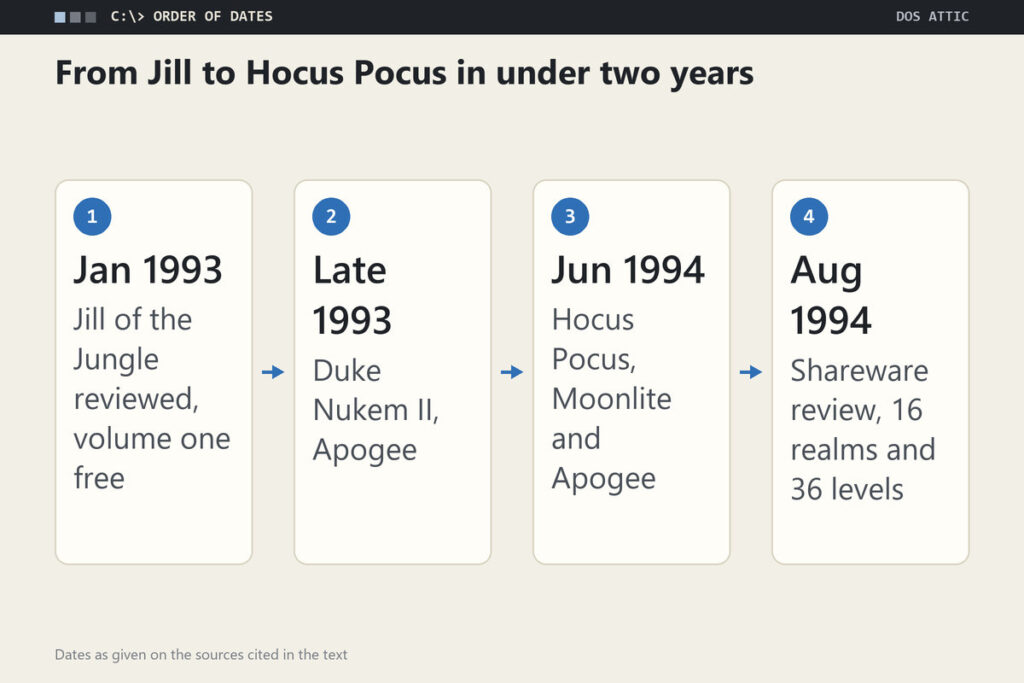
Steam lists Moonlite Software as developer and Apogee Entertainment as publisher, with a release date of June 1, 1994, and GOG repeats the year and the developer. The 1994 review tells the story from the publisher’s side: it introduces Hocus Pocus as Apogee’s newest game, does not name Moonlite, and sends registrations to Apogee Software in Garland, Texas, by mail or an 800 number. For a 1994 reader this was simply an Apogee release, and only the store pages keep the developer’s name. That sets it a little apart from the in-house platformers around it, such as the earlier original Duke Nukem from 1991.
Nine Levels Free, Thirty-Six Paid
The magazine spells out the business model. Nine levels were included in the shareware version, and registration unlocked all 36, together with cheat codes, for $24.95 plus shipping, ordered from Apogee by mail or phone. That is a quarter of the game given away to sell the rest. The same trade was running across the whole shareware scene, and Epic’s free-first-volume Jill trilogy was sold by mail in much the same way.
The 256-Color Floor
The most useful line in the review is a requirements list. Hocus Pocus needs a 386SX or better, 256-color VGA graphics and 567 KB of free memory, with all major sound cards supported. The reviewer praises 360-degree scrolling with parallax backgrounds and animated sprites, and compares the look to a cross between Duke Nukem and Shadow of the Beast.
Set that beside the Jill of the Jungle review the same magazine printed in January 1993. That column says Jill needs only a 286 or better and runs on CGA, EGA or VGA graphics, with 512 KB of RAM. The older game accepted far more machines. Hocus Pocus chose the opposite, and the hardware history behind that 256-color mode explains exactly what the mode was and why IBM’s manuals treat it as a single special mode.
The same column also praises Jill’s crisp, attractive 256-color VGA graphics, so the 256-color look itself was not new in 1994. What changed was the requirement. Jill drew in 256 colors for the players who had them and still ran on CGA and EGA, while Hocus Pocus listed 256-color VGA as the minimum.
So the answer to “best-looking” is partly a hardware decision. Jill already had the 256-color art, and Hocus Pocus made it the price of admission. Whether the result looks better is taste, but the requirement is on paper and the difference in ambition is real.
An Apprentice, His Potions and Four Bosses
The premise on the store page is simple. Terexin, leader of the Council of Wizards, sends the young sorcerer Hocus on a special mission to prove his worthiness. Along the way Hocus meets dragons, imps, ghosts and 30 more kinds of creatures, demons and enemies, and four huge bosses wait at the end of the episodes. Survive, the page says, and Hocus becomes a full-fledged, card-carrying wizard. The tone is cheerful fantasy, which suits a game whose selling point was its colors.
The magazine’s version of the setup adds names and a joke at the hero’s expense. Terexin’s council sits in the land of Lattice, the apprentice must cross the 16 realms to defeat the vile Trolodon, and the lovely princess he delivers from a horrible fate ends up facing a commonplace disaster instead: marriage to the player.
Hocus starts with a standard magic spell because he is not yet a full wizard. Potions found in the levels give temporary boosts: rapid shooting, higher jumps, teleporting and an energy blast. The store text also says each level has puzzles built into its structure, and the feature list adds saves, selectable skill levels and four cheat passwords. That is a small set of tools, and it is worth noticing what is missing: the page names no weapon upgrades and no elemental system, so none are described here.
What the 1994 Review Praised, and Where It Stalled
The review in Computer Gaming World is generous about the surface. It calls the 360-degree scrolling astoundingly smooth, praises the parallax backgrounds and the animated sprites, and says the multi-channel sound produced by Apogee’s new sound engine is a pleasure to listen to. It sums up the look as an attractive cross between Duke Nukem and Shadow of the Beast.
The same column is candid about the other side. Dying anywhere in a level sends Hocus back to the start of that level, and the reviewer writes that his own progress had been stopped by the puzzles rather than by the monsters. That is useful evidence in a discussion about difficulty, because it comes from a first-hand play report published within weeks of release, not from memories written decades later.
Where the Official Edition Lives
GOG sells Hocus Pocus, powered by DOSBox, and Steam sells it too. GOG’s changelog mentions verified compatibility with Windows 10 and 11. Neither store offers it free, and this article does not point to any free copy: the first-episode shareware release is a separate matter, and no official free source for it was confirmed.
Three Platformers, Three Ways In
Put the three games side by side and the difference is mostly in how the player gets through the door.
| Hocus Pocus | Duke Nukem II | Jill of the Jungle | |
|---|---|---|---|
| Developer and publisher | Moonlite Software, Apogee | Apogee | Epic MegaGames |
| Free portion | Nine of 36 levels | First of four episodes | Volume one of three |
| Full version in period sources | $24.95 plus shipping | Not stated in the sources used | $32 for all three volumes |
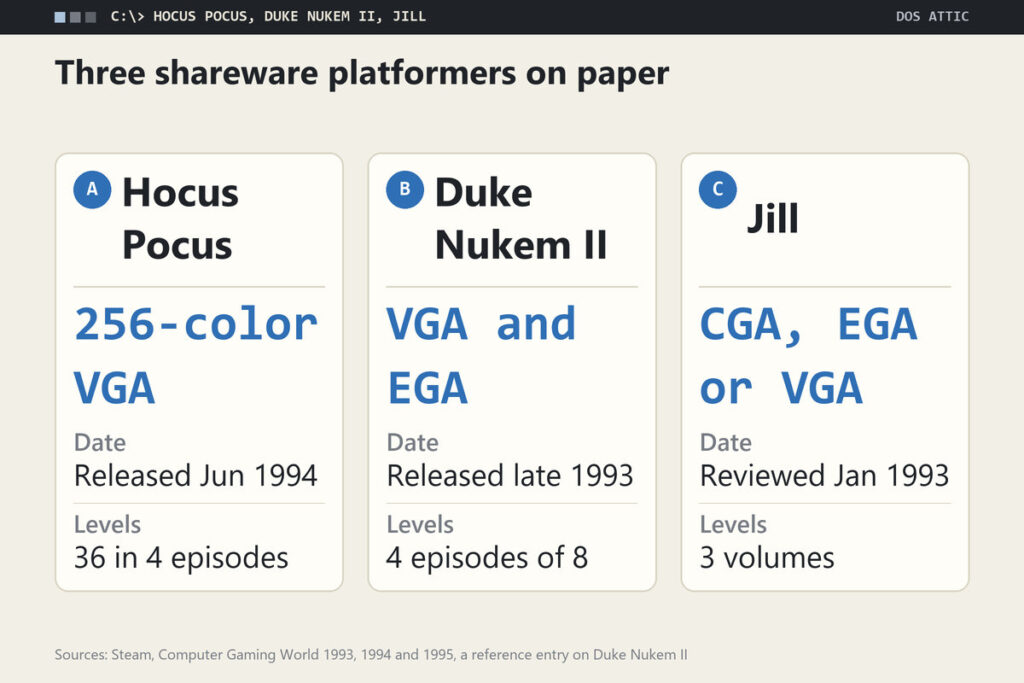
| Levels | 36 in four episodes | Four episodes of eight | Three volumes |
Duke Nukem II, which a July 1995 Computer Gaming World preview of Duke Nukem 3D places in late 1993, followed the same pattern: four episodes of eight levels, the first released as shareware, with VGA and EGA graphics. It is the same sell-the-rest-by-mail split that the Hocus Pocus review describes.
Read together, the table says Hocus Pocus was not a different kind of game so much as a different grade of hardware demand on the same shareware model. The one thing it adds to the formula is a requirement the other two did not make, and that is the piece of the 1994 record that lasts: a platformer asking for 256 colors from every player.
The money works out in the same direction. Registration at $24.95 unlocked the 27 levels beyond the free nine, which is a little under a dollar per level at 1994 prices, and it came with cheat codes. The shareware slice also lines up neatly with the structure: nine free levels is exactly one of the four episodes, so a player who finished the free copy had seen a quarter of the game from start to boss, and could judge the look and the puzzles before paying anything.