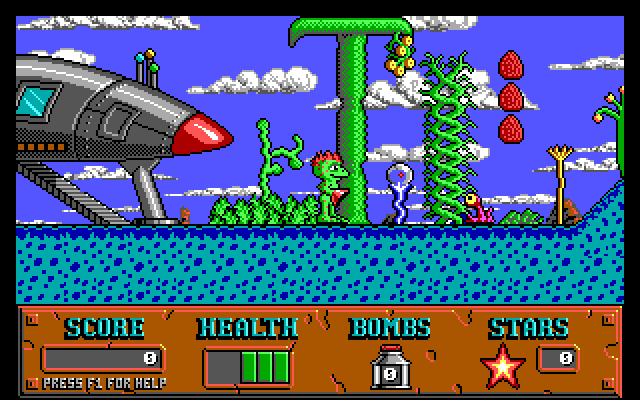
Not every great DOS game needs guns or demons. Cosmo’s Cosmic Adventure, Apogee’s 1992 side-scrolling platformer, stars a wide-eyed alien child with sticky suction-cup hands who kicks enemies instead of shooting them, and the whole thing is built around curiosity and exploration rather than violence. It’s one of the most purely charming things the shareware era produced.
A Family Stranded, a Child Left to Explore
Cosmo is a young alien traveling with his parents when their spaceship is forced to land on a mysterious world for repairs. While his parents work on the ship, Cosmo wanders off to explore, and comes back to find they’ve been captured by the planet’s inhabitants. What follows is three full episodes of alien jungles, caves, and strange structures as Cosmo works to get them back. Apogee published the game with families specifically in mind: the violence is minimal, the art is colorful and expressive, and the difficulty, while present, is never unfair to a younger or less experienced player.
Sticky Hands Change Everything
Cosmo’s defining mechanic is his suction-cup hands: hold up against any wall or ceiling and he latches on, letting you climb surfaces that most platformer characters of the era could never reach. That single mechanic opens up vertical exploration in a way that still feels fresh today — entire sections of levels exist above the standard play area, accessible only to players who think to look up and try climbing something that doesn’t look like a normal platform.
Secrets, Stars, and What Rewards Exploring
Levels are packed with secrets, hidden stars to collect, and bonus stages that reward thorough exploration over speedrunning. Bombs serve as Cosmo’s main offensive tool, and power-up fruits scattered through the levels grant temporary abilities that make certain sections noticeably easier if you take the time to find them. The boss fights are creative and memorable, and each one requires a genuinely different strategy rather than reusing the same pattern with a new coat of paint.
Cosmo Against Commander Keen
It’s hard not to compare Cosmo’s Cosmic Adventure to Apogee and id Software’s earlier Commander Keen series, which established a lot of the shareware platformer conventions Cosmo builds on. Where Keen leans on a wisecracking, precocious kid hero and tighter, faster platforming, Cosmo trades some of that speed for a gentler pace and the unique wall-climbing mechanic, giving it a more exploratory, puzzle-driven feel than Keen’s more action-forward levels. Both hold up well, but they scratch slightly different itches.
Tips for 100%-ing Each Level
Because so many secrets sit above the visible play area, developing the habit of testing every wall and ceiling for a climbable surface, rather than assuming a dead end is really a dead end, uncovers far more than casual play will. Bonus stages are typically reached through a specific hidden path rather than being obvious side rooms, so backtracking through a cleared section once with fresh eyes tends to reveal what a first pass missed.
Why It’s Worth Playing Today
Cosmo’s Cosmic Adventure is pure joy, and it’s the kind of game that reminds you why platformers became so beloved in the early 90s: tight controls, creative level design, and a real sense of discovery around every corner. It’s equally enjoyable for children and adults, and it runs perfectly in DOSBox with zero fuss.
Three Episodes, One Consistent Vision
Unlike some shareware trilogies where quality noticeably drops off after the free first episode, Cosmo’s three chapters maintain a consistent level of polish and creativity throughout, with each episode introducing new enemy types and environmental hazards rather than just recoloring the same assets from the one before it. That consistency is part of why the game still holds up as a complete experience rather than feeling like a single good episode padded out with filler.
A Gentler Alternative Worth Remembering
In a shareware landscape dominated by increasingly violent shooters chasing the success of id Software’s output, Cosmo’s Cosmic Adventure is a useful reminder that the era produced genuinely thoughtful, family-friendly design too, and that the format wasn’t exclusively about body counts and gore. It’s worth recommending to anyone who assumes early-90s DOS shareware was universally aggressive in tone, because Cosmo proves otherwise with real craft behind it.
A Small Thing Worth Noticing
Cosmo’s kick-based combat, rather than a gun, is a small design choice that shapes the whole feel of the game more than it might seem at first glance. It forces closer engagement with enemies than a ranged weapon would, and it keeps the tone playful rather than aggressive even during the more dangerous later stretches of each episode, reinforcing that this is a game about a curious kid finding his way home rather than a power fantasy dressed up in a colorful skin.
It’s a small design decision, but it’s exactly the kind of thoughtful choice that keeps this one feeling gentle and inviting more than three decades on, and worth handing to a kid discovering DOS gaming for the first time today.
Before anything else, get DOSBox working with the help of our install guide. And if you want more games like this, our free DOS games list is the place to browse.
Download Cosmo’s Cosmic Adventure for Free
How to Run with DOSBox
- Install DOSBox if you haven’t already.
- Extract the files to a folder like
C:COSMO. - In DOSBox:
mount c C:COSMOthenc:thencosmo1.
Watch Gameplay
You might also like: