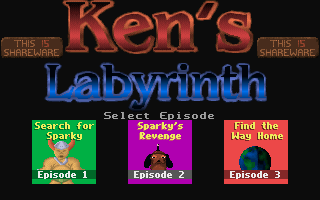
Every genre has a footnote game that history remembers mainly for who made it rather than what it was. Ken’s Labyrinth is exactly that kind of title: a scrappy, colorful first-person shooter built almost entirely by one programmer who would go on to define an entire generation of 3D engines.
The one-man engine that pointed toward Duke Nukem 3D
Ken Silverman wrote Ken’s Labyrinth largely by himself and distributed it independently before Epic MegaGames picked it up for wider release in 1993. It arrived months before id Software’s Doom would redefine what a first-person shooter could look like, and while its ray-casting engine is technically simpler than what Doom would deliver later that year, it’s a legitimate early showcase of Silverman’s talent for fast, efficient 3D rendering on limited hardware.
That talent didn’t stop here. Silverman went on to create the Build engine, the technology behind Duke Nukem 3D, Blood, and Shadow Warrior, and you can see the seeds of that later work in how Ken’s Labyrinth handles its geometry and secrets. It’s less a great game in isolation than a genuinely interesting first draft of a much bigger career.
What’s easy to forget is how young Silverman was when he wrote this. He was still a teenager, effectively self-taught in the kind of 3D math that most studios had entire specialist programmers dedicated to. That context matters when you’re judging the game: it’s rougher than Wolfenstein 3D in places, but it’s also the work of someone figuring out ray-casting largely on his own, years before engine licensing and shared source code made that knowledge common currency in the industry.
Why it plays like a maze, not a shooting gallery
Where Wolfenstein 3D pushed players down relatively linear corridors, Ken’s Labyrinth leans hard into its name. Levels twist back on themselves, hide secret rooms behind unremarkable-looking walls, and gate progress behind keys and switches rather than pure firepower. Light platforming sections and environmental hazards are mixed in alongside the shooting, so traversal becomes as much a puzzle as combat does.
The tone is different too. Its enemy designs and level humor lean goofy rather than grim, which sets it apart from the military and horror aesthetics that would soon dominate the genre through Doom, Rise of the Triad, and their imitators. Where those games wanted you tense, Ken’s Labyrinth mostly wants you curious, which is a strange but not unwelcome feeling in a first-person shooter from this period.
It’s worth remembering just how crowded the ray-casting shooter space got in the two years after Wolfenstein 3D proved the format could sell. Titles like Blake Stone, Corridor 7, and dozens of smaller shareware efforts all chased the same audience. Ken’s Labyrinth stands out from that pile mainly because its maze-first design philosophy makes it feel closer to a puzzle game wearing a shooter’s skin than a straight Wolfenstein clone.
Tips for surviving the labyrinth
- Lean on the slingshot early. Ammo for the stronger weapons is limited, and the weaker starting weapon handles early enemies fine.
- Treat unmarked wall segments with suspicion. Secret areas are a core part of level design here, not an optional bonus.
- Slow down around platforming sections. The fall hazards punish careless movement far more than the enemies do.
- Note switch locations even if you can’t see what they open yet; the door is often on the far side of the map.
- Save before unfamiliar junctions. The maze-like layouts make it easy to backtrack into danger you thought you’d cleared.
- Keep an eye on ammo counts between weapon types rather than relying on one favorite gun for everything; the game expects you to rotate depending on what’s in front of you.
Grabbing the free release
Epic’s involvement ended with the game eventually going freeware in 1999, so there’s no cost barrier to trying it today. For more shareware-era rarities in the same spirit, our roundup of free DOS games is worth a browse afterward.
Getting it running in DOSBox
Extract the archive to its own folder, mount it with mount c [folder], switch to that drive using c:, and start the game’s EXE from the prompt. The ray-casting engine can look choppy at very high cycle counts on some setups, so if scrolling feels off, try nudging cycles down rather than up. Our full DOSBox configuration guide covers this in more detail if you’re setting things up for the first time.
Verdict: a scrappy footnote worth playing anyway
Judged purely as a shooter, Ken’s Labyrinth is rougher than what came immediately after it: enemy variety is thin, and the maze-heavy design occasionally tips over into frustrating backtracking rather than clever exploration. But its historical value is real, and its offbeat, puzzle-box approach to level design still feels genuinely different from the Doom clones that flooded shelves in its wake.
I’ll admit the level layouts test my patience more than I expect a shooter to; a few maps genuinely need a mental notepad to get through cleanly, and that’s a big ask compared to how forgiving most FPS level design became within just a year or two. But that friction is also part of what makes it memorable instead of interchangeable with a dozen other Wolfenstein clones nobody remembers today.
If you’ve played every Wolfenstein and Doom clone worth remembering and want something with a different rhythm, this is a quick, free detour into the roots of an engine that shaped an entire decade of shooters.
Gameplay footage
You might also like: