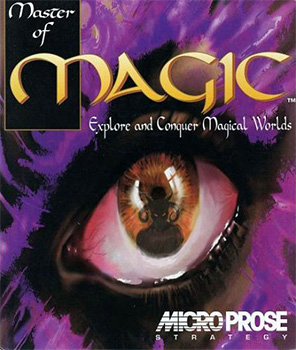
Sid Meier’s Civilization gets credit for inventing the modern 4X genre, but a small MicroProse-published game from 1994 quietly out-did it in one specific way: depth. Master of Magic took Civilization’s empire-building loop and bolted on a spell system with over two hundred spells, and the result is still one of the deepest strategy games ever released for DOS.
Simtex’s Answer to Civilization, With Wizards
Master of Magic was developed by Simtex and published by MicroProse in 1994. You play as one of fourteen wizards competing to dominate two interlinked worlds, and the influence of Civilization is obvious in the city-founding, tile-improvement, and turn-based empire management — but Simtex layered a genuinely deep magic system and a roster of fantasy races on top of that foundation, creating something that feels distinct rather than derivative.
Two Worlds, One Endless War
You expand your empire across Arcanus, the “normal” world, by founding or conquering cities, each populated by one of fourteen races with unique unit types and buildings. Myrror, the parallel plane layered beneath it, holds rarer resources and powerful node sites behind more dangerous encounters, offering a genuine high-risk, high-reward expansion path once you’ve got a foothold strong enough to defend it.
The Spellbook Is the Real Strategy Layer
The spell research system is the heart of the game. Over two hundred spells span five books — Life, Death, Chaos, Nature, and Sorcery — and your starting book choices at character creation effectively define your entire strategic identity for the rest of the campaign. Summoned creatures, from spearmen up through dragons and archangels, can turn the tide of entire wars once your research catches up to your ambitions.
Race choice compounds all of this further. Each of the fourteen playable races comes with its own unit roster and building set, so a High Men empire plays very differently from a Klackon or Dark Elf one even under identical spellbook choices, and pairing an aggressive race with an aggressive magic school produces a noticeably different game than pairing the same race with a defensive, Nature-heavy build. That combinatorial depth, race plus spellbook plus map layout, is a big part of why the game still gets replayed decades later; very few individual campaigns end up feeling the same.
Mistakes New Wizards Make
- Spreading your spellbook picks too thin at creation. Committing heavily to one or two schools gives you a coherent strategy faster than dabbling in all five.
- Neglecting Myrror. It’s more dangerous, but the resources and node sites there are often what separate a strong empire from a stalled one by the midgame.
- Underestimating unit upkeep. A large army you can’t afford to maintain will bankrupt your empire faster than losing battles will, and a bankrupt treasury forces unit disbandment at the worst possible moments, often the units you need most to hold a contested border.
- Ignoring enemy wizards’ spellbook colors. Knowing whether a rival leans Chaos or Life tells you a lot about what kind of army and counter-magic to prepare.
Where It Sits Next to Civilization and Warlords
Next to Civilization, Master of Magic trades historical breadth for fantasy specificity, and it’s better for it — the tech tree here is a spellbook, and every choice feels more personal than picking between Bronze Working and Currency, since a research choice here is also a statement about how you intend to fight your rivals, not just what buildings you’ll eventually unlock. Next to Warlords II, which was doing turn-based fantasy conquest around the same period, Master of Magic is the far more systemic game: Warlords is about armies and heroes, while Master of Magic is about the interaction between magic schools, race combinations, and wizard abilities, which creates far more distinct playstyle variation from game to game.
Running Master of Magic in DOSBox
Once you have the game files from a legitimate copy, extract them and open DOSBox. Use mount c [folder] then c: to switch drives, and run MOM.EXE to launch. If you’re setting up DOSBox for the first time, our DOSBox setup guide covers sound and control configuration in more depth than you’ll need for this specific game, but it’ll save you time either way.
Why It’s Still a Cult Classic
Master of Magic has been actively maintained by modders for decades, which tells you something about how much strategic depth people found worth preserving, long after the studio itself had moved on to other projects and the original box copies had become collector’s items in their own right. That’s a rare fate for a 1994 strategy title, and it’s earned through sheer replayability rather than nostalgia alone. The combination of empire building, military strategy, and magical progression creates more distinct playstyle variation than almost any strategy game before or since. If I’m being honest about its flaws: the AI can be erratic at higher difficulties, sometimes punishingly so, and the interface shows its age in ways a modern 4X player will need patience for. But if you enjoy deep strategy and have never played it, you’ve been missing one of the genre’s real peaks. The fan community deserves real credit here too — unofficial patches have fixed long-standing bugs, rebalanced late-game spell costs, and kept the multiplayer scene alive well past the point most 1994 strategy games were forgotten entirely, which says as much about the strength of the original design as any review could.
Watch Gameplay
You might also like: