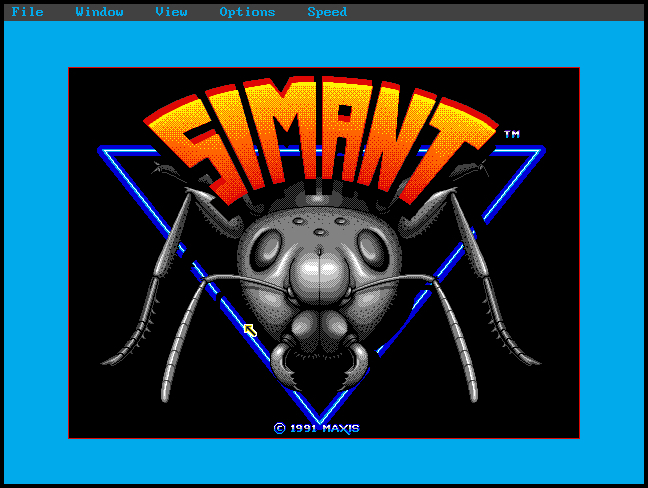
Right after SimCity turned Will Wright into one of the most recognizable names in game design, Maxis followed it up with something considerably weirder: a game about ants. SimAnt drops the skyscrapers and traffic grids in favor of a suburban backyard, and instead of managing a metropolis you’re commanding a colony of black ants at war with the red colony next door.
A Simulation With Teeth
SimAnt was Maxis’ third major simulation release, and it kept the studio’s habit of turning a real-world system — here, insect ecology and colony behavior — into something you can actually play with. You can take direct control of a single ant, digging tunnels, laying pheromone trails, and fighting off spiders, or pull back to a colony-level view and manage breeding priorities and territorial expansion. Few games before or since have tried to make ant biology this legible to a general audience.
What keeps it from feeling like a dry educational title is the war with the red colony. Skirmish games are short, aggressive, and winnable in an afternoon, while the longer campaign pushes you to expand from the yard into the house itself, eventually nudging the human family that lives there. That house-invasion arc gives SimAnt a goal beyond “survive,” which the original SimCity never really had.
It’s worth remembering how unusual this pitch was for Maxis at the time. SimCity had proven that abstract systems — zoning, traffic, tax rates — could be genuinely entertaining, but insect colony behavior is a far stranger subject to hand to a mainstream audience. That Wright and Maxis pulled it off, and did it with real biological grounding rather than just borrowing the SimCity interface and reskinning it, says a lot about how seriously the studio took its “simulation” branding in the early 90s.
Playing an Ant Well
- Lay pheromone trails deliberately — your worker ants follow them, so a sloppy trail back to a food source will waste more foraging trips than it saves.
- Don’t neglect the queen. Losing her effectively ends your colony’s ability to grow, so keep her chamber defended even when the fighting is elsewhere.
- Spiders are more dangerous than they look in the early game. A single ant caught alone in the open is often a lost ant; group up before pushing into contested territory.
- Watch for human intervention — lawnmowers, sprinklers, and pesticide can wipe out a tunnel network in seconds if you’ve built too close to foot traffic.
- Switch between direct ant control and the colony-level view often rather than picking one and sticking with it; each mode reveals threats and opportunities the other one hides.
Colony Management vs Direct Control
The hybrid control scheme is really the heart of what makes SimAnt distinct, and it’s worth understanding why it works. Direct ant control gives you precision — you can guide a single worker exactly where you want, fight off a specific threat, or scout unexplored territory. But it’s also blind to the bigger picture: you can’t see colony-wide food reserves or breeding rates while you’re piloting one ant through a flower bed.
Flip to the colony view and you get the opposite trade-off: full visibility into growth and resources, but no ability to react to an individual threat in real time. Good play means treating these as two different tools for two different problems rather than defaulting to one. I tend to run the colony view as my baseline and drop into direct control only when a specific crisis — a spider incursion, a contested food source — needs hands-on attention.
A Genre Ahead of Its Time
It’s worth remembering that SimAnt predates the modern colony-sim and ecosystem-management genre by a couple of decades. The direct-control-plus-macro-management hybrid it uses feels closer to a real-time strategy skirmish than to SimCity, and that hybrid identity is still fairly unusual today. Whether that was Wright’s intent or a happy accident of trying to model ant behavior faithfully, it gives SimAnt a distinct rhythm that separates it from Maxis’ other Sim titles of the era.
My honest take: it’s a fascinating curiosity more than a game I’d recommend for long sessions. The skirmish mode is genuinely fun in short bursts, but the house-conquest campaign can drag once you’ve seen most of what the simulation has to offer. Still, as an early example of turning a biological system into playable mechanics, it holds up better than you’d expect, and it’s aged more gracefully than a lot of its early-90s simulation contemporaries.
Part of what keeps it interesting today is how little SimAnt tries to dress up its subject matter. There’s no cute cartoon mascot softening the premise — it’s a genuinely insect-eye view of backyard warfare, hazards and all, and that directness is refreshing next to how sanitized a lot of “cute” simulation games became later in the 90s. If you go in expecting SimCity with ants, you’ll be surprised at how much SimAnt actually commits to the biology.
Getting a Copy Running
SimAnt is a commercial Maxis release and isn’t available as a legal free download, so your best bet is tracking down an official re-release through GOG or Steam rather than hunting for old shareware copies. If DOSBox is new territory for you, we’ve laid out the whole process in our setup guide, and our list of free DOS games is a good place to look while you wait to track this one down.
DOSBox Setup Notes
Mount the folder containing your installed copy with mount c [folder], switch to it using c:, and run the EXE. SimAnt is undemanding on emulated hardware and runs fine under DOSBox’s default cycle settings; if sound or display modes act up, our guide above covers the usual fixes.
See It in Action
You might also like: