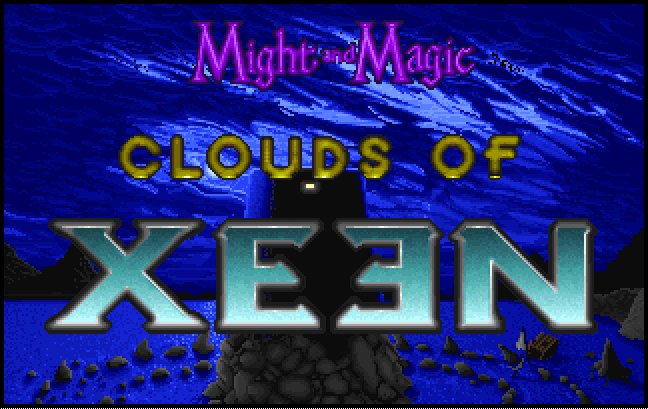
Most CRPGs from 1992 wanted you to buy one box. Might and Magic IV: Clouds of Xeen wanted you to buy two — and if you did, something happened that almost no other game of its era attempted: two separately-boxed, separately-sold RPGs quietly recognized each other on your hard drive and fused into a single, larger world. That merge feature, more than the goblins or the spellbook, is the reason Clouds of Xeen still comes up in conversations about ambitious 1990s game design.
New World Computing and Where This Fits in the Timeline
Clouds of Xeen was developed and published by New World Computing, the studio Jon Van Caneghem founded in 1983. Van Caneghem had already made his design debut with the original Might and Magic in 1986, and by the early 1990s the series had become New World’s flagship line. Clouds of Xeen is the fourth mainline entry, arriving in 1992 for MS-DOS (with FM Towns and NEC PC-9801 ports as well), and it picks up the story of the shapeshifter Sheltem, whom the previous game’s adventurers had chased off the world of Terra. The trail leads to a new world called Xeen, where a tyrant named Lord Xeen has imprisoned the world’s guardian spirit, Corak.
Rather than build a new engine from scratch, New World Computing reused and refined the interface and technical foundation of Might and Magic III: Isles of Terra’s engine, which let the team focus effort elsewhere — namely, on a follow-up game designed to interlock with this one.
Building the Party: Races, Classes, and the Xeen Formula
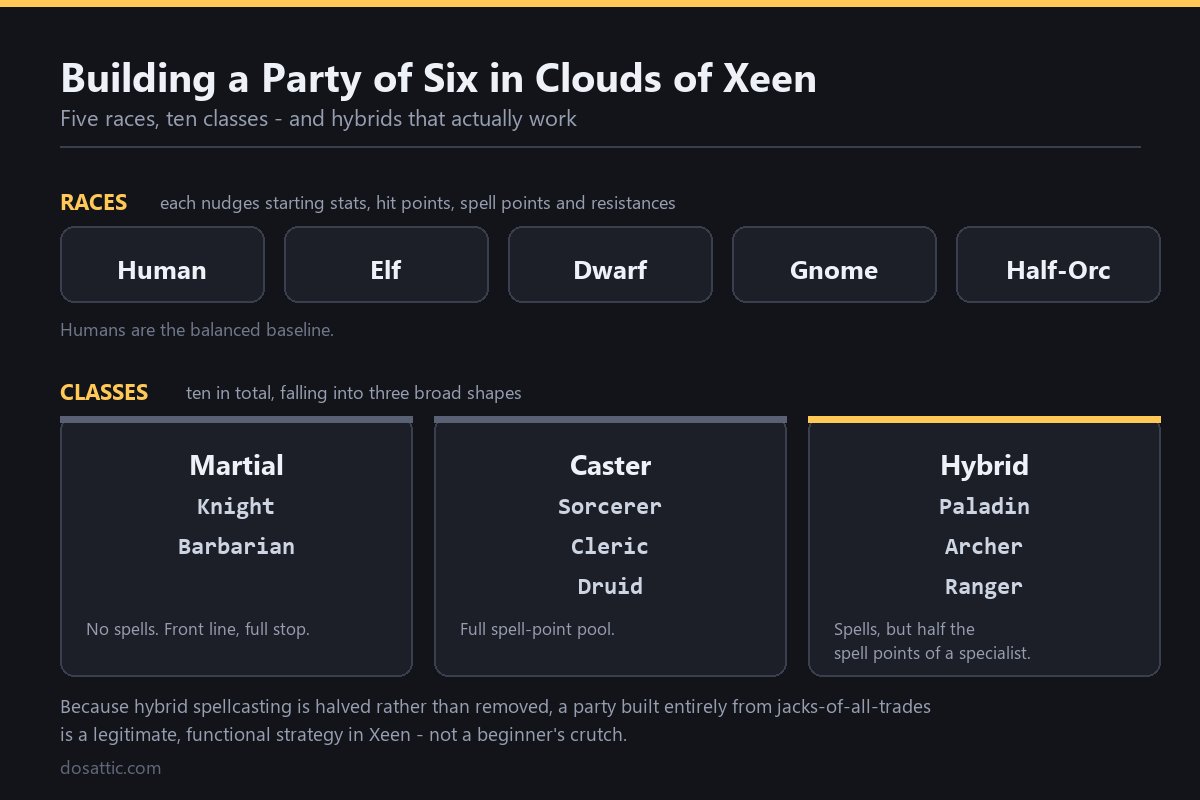
Like its immediate predecessor, Clouds of Xeen has you assemble a party of six adventurers, mixing and matching from five playable races — Human, Elf, Dwarf, Gnome, and Half-Orc — each of which nudges starting stats, hit points, spell points, and resistances in a different direction (Humans are the balanced baseline). Class choice is where the real variety shows up: ten options ranging from pure martial types (Knight, Barbarian) to pure casters (Sorcerer, Cleric, Druid) to hybrids that split the difference. Paladins, Archers, and Rangers, for example, get access to spells but with their spell-point pool halved relative to a dedicated caster, which makes them flexible but never as powerful in either direction as a specialist.
This is a meaningful design decision worth flagging for newcomers: unlike party-based RPGs where hybrid classes are strictly worse, Xeen’s halved-but-present spellcasting on hybrids means a six-person party built entirely around “jack of all trades” characters is a legitimate, functional strategy — not just a beginner’s crutch.
Grid Movement and Turn-Based Combat
Exploration happens in first-person, one grid square and one 90-degree turn at a time, across town hubs, dungeons, and outdoor wilderness maps — the same control scheme popularized by Eye of the Beholder, though Xeen’s world is more open, with overworld travel connecting multiple towns rather than one continuous dungeon. Combat is turn-based: your whole party and any enemies act in initiative order, choosing to attack, cast, defend, or use items each round. Two quality-of-life additions distinguish Clouds of Xeen from earlier entries — a dedicated in-game notes screen for jotting down clues, coordinates, and riddles, and a separate quest-item inventory so plot-critical objects can’t be accidentally sold or dropped alongside your regular loot. Two difficulty settings, Adventurer and Warrior, are offered at the start.
How the World of Xeen Merge Actually Worked
Here’s the part most retrospectives gloss over. Might and Magic IV: Clouds of Xeen was built with a sequel in mind from day one: Might and Magic V: Darkside of Xeen, released in 1993. Each game covers one half of the same flat, disc-shaped planet — Clouds of Xeen is the “light side,” Darkside of Xeen is, unsurprisingly, the other. Played separately, each is a complete, self-contained RPG with its own campaign and ending.
The trick is what happens if you own and install both. If Might and Magic IV and Might and Magic V are present on the same system, the games detect one another and combine into a single unified campaign — Computer Gaming World’s editors at the time called it “the most impressive linking of two CRPGs in computer game history.” In practical terms for a 1992-93 player, that meant:
- Your existing party and its full inventory carried over between the two games instead of starting fresh.
- Areas of each map that were sealed off or non-functional when played standalone opened up once both games were installed — the “dark side” and “light side” became two halves of one continuous landmass instead of two separate maps.
- New content became reachable that neither game contained on its own, including additional quests that only exist in the combined state and function as an epilogue to both stories.
- The combined campaign builds toward a shared finale — the wedding of Prince Roland and Queen Kalindra — which is staged as the event that formally reunites Xeen’s two halves into one world.
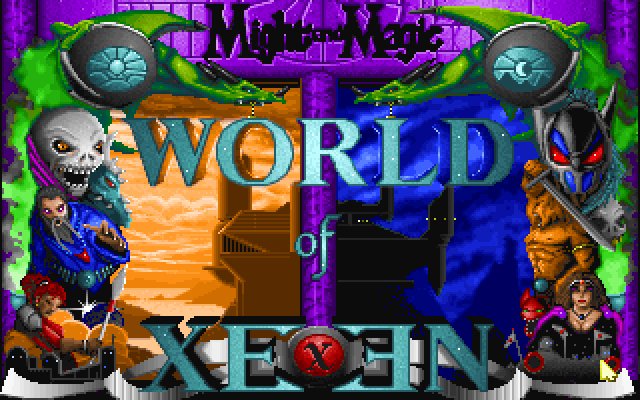
Why go to this trouble? Partly ambition, partly a business model: two full-price boxed sales instead of one, plus a strong incentive for fans of the first game to buy the second rather than skip it as an unrelated sequel. For anyone who owned both — not a trivial ask at full 1993 retail prices — the payoff was a scale of interconnected world-building essentially no other RPG series attempted at the time. It’s also not the same trick as a simple “import your save file” feature; the merge changes what map content exists and is reachable, not just which stats your characters carry in.
Might and Magic III vs. IV vs. V: What Changed
| Feature | III: Isles of Terra (1991) | IV: Clouds of Xeen (1992) | V: Darkside of Xeen (1993) |
|---|---|---|---|
| Engine | New engine for the series | Reuses and refines III’s engine/interface | Shares IV’s engine, adds speech support |
| Standalone world | Isles of Terra | Clouds of Xeen (light side) | Darkside of Xeen (dark side) |
| Cross-game merge | Not applicable | Merges with V if both installed | Merges with IV if both installed |
| Quest-item inventory | No | Yes | Yes (inherited) |
| Notable tech addition | Larger, non-grid-locked maps | In-game notes screen, two difficulty modes | Digitized speech, animated cutscenes (CD version) |
| 1994-95 re-packaging | Bundled in Might and Magic Trilogy (1995) | Combined into World of Xeen; also in Trilogy | Combined into World of Xeen; also in Trilogy |
Making the Merge Work: DOSBox Setup for Clouds of Xeen
Clouds of Xeen predates the Sound Blaster 16 era, and its DOS setup utility asks for both a video mode and an audio device separately — you generally want to select VGA for graphics and Sound Blaster for sound/speech rather than accepting EGA or AdLib-only defaults, since VGA is what the game’s color art was designed around. A couple of DOSBox-specific notes that trip people up:
- Sound Blaster IRQ: the game’s speech/sound driver expects IRQ 5 and doesn’t always respect a different value set in DOSBox’s Sound Blaster configuration — if audio cuts out or the setup utility won’t detect your card, check that DOSBox’s
sbirqis set to 5 to match. - Launch parameters: the launcher can be pointed straight at a video/sound combination from the command line instead of walking through the setup menu every time, once you know which combination works on your setup.
- Conventional memory: like most large 1992 DOS RPGs, Xeen is happiest with as much free conventional memory below 640 KB as you can give it — strip down a busy autoexec or TSRs for this game specifically rather than troubleshooting mystery crashes later.
- CPU cycles: the game doesn’t need much horsepower — if combat text or the notes screen scrolls unnaturally fast, lower
cyclesrather than assuming it’s a bug.
If you’ve already got a working DOSBox setup for other era-appropriate titles, our general DOSBox configuration guide covers the baseline steps this builds on.
Tips for New Xeen Adventurers
- Don’t build six pure spellcasters. Spell points regenerate slowly early on, and a party with no reliable melee damage will grind to a halt against anything with decent hit points. Two to three front-line fighters (Knight, Paladin, Barbarian) is a safer core.
- Take at least one Cleric. Healing spells are not optional quality-of-life in Xeen; without one, you’ll burn through consumable potions far faster than early-game gold supports.
- Use the notes screen relentlessly. Clouds of Xeen expects you to write down riddles, door codes, and NPC hints yourself. New players who skip this feature end up backtracking across the map for information they already received once.
- Keep the quest-item inventory in mind, but don’t hoard everything else. Regular inventory space is limited per character; sell obsolete gear at town shops early rather than letting your party get encumbered.
- Rest often, but not blindly. Resting restores HP and spell points, but it also advances in-game time and can trigger wandering monster encounters — do it in cleared areas or town, not in the middle of an unexplored dungeon floor.
- Save before teleporters and unfamiliar doors. Several of Xeen’s map transitions — including ones tied to the World of Xeen merge content, if you have both games installed — drop you somewhere new without warning.
Legacy: From Two Boxes to One World
The merge feature didn’t stay a two-box-only curiosity for long. In 1994, New World Computing released World of Xeen as a CD-ROM compilation bundling both games as a single product from the start, with expanded digitized speech — no separate boxes required. A year later, Might and Magic Trilogy folded III, IV, and V into one package. Digital storefronts continue that consolidation today: the modern release simply ships as “Might and Magic 4-5 – World of Xeen,” the cleanest way to experience the game now.
Beyond its own series, Clouds of Xeen’s world-merging trick remains an unusual footnote in RPG history — few later franchises attempted anything structurally similar, making it as much a design curiosity today as it was a marketing hook in 1992. Its DNA is easier to trace in New World Computing’s own later output, particularly the spin-off Heroes of Might and Magic strategy series, which inherited the same setting and lore rather than the merge mechanic itself. Open-world first-person RPGs would keep evolving through the decade — compare Xeen’s town-and-wilderness structure to the fully seamless province of The Elder Scrolls: Daggerfall just four years later — but few matched Xeen’s specific trick of merging two separately-sold games into one.
Questions About Merging the Two Halves of Xeen
Do I need Might and Magic V to play Clouds of Xeen?
No. Clouds of Xeen is a complete, self-contained RPG with its own story and ending. Darkside of Xeen adds the second half of the world and enables the merge, but it’s not required to finish or enjoy Clouds of Xeen on its own.
Can I still merge the two games today?
If you’re running the original separate DOS releases of IV and V under DOSBox, the original detection-and-merge behavior is generally reported to still work when both are installed correctly. The simpler modern route is to get the official “World of Xeen” combined release, which starts you off already merged.
Is World of Xeen a different game from Clouds of Xeen?
Not exactly — “World of Xeen” is the name used both for the combined-play state you reach by merging IV and V, and for the later official compilation release that packages both games as one product.
What’s the difference between Clouds of Xeen and Darkside of Xeen?
They’re companion games covering opposite halves of the same world (Xeen is depicted as a flat, disc-shaped planet with two sides), released a year apart by the same studio, each playable and completable on its own, but designed to combine into one larger campaign when both are present.
Does Clouds of Xeen use the same engine as earlier Might and Magic games?
Yes — it reuses and refines the engine and interface introduced in Might and Magic III: Isles of Terra, adding features like the notes screen and separate quest-item inventory on top of that foundation.
You might also like: