Dennis Owens opened his June 1991 review in Computer Gaming World with a choice of viewpoints. The distant, god-like seat, he suggested, lets a player dispatch foes “as though throwing thunderbolts from a far-off cloud.” The alternative was a first-person view in which monsters spring out of the dark at eye level. He judged the second more tense, and Eye of the Beholder was the game that took it.
Owens also gave the game a parentage in one line, Dungeon Master meets the veteran storyteller George MacDonald. A store page today names a different parent, Westwood Associates, and so did a Computer Gaming World news column two years later. The records are not as far apart as they look, and untangling them is a good way to read what a credit actually tells you.
Two Verdicts in the Same June 1991 Issue
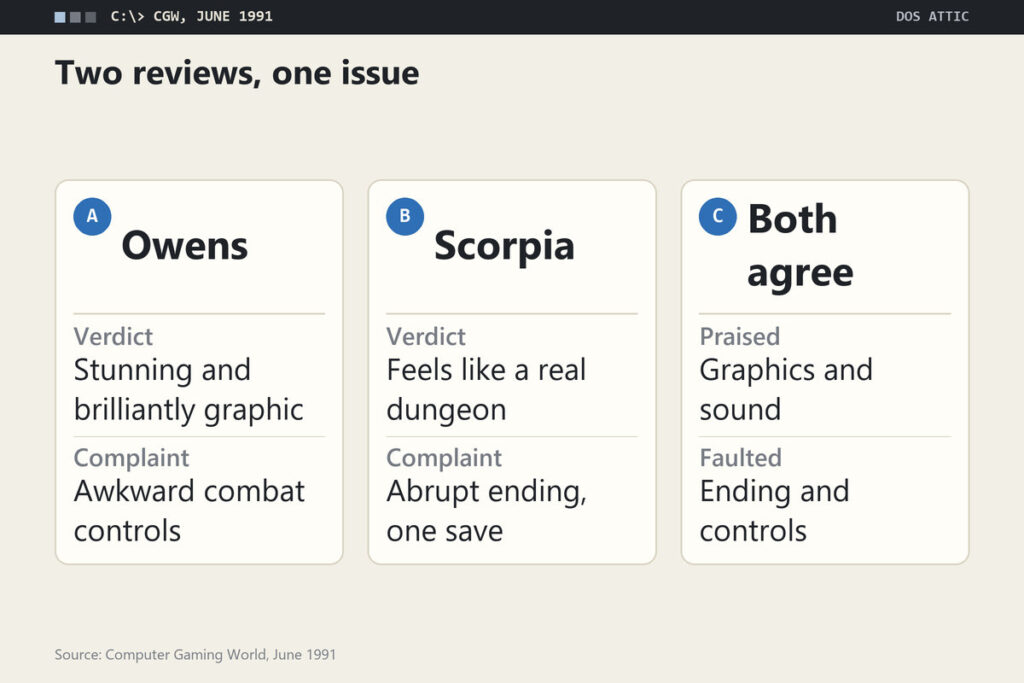
Computer Gaming World’s June 1991 issue ran two assessments side by side. Owens called Eye of the Beholder a gorgeous, fiendishly hard step into 3-D role-playing, and the launch title of SSI’s Legend Series, a fresh range of AD&D games for computers. His conclusion was that IBM owners could stop complaining, because they finally had a game in the mould of Dungeon Master, a magnificent one that he expected to start a run of many more.
The department called Scorpion’s View, signed by the reviewer Scorpia, was warmer about the dungeon than about the package. No other game she had tried made her feel so present in a dungeon, and that alone justified the price, but combat needed work, the plot needed development, non-player characters needed more to say and the endings needed to be better. If those were fixed, she thought, the Legend series could become one of the leaders in the genre.
Real Time, Four Heroes, Hidden Hit Points
Combat is not turn-based but runs close to real time, Owens notes, with a recovery pause after a weapon or item whose length depends on the item and the character’s dexterity. The game never shows how many hit points an opponent has, and the party’s own health defaults to a bar graph, a choice he recommended. Health becomes a sense of well-being instead of a race between numbers. The party starts with four characters, Scorpia notes, where the Gold Box series typically gave six.
Interface and sound get the same specific attention. Graphics modes cover EGA, CGA and Tandy, with VGA strongly advised, and AdLib and Sound Blaster boards are supported in detail: zombies’ hands swoop, swords clash and spells chime.
Twelve Levels Under Waterdeep
The setting is the sewers and catacombs beneath Waterdeep, where evil is plaguing the city and the trail leads to Xanathar the beholder. Owens describes a quest for seven stone objects, none of them necessary to finish. Scorpia counts twelve levels and says a map is a necessity after the first three, the ones that come in the box, especially in the drow areas where position becomes uncertain after stairs, pits and portals.
SSI also hid a contest in them. According to Scorpia, each of the twelve levels held a special hidden puzzle for the Beholder Bonus contest, except level four, where the bonus sits in the open and cannot be missed, and none of them was needed to complete the mission.
Ending With a Text Box, Then DOS
Both reviewers disliked how it ended. Owens complains that the game stops straight after the last battle with Xanathar, with no chance to go back and explore. Scorpia is blunter: you kill the Beholder, get a text box of congratulations, and are dropped out to DOS, an ending she calls outrageous and compares to Sentinel Worlds I. She reports that SSI said a real ending would have needed another disk.
Scorpia hoped the series would do better. Her August 1993 review of the third game, though, still calls its finale the usual Kill the Foozle ending, which suggests the complaint about thin endings was never fully answered. The grievance here belongs to the DOS game of June 1991, and it is worth keeping apart from the later chapters when reading old complaints.
Rough Edges Before the First Step
Scorpia lists what bothered her at the keyboard. Every launch asks for the graphics mode, the sound card and whether to use a mouse, where a configuration file, as the Gold Box games kept, would remember the answers. Casting takes three clicks, the spellbook, the level and the spell, while only one character acts and the monsters keep hitting. Owens adds that mouse movement works only through a small cluster of buttons beneath the view window, so frantic fights end with the party walking into walls.
One save slot, copied by hand
The game has a single save position. Scorpia finds that hard to understand in a game full of puzzles that demand experiment, and says it forces players to quit and copy the save files elsewhere to be safe. It is worth knowing before you try the game today: the reviewer’s only safeguard was a hand-made copy of the save files.
Selling a Series
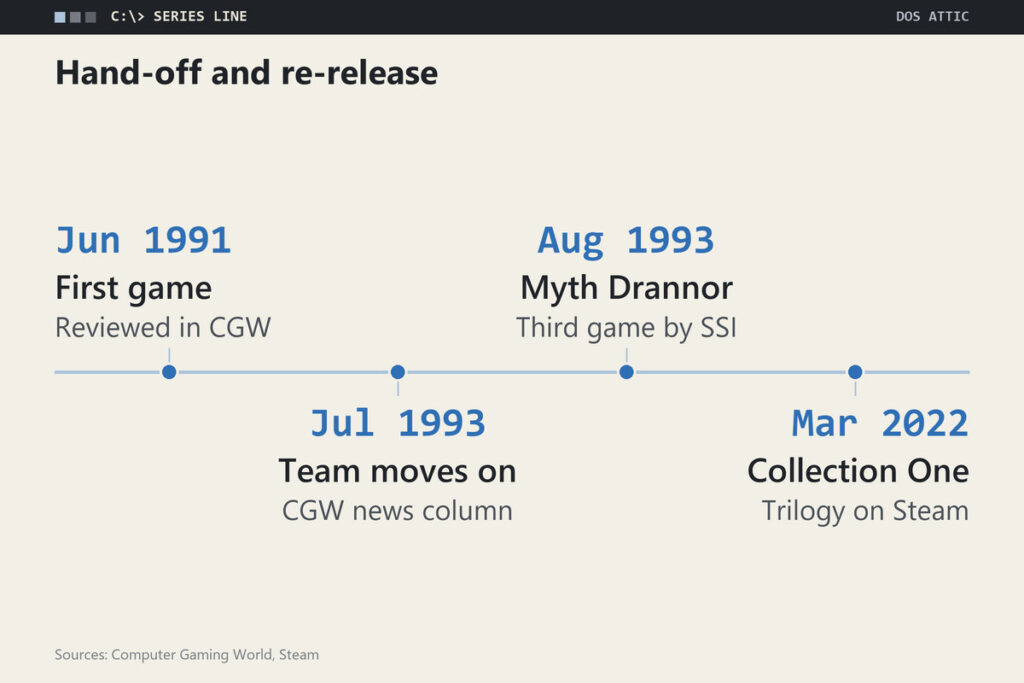
The series did not stop at one game. A July 1993 news column in Computer Gaming World says the Westwood team behind the good first game and the better second one, The Legend of Darkmoon, had moved on to new adventure worlds, so SSI had to build its own engine for the third, Assault on Myth Drannor, which looked much like the earlier two but lacked auto-mapping. Scorpia reviewed that third game in August 1993 under the designers Nicholas Beliaeff, David A. Lucca and John Miles, at $69.95, and told players that characters could be carried over from the second game, although the transfer utility simply takes the first four from the chosen save. Her other headline was an All-Attack command that lets the whole party strike at once, one of a couple of long-awaited improvements in her words. For a bigger, freer RPG, the site’s look at the open-world scale of Daggerfall covers the extreme, and a party-based first-person RPG from a year later covers the gentler version.
Buying the Trilogy Today
The game is on sale, not free. Steam and GOG both sell it as part of a trilogy titled Forgotten Realms: The Archives, Collection One. The Steam page presents the three Eye of the Beholder games as first-person, real-time RPGs and shows a release date of 29 March 2022, while GOG’s page carries the same collection under the year 1991. Both credit DOSBox, GOG saying the game is powered by it, which points to the original DOS programs inside a Windows wrapper, although neither page says so in those words. Neither page offers a free edition, so the paid collection is the only official route these listings show.
Who Built It: Three Records, Three Answers
Record one is the 1991 credit box in Computer Gaming World: developer George MacDonald, designers Phil Gorrow, Eydie Laramore, Paul Mudra and Joe Bostic, publisher Strategic Simulations. Record two is the magazine’s later reporting. In its July 1993 issue a news column names the Westwood Studio team as the people behind the first two games, and in the August 1993 issue an advertisement for Westwood’s Lands of Lore bills it as coming from the development team that created Eye of the Beholder I and II, while a news item calls the engine one Westwood built for SSI’s series. Record three is the store pages, which name the developers as Westwood Associates and Strategic Simulations, with SNEG as publisher on Steam.
The records answer different questions. A 1991 box names people, and as a contemporary credit it sits closest to the work, though one line cannot say which company employed whom. The magazine’s later reports and Westwood’s own advertising name the studio, and they agree with the 2022 store pages, which name companies, the ones the re-release was filed under. Read this way, the box is the better guide to who did the work and the other two the better guide to which studio and publisher stand behind it. Nothing in the three says Westwood did not make the game. Taken together they say it did, for SSI, and that the 1991 box named individuals the later records leave out, which answers the title’s question better than either name alone.