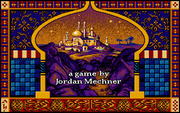
Somewhere in a driveway in the mid-1980s, Jordan Mechner pointed a video camera at his younger brother David and asked him to run, jump, and vault over things while wearing loose white clothing. That home video became the animation backbone of one of the most influential platformers ever made — not through any studio’s motion-capture rig, but through a technique called rotoscoping, traced frame by frame from ordinary footage by a designer who, by his own account, simply didn’t think he was skilled enough at freehand animation to fake realistic human movement any other way.
A Camcorder, a Kid Brother, and the Discovery of Rotoscoping
Mechner had already shipped one game for Broderbund — Karateka, released a few years earlier — and that success bought him something rare for the time: creative freedom to build an original concept rather than a sequel. He began work on what would become Prince of Persia in 1985, after graduating from Yale, and spent roughly four years on it before its 1989 release.
The animation approach he landed on was rotoscoping — filming real human movement, then tracing over the footage frame by frame to produce sprite animation with genuine weight and follow-through. His brother David, then a teenager, was the model, filmed performing running starts, standing jumps, and tumbling falls in white clothing chosen to make the silhouette easy to trace against. The result is still visible in how the prince moves on screen: a slight forward lean before a jump, a stumble-recovery on a rough landing, a very human hesitation before stepping onto something narrow. None of that was hand-animated guesswork; it was traced from a real body doing real physical things.
The Sword and the Film It’s Copied From
Combat got the same treatment, but from a different source. Rather than filming new footage for the sword fights, Mechner traced movement from the climactic duel between Errol Flynn and Basil Rathbone in the 1938 film The Adventures of Robin Hood — a fight famous among film historians for its shadow-play staging and its sense of two skilled swordsmen actually reading each other’s stances. That’s a small production detail that rarely makes it into modern retrospectives, but it explains something specific about how combat feels in Prince of Persia: guards don’t just attack on a timer, they hold high or low guard positions that telegraph what kind of strike is coming, which is a very theatrical, very Hollywood-swashbuckler way of designing a fight system rather than a purely mechanical one.
Sixty Minutes, Twelve Levels, No Second Chances
The premise is simple on paper: an unnamed prince, imprisoned by the scheming Grand Vizier Jaffar, has exactly sixty in-game minutes to fight through a twelve-level dungeon and reach the princess before Jaffar forces her to marry him. That clock never pauses for backtracking, never resets on death, and runs whether you’re solving a puzzle or just standing still — which turns every wrong turn into a real cost rather than a cosmetic inconvenience.
Movement is the actual core skill the game is testing, more than combat is. The prince carries momentum — holding the run key too long past a ledge sends him overshooting into a pit, and stopping short of a gap that needed a running start leaves him grabbing at nothing. Traps (spike floors, guillotine blades, pressure-plate gates) are built around that momentum system rather than around reflexes alone; most of them are survivable if you’re moving at the right speed, not just moving fast. Combat, when it does happen, is a one-on-one, stance-based sword system — guards block high or low depending on how they’re standing, and beating them means reading that stance rather than mashing the attack button. Potions scattered through the levels are unmarked and can heal or poison in equal measure, which means every unfamiliar bottle is a small gamble the game never explains to you directly.
Keeping the Prince’s Jump Timing Honest in DOSBox
Prince of Persia’s DOS port is generally well-behaved under DOSBox’s default cycles=auto setting, since its animation and timing were designed to be frame-based rather than tied to raw CPU clock speed the way some earlier titles were — but if you notice the prince’s jumps feeling floatier or snappier than expected, dropping to a fixed cycle count in the low thousands is worth trying before assuming it’s a control problem. Keyboard controls are the traditional setup (arrow keys to move, a modifier key to draw and use the sword), and mapping them to a modern gamepad is common but optional; the original design assumes exactly the precision a keyboard’s discrete key-presses provide, which is worth keeping in mind if analog stick input feels imprecise for ledge grabs.
Surviving the First Few Levels
- Never hold the run key on reflex — tap toward a ledge and release before you’d naturally stop, since overshooting a landing is one of the most common early deaths.
- Watch a guard’s blade position before engaging — a high guard blocks high attacks, a low guard blocks low ones, and attacking into a guard’s active block just wastes a turn.
- Treat unmarked potions as a real risk, not a guaranteed heal — drink one when you’re at full health and can afford to find out it’s poison, not when you’re already low.
- Save backtracking for when you’re certain it’s necessary — the clock keeps running during exploration, and the early levels are tight enough that a few wasted minutes can cost you the ending.
- Use falls deliberately, not just avoid them — some drops that look punishing are actually the intended (and only) way past a gap, and the prince can survive a fall from a greater height than instinct suggests.
- Learn each trap’s tell before trying to rush it — spike floors and swinging blades usually have a visible cue a beat before they trigger, and memorizing that timing is faster than trial-and-error stumbling.
From Apple II Curiosity to Two Million Copies
The original release was for the Apple II in October 1989, and by mid-1990 it had sold only modestly in North America — around 7,000 units each on Apple II and IBM PC. The DOS version cleaned up the graphics and sound without redesigning the core game, and it became the template most later ports (Amiga, Genesis, SNES, and beyond) actually built from. The real commercial breakthrough came overseas: strong reception in Japan and Europe eventually pushed worldwide sales to roughly 2 million copies by 1993, turning a modest Apple II release into one of the defining PC games of its decade.
Its influence on what came after is hard to overstate. The specific combination it introduced — physically grounded platforming, environmental puzzle design, and a story told through cinematic staging rather than text dumps — is usually credited as the template that games like Another World pushed even further just two years later, and that lineage runs in a fairly direct line to cinematic action-adventure design well beyond the DOS era. Even a narratively driven adventure game like Beneath a Steel Sky, arriving five years later in a completely different genre, owes something to the same underlying idea Mechner proved commercially viable first: that a DOS-era game could carry itself on staging and atmosphere rather than on score counters and power-ups.
What’s easy to miss, looking back from an era of fully mo-capped cutscenes, is how deliberately low-tech the original solution was. Mechner didn’t have access to anything resembling motion capture hardware in 1985 — rotoscoping was a decades-old animation technique borrowed from traditional film, repurposed with a home video camera and a willing sibling because it was the only method available to a nearly one-person team that could produce movement good enough to sell the illusion. That constraint, as much as any design philosophy, is why the game reads as unusually physical even today.
| Apple II Original (1989) | DOS Port | |
|---|---|---|
| Graphics | 16-color, lower resolution | Enhanced EGA/VGA color depth |
| Sound | Basic internal speaker | AdLib/Sound Blaster support |
| Core design | Original 12 levels, 60-minute clock | Unchanged — same levels and timer |
| Role in the series | Original release | Basis for most later console/computer ports |
Racing the Clock: Questions Players Ask
Was Prince of Persia originally made for DOS?
No — it launched on the Apple II in October 1989. The DOS version came shortly after and improved the presentation, but the underlying game is identical.
How was the character animation actually made?
Jordan Mechner rotoscoped footage of his brother David performing running, jumping, and falling movements, tracing the film frame by frame into sprite animation — the same technique used separately for the sword-fighting animations, sourced from a classic swashbuckler film duel.
Is the 60-minute time limit really that strict?
Yes. It runs continuously from the start of the game and doesn’t pause for exploration or puzzle-solving, which is a core part of the intended tension rather than an arbitrary difficulty setting.
Do I need a joystick or gamepad to play it properly?
No — it was designed entirely around keyboard input, and the precision of discrete key presses actually suits its jump-timing mechanics better than analog stick movement.
How does the DOS version compare to later remakes?
The 1989 DOS original is the base design that every remake and sequel reinterprets; later versions add new graphics, physics, or narrative framing, but the core rotoscoped movement and 60-minute structure trace directly back to this release.
You might also like: