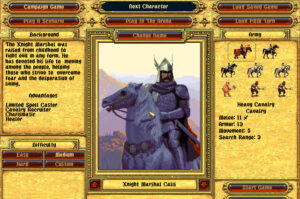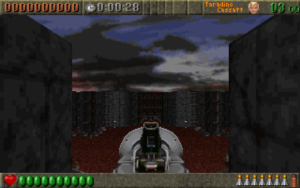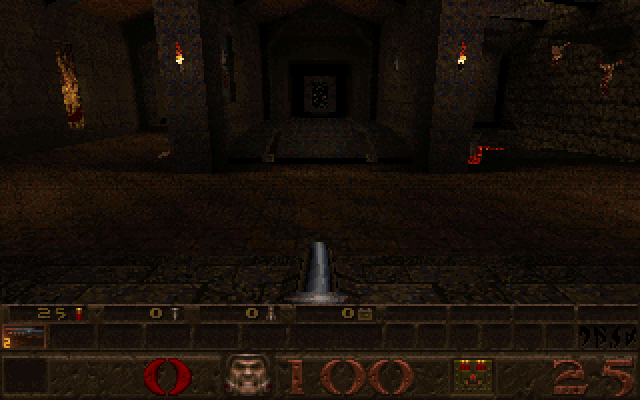
Every id Software shooter before 1996 was, underneath the perspective trickery, a flat map with height slapped on top. Wolfenstein 3D raycast a grid of identical-height corridors. Doom’s binary space partitioning let floors and ceilings vary, but a level was still a 2D blueprint wearing a 3D costume — no room could sit above another, no wall could tilt. Quake broke that rule. It replaced the blueprint with actual three-dimensional space: polygons with real X, Y, and Z coordinates, a camera that could pitch up and down, and levels where a walkway genuinely passed over a corridor below rather than faking it with sector tricks. That structural change is why Quake still gets cited in engine-history discussions decades later, long after its dark, muddy look stopped being anyone’s idea of cutting-edge.
From Doom’s shadow to a new engine, 1995-1996
Quake was id Software’s fourth major release, arriving in summer 1996, roughly three years after Doom defined the genre. The core team included programmers John Carmack, Michael Abrash, and John Cash; designers John Romero, Sandy Petersen, American McGee, and Tim Willits; and artists Adrian Carmack, Kevin Cloud, and Paul Steed. Development started in early 1995, and for most of that year the project existed mainly as an engine — Carmack was building true 3D rendering essentially from scratch, and it took considerably longer than the team had budgeted for. Only in a late-1995 planning meeting did id settle on the game’s final direction: a fast, dark, physics-driven shooter rather than the RPG-inflected fantasy game some on the team, including Romero, had originally pushed for.
That long engine gestation created real friction, documented well enough — in David Kushner’s Masters of Doom and in later oral-history pieces by outlets like Shacknews — to state plainly. Romero was nominally the lead designer, but with no finished engine to build levels in for most of 1995, direction stalled, and colleagues described him as hard to get concrete decisions from. Carmack, in turn, grew frustrated that design work wasn’t further along once the engine started coming together. It never blew up publicly during development, but it never got resolved either: within weeks of shipping, Romero left id Software, and most of that era’s team followed within the year. Quake was both id’s biggest technical achievement yet and the last game its founding lineup made together.
The release landed in a genre that had gotten crowded fast. Doom clones had proliferated for three years, and 3D Realms’ Duke Nukem 3D — built on the still-2.5D Build engine — had been a commercial hit just months earlier. Quake didn’t compete on jokes or gun count. It competed by rendering space nothing else on shelves could.
What “true 3D” actually meant under the hood
It’s worth being precise here, because “Doom was 2.5D, Quake was 3D” gets repeated so often it’s lost its meaning. Doom already used binary space partitioning (BSP) to pre-sort a level’s geometry for efficient rendering. The limitation wasn’t BSP itself — it was that Doom’s world data was fundamentally two-dimensional: a top-down floor plan with a height value attached to each sector. Walls had to be vertical, floors and ceilings flat, and two rooms could never occupy the same footprint at different heights. That’s why Doom can’t have a bridge crossing a lower walkway in the same space, and why the camera never actually looked up or down — id faked vertical aiming with screen-shearing rather than real perspective change.
Quake extended BSP into genuine three dimensions. Levels were built from arbitrary polygons positioned in true 3D space, the camera could pitch freely, and room-over-room geometry — stairwells, overlapping platforms, interiors stacked on exteriors — became possible for the first time in a mainstream shooter. Lighting moved forward with it: static geometry used precomputed lightmaps baked into the level data, while moving objects were shaded with Gouraud interpolation, giving Quake’s grimy stone-and-lava look a depth Doom’s flat-lit sectors never had. Michael Abrash, who joined Carmack specifically for this project, spent much of his time on the assembly-level optimization that made real-time software rendering of that geometry feasible on mid-90s hardware — which is also why period 486s and early Pentiums visibly struggled to keep Quake smooth at higher resolutions — id’s own recommendation at release leaned on a fast Pentium rather than the more modest hardware Doom had been comfortable on three years earlier.
The other leap arrived a few months after launch: better networking. Quake’s original multiplayer code waited for server confirmation before showing the results of a player’s own movement, which felt sluggish over 1996-era dial-up. In December 1996, id shipped QuakeWorld, adding client-side prediction — the client now guessed the outcome of your own inputs immediately and reconciled with the server afterward. Carmack described the change in his developer .plan notes at the time, and it’s generally regarded as the first workable, large-scale solution to input latency in a real-time multiplayer action game, a technique now standard in essentially every online shooter since.
| Attribute | Doom engine (1993) | Quake engine (1996) |
|---|---|---|
| World geometry | 2D floor plan + per-sector height (2.5D) | True 3D polygons in real X/Y/Z space |
| Room-over-room | Not possible | Fully supported |
| Camera pitch | Faked with screen shearing | Genuine perspective look up/down |
| Lighting | Flat per-sector light levels | Precomputed lightmaps + Gouraud shading |
| Enemies/objects | 2D sprites | 3D polygon models |
| Level structure | BSP over 2D sectors | BSP over full 3D geometry |
| Online multiplayer | LAN-focused (IPX) | Internet deathmatch, client-side prediction via QuakeWorld (Dec. 1996) |
The Nine Inch Nails soundtrack: how it actually came together
The Quake soundtrack often gets treated as a marketing footnote, but the real story is more specific than “id hired a rock star.” Trent Reznor and Nine Inch Nails drummer Chris Vrenna had become serious PC gamers while recording The Downward Spiral in the early 1990s — Vrenna has described the two of them setting up dueling PCs on the band’s tour bus to play deathmatch in Wolfenstein 3D. Reznor talked about that gaming habit in interviews often enough that word reached id Software directly, and the studio invited Reznor and Vrenna to Dallas to meet the team. Out of that meeting came an agreement: rather than licensing existing NIN tracks, the band would build an original, ambient instrumental record made specifically to underscore Quake’s levels — Reznor’s first real venture into ambient composition, a direction he’d return to years later with the Ghosts series. He’s said he was aiming for “the most sinister, depressive, scary, frightening kind of thing” rather than anything melodic, and beyond the score he contributed to the game’s sound design too. id folded the partnership into the game itself, giving Quake’s nailgun weapon and its ammo crates the Nine Inch Nails logo as an in-fiction nod. The soundtrack wasn’t sold as a standalone release until a vinyl pressing in 2020 — for nearly twenty-five years the only way to hear it was to own the game.
Streaming the Nine Inch Nails Score: DOSBox Setup for Quake
The original DOS release still runs cleanly in DOSBox, but a few settings matter more for Quake than for most 1993-vintage shooters, since it pushes far more geometry and, for the full experience, streams CD audio at the same time.
- CPU cycles: Start with
cycles=auto, then use Ctrl+F12 to add cycles if movement or the console feel choppy. Quake’s software renderer is CPU-bound, so on modern hardware you generally want cycles set high rather than conservative. - Memory: Give Quake a full 16 MB via DOSBox’s
memsizesetting — it’s noticeably hungrier than earlier id titles and will refuse to load larger levels otherwise. - Sound: Run Quake’s own SETUP program to select a Sound Blaster-compatible card and confirm the IRQ/DMA settings match DOSBox’s emulated defaults (typically IRQ 7, DMA 1) before launching QUAKE.EXE.
- CD audio for the Nine Inch Nails tracks: The music was pressed as Red Book CD audio, not game data, so it only plays if DOSBox mounts a CD image correctly. Mount the disc image with the
-t cdromswitch so DOSBox exposes the MSCDEX interface Quake expects, and make sure the volume label on your mounted image matches the original disc — mismatched labels are the single most common reason players get silence where music should be. - Common problem — physics acting odd at very high cycle counts: If jumps or projectiles start behaving strangely on a large fixed cycle value, drop back toward
cycles=auto; Quake’s simulation has more timing sensitivity than Doom’s did.
Tips for playing Quake now
- Learn rocket jumping early. Firing a rocket at your feet and jumping simultaneously launches you into space you couldn’t otherwise reach. It costs health but opens shortcuts across most levels.
- Circle-strafe instead of backing straight up. Quake’s monsters react to genuine 3D positioning, and strafing around an enemy while facing it keeps you dodging and dealing damage rather than trading hits in a straight retreat.
- Lean on the nailgun for sustained fights. Its ammo is common and its fire rate suits Quake’s faster enemies better than the single-shot weapons once you’re past the opening levels.
- Grab runes deliberately, not accidentally. Each episode’s secret levels award a rune tied to the true ending, so budget time to hunt secrets rather than beelining every exit.
- Watch water and lava for movement penalties. Quake’s true 3D physics apply real buoyancy and damage rules to liquids that Doom’s flat sectors never modeled — swimming slows you and lava punishes lingering.
- Save often, and manually. There’s no autosave safety net; Quake expects players to manage their own save slots, and later levels can turn on a single ambush.
Why it still matters
Quake’s influence shows up less in direct sequels than in the engines it spawned. id licensed the engine almost immediately — Raven Software built Hexen II on it, and Valve’s original GoldSrc engine, the foundation for Half-Life, was a heavily modified branch of Quake’s code. id also released the full engine source under the GPL in December 1999, which is why the retro-engineering community still studies its BSP and rendering code directly. On the multiplayer side, QuakeWorld’s client-side prediction became the template every online shooter since has built on, and the deathmatch scene it enabled is a direct ancestor of today’s esports FPS scene.
Revisiting it now, Quake reads less as “the game with the brown levels” and more as the moment first-person games stopped simulating three dimensions and started using them. For the fuller picture, Doom shows what the 2.5D ceiling looked like right before Quake broke it, and Heretic pushed that same Doom-generation engine about as far as it could go before true 3D made it obsolete. For getting either era running cleanly today, our DOSBox setup guide covers the baseline configuration this article builds on.
You might also like: