Thirty-plus years after its release, Another World still turns up in museum retrospectives, design-school reading lists, and “most influential games ever” polls answered by other developers. That’s unusual for a 1991 action game, and the reason is almost never “it was the hardest” or “it had the most content.” It’s that almost none of it was built the way games of its era were normally built. There’s no sprite sheet full of hand-drawn frames, no health bar, no lives counter, no text box explaining the plot — just a stranded physicist moving through scenes made of painted polygon shapes and fragments of real human motion, cut together like film footage. Éric Chahi didn’t design Another World so much as direct it, and that distinction is still the reason people write about it today.
A Solo Project That Outgrew Its Studio
Another World was created almost entirely by one person: French developer Éric Chahi, who handled the design, programming, and animation himself over roughly two years of development, with musician Jean-François Freitas contributing the soundtrack. Chahi built the game on an Amiga 500, writing the engine in 68000 assembly and constructing a custom animation editor in GFA BASIC to compose the game’s polygon-based scenes. The finished game was published by the Paris studio Delphine Software (Delphine Software International) for Amiga and Atari ST in November 1991.
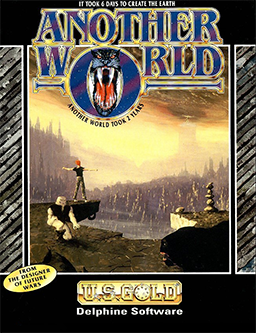
The MS-DOS version followed at the end of 1991, ported by Daniel Morais, and reached North America through Interplay Productions and U.S. Gold under a new title: Out of This World. The rename wasn’t a marketing flourish — “Another World” was already the name of a long-running NBC daytime soap opera, and Interplay wanted to avoid the collision at retail.
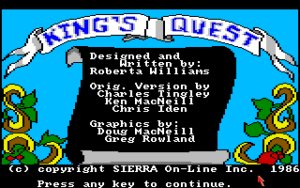
Placed next to what else was filling out the DOS action shelf in 1991 — corridor shooters, run-and-gun platformers, games built around bitmap sprite sheets and an always-visible score readout — Another World’s approach reads less like an evolution of the genre and more like a rejection of most of its conventions. It had no interface elements at all during play, no text dialogue, and animation that moved more like rotoscoped film than a typical DOS platformer. That gap between Another World and its shelf-mates is exactly why press at the time flagged it as something categorically different rather than simply a well-made version of the familiar thing.
A Game Told Almost Entirely Without Words
The premise is simple and delivered without a word of dialogue box: physicist Lester Knight Chaykin is caught in a lab accident during a thunderstorm and thrown into a hostile alien world. From that cold open, the game never puts a HUD on screen — no score, no lives display, no ammo counter, nothing. Everything the player needs to know is communicated through staging: a creature’s shadow crossing a wall, a distant explosion, a companion’s gesture. It’s closer to environmental storytelling as later game-design writing would come to define the term than anything else on DOS shelves in 1991.
Mechanically, Another World plays as a cinematic platformer: the player runs, jumps, crouches, and fights using a single energy weapon capable of three functions — a defensive shield, a direct shot, and a chargeable blast that can punch through obstacles. Death arrives suddenly and often, and it isn’t softened by a lives system; a checkpoint at the start of the current scene is usually the only cushion. That structure has always drawn comparisons to trial-and-error design, and the label is fair, but it’s a deliberate kind of trial and error — closer to memorizing the blocking of a scene in a film than testing raw reflexes.
Case Study: From Camcorder Footage to Polygon Outline
The technique behind Another World’s animation is worth walking through in detail, because it’s the single biggest reason the game still looks unlike its DOS contemporaries. Chahi filmed reference footage of a performer acting out the protagonist’s movements, then used a genlock device to bring that video directly into his development setup so he could trace key poses against it — a rotoscoping workflow borrowed from animation, not games, and one Chahi has cited as inspired partly by the flat cel-shaded look of Dragon’s Lair.
Where Another World diverges from a typical rotoscoped game like Prince of Persia is what happens after the tracing. Instead of turning those traced poses into a bitmap sprite sheet — a fixed stack of individually drawn frames that the engine blits to the screen one at a time — Chahi’s custom engine stored characters, creatures, and much of the environment as filled polygon outlines: vector shapes defined by a handful of coordinate points rather than a full grid of pixels. His engine interpolated between those polygon key poses at runtime, which is why the movement reads as unusually fluid rather than as a small number of hand-drawn frames looping. It also had a practical payoff: vector data describing a shape as a few connected points takes up dramatically less storage than dozens of full bitmap frames per animation, which mattered enormously on Amiga-class hardware and DOS machines with limited disk space and RAM in 1991. It’s worth being precise about what this wasn’t — it isn’t 3D geometry or hardware-accelerated rendering of any kind. It’s 2D vector fill, computed entirely in software, years before consumer 3D acceleration existed.
Another World vs. a Typical 1991 DOS Action Game
| Category | Another World (1991) | Typical DOS action game, 1991 |
|---|---|---|
| Graphics technique | Vector/polygon shapes animated by interpolating rotoscoped key poses | Fixed bitmap sprite sheets, hand-drawn frame by frame |
| Narrative delivery | Wordless, told through staging, cuts, and character gesture | Text-based intro/briefing screens; little or no in-fiction narrative during play |
| On-screen interface | None — no HUD, no score, no lives display | Persistent readouts for health, ammo, score, and lives |
| Difficulty design | Scene-based memorization; instant, frequent death with scene-start checkpoints | Lives-and-continues system, extra-life pickups, gradual attrition |
| Team structure | One primary developer building a custom engine and editor from scratch | Small studio teams, often reusing or licensing existing engine code |
Why This Game Punishes the Wrong DOSBox Cycle Count
Another World is one of the more cycle-sensitive games you’ll run in DOSBox, precisely because of the animation system described above: motion and event timing are tied to how fast the emulated CPU executes instructions, not locked to a fixed frame rate. Set DOSBox’s cycles too high — including cycles=max on most modern hardware — and movement, cutscene pacing, and timing-based obstacles will run noticeably too fast. Set them too low and the game crawls. There isn’t one universal number that works everywhere, since it depends on your host machine, but a reasonable starting point is cycles=auto or a moderate fixed value, adjusted from there with Ctrl+F11 (decrease) and Ctrl+F12 (increase) while watching the opening thunderstorm cutscene. If the lightning flicker and the protagonist’s fall look natural rather than rushed or sluggish, you’re close.
For sound, the original DOS release supports Sound Blaster, AdLib, Pro Audio Spectrum, Disney Sound Source, PC Speaker, and Roland MPU-401-compatible devices such as the LAPC-I and CM-32L. Sound Blaster is the safer pick in DOSBox: the game can push digitized sound effects through an AdLib card, but that path produces lower audio quality and asks more of the emulated CPU than the Sound Blaster driver does. If you get no audio at all, check that the in-game sound setup (run before launching the main executable on original installs) matches DOSBox’s configured Sound Blaster base address and IRQ rather than assuming the emulator will autodetect it.
Surviving the Opening Hour
- Expect to die immediately, repeatedly, in the first few minutes. The opening sequences are built around learning exact timing through failure, not testing your reflexes on a first attempt.
- Watch the background, not just your character. Since there’s no health bar or warning icon, danger is telegraphed entirely through animation — a shadow, a ripple, a creature’s wind-up — so treat the environment itself as your UI.
- Learn all three weapon functions before you need them. The shield, direct shot, and charged blast each solve different obstacles, and several sequences are unsolvable if you’re only using one.
- Use save states if your setup allows them. The original checkpoint system is sparse and scene-based, so leaning on your emulator’s save-state feature avoids replaying long stretches after a death.
- Move deliberately through unfamiliar areas on your first pass. The game rewards observation over speed — rushing a new screen is the fastest way to walk into a scripted death you had no way to anticipate.
- If a specific timing puzzle keeps beating you, retry immediately rather than backing up. Restarting right at the point of death, scene by scene, is how the game is designed to be learned.
Why Designers Still Point to It
Another World’s influence shows up less in direct sequels than in the developers who cite it as formative. Ico director Fumito Ueda, Metal Gear creator Hideo Kojima, Silent Hill director Keiichiro Toyama, and Suda51 have all named it among the games that shaped how they think about atmosphere and wordless storytelling. Chahi’s own next major project, Heart of Darkness (1998), reworked similar ideas about cinematic platforming and a mute protagonist; a licensed sequel, Heart of the Alien, arrived on Sega CD in 1994 without Chahi’s direct involvement. Modern retrospectives regularly draw a line from Another World through games like Flashback and Oddworld: Abe’s Oddysee to the wordless, atmosphere-first cinematic platformers of the last decade — the family of games Another World effectively founded.
The game has also had an unusually long re-release life for something built on Amiga hardware in 1989–1991: a 20th Anniversary Edition reached Steam and GOG in 2013, mobile ports arrived on iOS in 2011 and Android in 2012, and further re-releases followed on PS3, PS4, Vita, and Xbox One in 2014 and Nintendo Switch in 2018. In 2012, it was added to the Museum of Modern Art’s video game design collection, and in 1993 Electronic Gaming Monthly named it Most Innovative New Game.
For more on the DOS-era platformer this owes a technical debt to, see our piece on Prince of Persia, which pioneered the rotoscoped-movement approach Chahi built on. If you’re setting up DOSBox for the first time, our general DOSBox guide covers the basics this article assumes. And for background on how DOS graphics hardware evolved around games like this one, see our rundown of CGA, EGA, and VGA graphics history.
You might also like: