
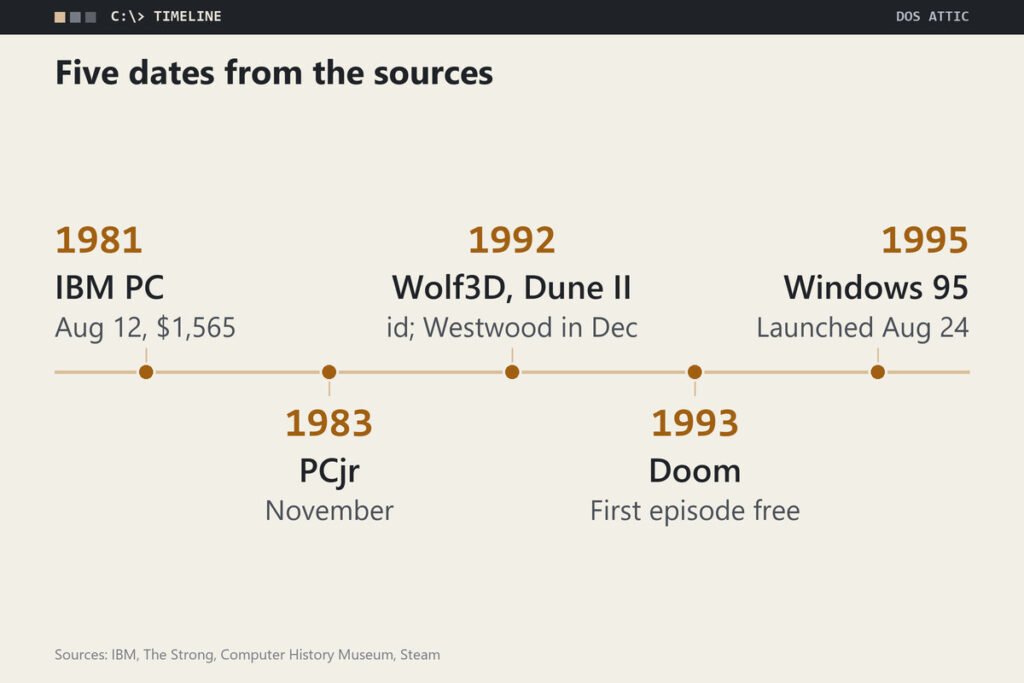
On August 12, 1981, IBM unveiled a computer priced at $1,565 with 16 kilobytes of RAM and no disk drive, and the two programs in the box were VisiCalc and EasyWriter, a spreadsheet and a word processor (IBM’s own company history). Add a display, two diskette drives and a printer and the bill grew by nearly $3,000 more. IBM’s history mentions games only in passing, as something the machine could do on a television alongside text processing, which makes the fourteen years that followed, ending with Windows 95’s launch on August 24, 1995, a useful test of what a platform’s makers can plan and what they cannot.
This timeline keeps to dates and claims that a company, a museum or a period source states outright. Where those sources disagree, the last section lays the disagreement out instead of picking a winner by habit.
A practical note before the dates. Two of the games discussed here are on sale today. Steam’s DOOM + DOOM II edition states that the original DOS versions of both games are included. Wolfenstein 3D is on Steam under Bethesda’s name, and its page does not say whether the 1992 DOS original is part of the package. Editions change, so read the product page before you buy.
Sixteen Kilobytes and Two Office Programs
IBM’s own account says the consumer machine began as a pitch to CEO Frank Cary, who gave William Lowe a month to build a prototype at a target of $1,500 and a year to bring it to market. The team decided that only off-the-shelf parts could hit that price and that deadline. They chose Intel’s 8088 chip, which ran at up to 5 megahertz and could address 1 megabyte of memory, while Microsoft provided the operating system that later became known as MS-DOS. About half of the system, including the expansion bus, display and keyboard, was lifted from IBM’s System/23 Datamaster.
Play gets a single passing line in IBM’s account: the PC could connect to a television and let users play games as well as process text. The ceiling that later memory managers spent years working around, one megabyte of address space, was a cost-and-schedule decision made by a team racing a price target and a deadline. The lesson for anyone reading DOS gaming as a planned movement is that the platform was assembled from available parts under a deadline.
Open Hardware That Outsiders Could Build For
The most consequential choice on that list was openness. IBM’s history calls it the most surprising decision the team made: they embraced an open architecture and published a technical reference with circuit designs and source codes so that other companies could write software and make peripherals. The results arrived fast. Within a year of launch more than 750 software packages were available, dozens of companies were selling memory expansion cards, and a few reverse-engineered the system boot code to make their own compatible computers.
Improvement as something you plug in
Read as game history, that openness explains the shape of everything that follows. The base machine stayed plain and anything better arrived as a board: a different display adapter, a different sound card, more memory. Each upgrade split the audience into people who had it and people who did not, and each split shaped what a developer dared to ship. The graphics side of that story is told in the CGA, EGA and VGA hardware history, and the audio side in the AdLib and Sound Blaster comparison.
November 1983: the PCjr Arrives
IBM’s own model list places the family-oriented PCjr in November 1983. For a games timeline the interesting part is the pitch, not the sales record: IBM, which had begun by selling an office machine, was now aiming at living rooms. Compatibility became the through-line. Because other makers could build machines that ran the same software, a game written for DOS could in principle reach any of them, and developers started to treat the compatible PC as one market rather than a family of incompatible brands.
A Standard That Outgrew Its Maker
IBM’s model list keeps going after the PCjr: the Portable PC in February 1984, the PC-AT in August 1984 and the PC Convertible in April 1986. The company’s own summary of the decade after the original machine reads as a list of multiplications: processing speed up tenfold, the instruction execution rate up by 100, system memory growing from 16 kilobytes to 16 megabytes and storage up by a factor of 10,000. For game developers each of those jumps moved the line between what a program could assume and what it could only hope for.
The same history quotes the author James Cortada on what openness cost IBM: its share of the PC market shrank from roughly 80 percent in 1982 and 1983 to 20 percent a decade later. The two facts belong together. The published specifications that let outsiders write software also let them build compatible machines, so the audience for DOS games grew while the company that started it held a shrinking part of it. Games did not cause that shift, and IBM’s account does not claim they did.
Apogee Gave the First Episode Away
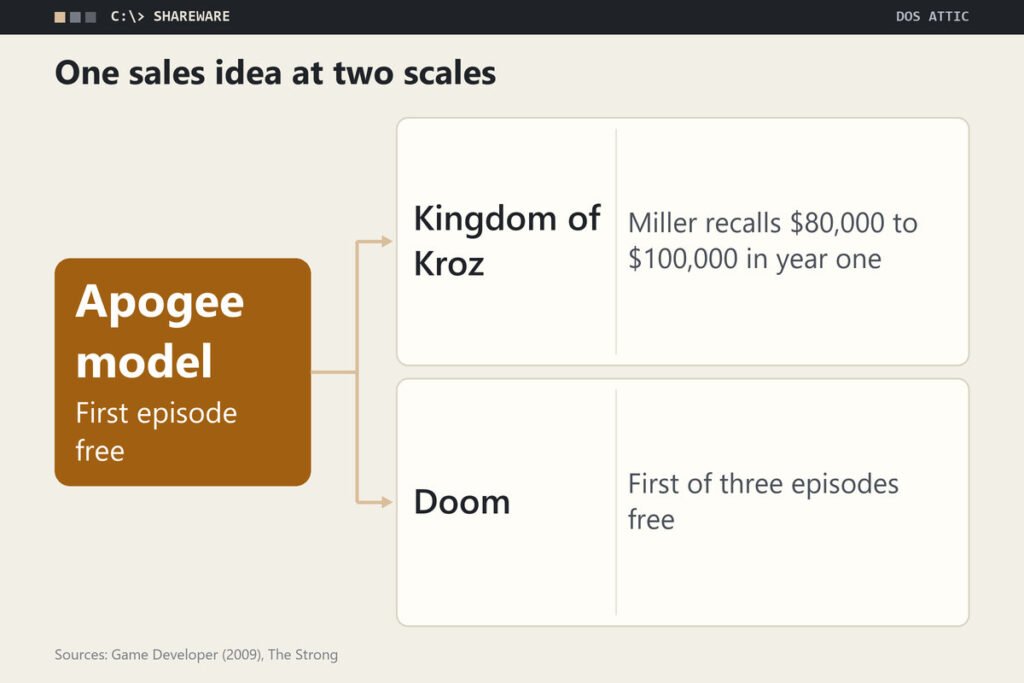
Game Developer’s 2009 write-up of its Scott Miller interview describes the problem he set out to fix: in the shareware model, few players paid. His answer, named the Apogee Model after his company, was to distribute a game’s first episode for free and offer further episodes for purchase if the player liked it. Miller also says that when he released Kingdom of Kroz he advertised two more Kroz games inside it, so that anyone who had finished the free game knew exactly where to send a check. Scott Miller’s Apogee model has its own full article here.
What one free episode earned
In the same piece Miller recalls making roughly $80,000 to $100,000 in the first year from people mailing checks, with orders arriving several times a day and often adding up to $100 to $200 daily. These are recollections offered in 2009, more than twenty years after the fact, not audited sales records, and they are best read as an order of magnitude. Even so, they show the logic: the free episode was the advertising budget, and the checks arrived without a retailer in the middle.
Wolfenstein 3D Puts a Corridor on the Screen
Steam’s page for Wolfenstein 3D says it was developed by id Software in 1992 and describes it as the game that started the modern-day first-person shooter genre. That sentence is publisher copy, which is worth remembering: a store page is a claim about history made by the people selling the product. It is a useful marker for the date, and it does not settle the question of who deserves credit for the genre. The last section returns to that question.
Doom Makes Two Bets at Once
The Strong National Museum of Play inducted DOOM into its World Video Game Hall of Fame in 2015. Its entry credits id Software’s team, led by John Carmack and John Romero, with creating a landmark game in 1993 that popularized the first-person shooter. The museum makes two further points that matter for this timeline, one technical and one commercial, and both are about how the game was built and sold rather than how it played (The Strong’s DOOM entry).
Engine apart from artwork
The museum notes that the designers created an engine that separated the game’s basic functions from other aspects such as artwork. That gave other designers a great deal of flexibility in modifying the game, and they began programming their own games along the same lines. The practical effect is that Doom is the first entry in this timeline that you can study as a tool as well as a title.
Multiplayer and a free first episode
The same entry says id used emerging technologies to encourage multiplayer contests and digital distribution of the game. It also describes the sales model: the first of three episodes was made available for free, and users paid for further material. In the museum’s judgment this demonstrated a business model that today dominates much of the video game world. Apogee’s mail-order method and id’s networked distribution are the same idea at different scales.
Westwood Looks Across to the Genesis
Westwood Studios’ Dune II reached MS-DOS in December 1992 with Virgin Games as publisher (release and development details). The same page quotes Virgin Interactive vice president Stephen Clarke-Willson, speaking in 1998, on how the project started: Virgin staff had been shown a real-time strategy game for the Sega Genesis, Herzog Zwei (1989), and Westwood agreed to look at it for design ideas. A small oddity in his account is that Cryo’s own Dune adventure turned out not to be cancelled after all, which is why Westwood’s strategy game carries the name Dune II. The long version of Westwood’s side is in Westwood’s Dune II.
August 1995 Is a Launch Date, Not a Funeral
The Computer History Museum’s 1995 timeline records that Windows 95 launched on August 24, 1995, with a $300 million promotional blitz that included television commercials set to the Rolling Stones’ “Start Me Up.” The date is solid. It is also the right place to end a timeline of this kind, because it marks the arrival of a new Microsoft platform in the home market (Computer History Museum, 1995).
What the date can and cannot show
A launch date proves that a new platform appeared. It does not prove that developers stopped writing for DOS on that day, and none of the sources used here claims they did. This article therefore treats August 1995 as the edge of its window and makes no claim about when DOS gaming ended.
When Records Disagree About ‘First’
Three claims in this timeline are labeled “first” or close to it in the literature, and the sources checked for this article do not line up.
The first-person shooter. Steam’s Wolfenstein 3D page says that game started the modern-day genre. Steam’s DOOM page says Doom pioneered and popularized it, and The Strong says Doom popularized it. The verbs differ: started, pioneered, popularized. Wolfenstein 3D came first by a year, so the two statements are compatible, and the verb “popularized” is the safest one because it describes audience rather than priority.
Real-time strategy. Two questions get mixed up here, release order and influence. On release order the page is plain: Herzog Zwei came out in 1989 and Dune II in December 1992, so if Herzog Zwei counts as real-time strategy, as Virgin’s account assumes, Dune II was not first. On influence the accounts differ. Clarke-Willson’s 1998 account says Westwood agreed to look at Herzog Zwei for design ideas, while Brett Sperry, the Westwood co-founder who produced Dune II, said in 2008 that the inspiration was partly Populous, partly his own work on Eye of the Beholder and partly an argument with an SSI executive about why wargames had stagnated. Both accounts are quoted on that same page and they are not mutually exclusive, but they weight the influences differently. This article’s position is that Dune II was not first, and that how much it owed to Herzog Zwei remains an open question.
Audience size. Doom’s free episode is often given an enormous player count. The museum entry, the source checked for this article, states no figure, so this timeline gives none. That omission is deliberate and will stay until a verifiable number turns up.