Dune II comes with two labels that do not survive a close look. It is called the first real-time strategy game, and it is called a sequel. Technosoft’s Herzog Zwei had already reached the Mega Drive by 1990, and Westwood’s own producer names it as an inspiration, while the “II” on the DOS box came from a publishing mix-up, not from a story that continued the first game. What Westwood did make in 1992 was the version of the idea that other designers could copy, and that is a stronger claim than being first.
A license, a rival game and a numeral
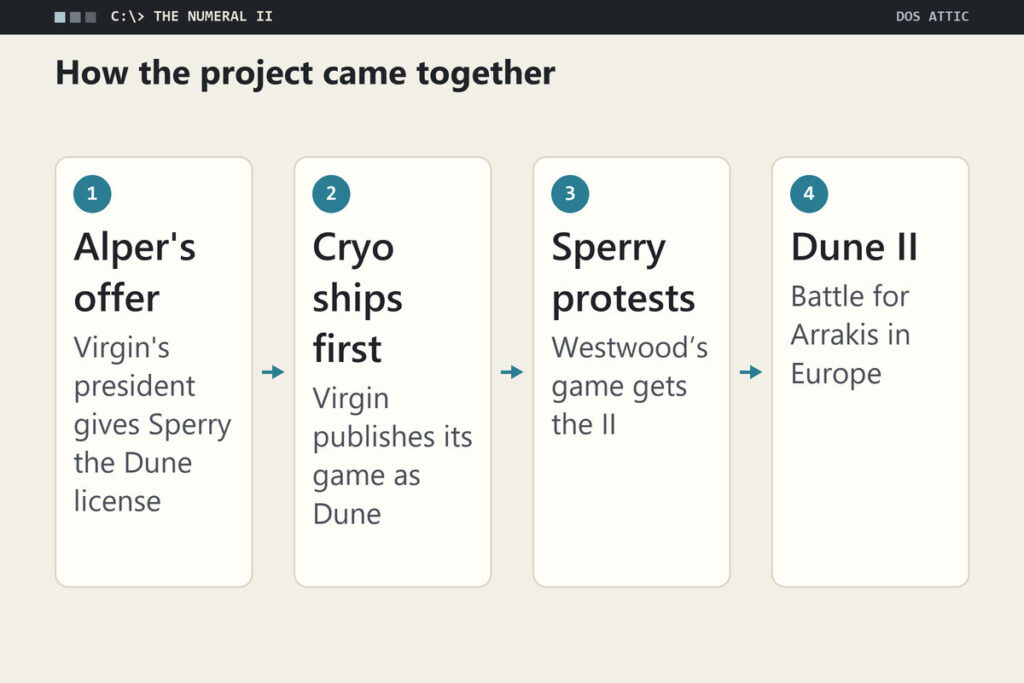
The mix-up starts at Virgin Interactive. In Edge’s interview with Sperry, Westwood’s Brett Sperry says the approach came from Virgin Games president Martin Alper, who asked what he thought of the Dune books and film and told him the license was his to use. Virgin had a second Dune project in hand at the same time: Cryo’s game came out ahead of Westwood’s, and Virgin published it as Dune.
Sperry, who produced the Westwood game, says he protested violently as his became Dune II: The Building of a Dynasty, with Battle for Arrakis as the title in Europe and on the Mega Drive. The numeral therefore tells you which game reached the publisher’s calendar first, not which one was the continuation.
Sperry’s mix of ingredients
Sperry named the sources of the design in that interview. Part of it came from Populous, part from his work on Eye of the Beholder, and the crucial part, in his words, from an argument with Chuck Kroegel, then a vice president at Strategic Simulations, about whether wargames had gone stale. Kroegel thought the category was in slow decline, while Sperry took the argument as a challenge to bring real-time dynamics and good controls to a wargame. He grants that Herzog Zwei was a lot of fun, but says the other inspiration was the Macintosh interface: if desktop items answer a click, why not a context-sensitive playfield, and why make hot keys the main way to play?
The first build did not work. Sperry says lead programmer Joe Bostic put movement and combat together from his description, with only four to eight units a side, and the result was boring and over in no time. Obstacles came next, then base and unit production and fog of war, with the production side partly inspired by Civilization. There was no fleshed-out design document, he adds, and the game was built iteratively. Computer Gaming World’s 1993 awards listing credits the designers as Aaron E. Powell and Bostic.
Spice, refineries and concrete
The rules are simple to state and the pacing is built around them. Spice production earns the credits that pay for buildings and units, which are then used to wear down the enemy: harvesting equipment works the spice fields, and processing and storage facilities turn the harvest into money. Computer Gaming World’s April 1993 review describes spice fields scattered across the map, some of them needing special transport to reach, and a set of hazards that includes mountains, dunes and the planet’s “legendary” sandworms, whose appetite is limitless and from which no participant is immune.
Building is constrained by terrain. The same review notes that rock outcroppings are the only ground on which bases may be built, and that they first require concrete foundations. Each scenario opens with a single unprotected construction yard on a rock formation and limited credits, and a rival family builds a base and attacks soon after. A map of spice, rock and sand therefore sets the shape of every base before any unit moves, which is why the harvest loop feels like geography instead of a menu.
The review gives the controls strong praise. Clicking a structure opens repair and upgrade commands, production buildings show an illustrated menu with costs and requirements, and clicking a unit offers movement and attack commands, which the radar lets the player issue across the whole map. That is the context-sensitive playfield Sperry described, and Edge’s retrospective observes that the same viewpoint, interface and controls are still reused today.
Houses that differ only slightly
Players choose from House Atreides, House Harkonnen or House Ordos. The review is blunt about how much that choice changes: the actions and strategies of the three families differ very little, though the Atreides are generally the easiest family to win with, followed by the Harkonnen, and the Ordos are the greatest challenge. The review adds that the Ordos are not an actual Herbert creation, and Edge makes the same point, counting them as the one faction invented for the game.
Late in a campaign accomplished leaders are also given a palace, which provides secret units of Fremen, Saboteurs or Death Hand missiles, depending on the family.
Nine scenarios, in order
Dune II unfolds in nine increasingly difficult scenarios that must be played in order, and the review says they differ only slightly by family. Each new scenario brings a more capable enemy, new equipment and new hazards buried in the desert, and the jump in complexity from one to the next is usually quite dramatic.
By the eighth and ninth missions the player faces huge pre-built enemy fortresses and several armies at once, including a climactic attack by the emperor’s Sardaukar troops, while still mining spice. Special weapons from research facilities arrive for those last scenarios, and which ones depends on the family.
Hearing Arrakis in 1993
Sound mattered in the review as much as the rules. Computer Gaming World called the digitized effects dramatic, from exploding tanks to collapsing buildings, and praised one of the most original and enjoyable music scores ever written for a computer game. Owners with a Sound Blaster or an AdLib Gold card and 2 MB of available memory also heard the mentat narrating the action on the battlefield. Players without one of those boards did not get the narration.
Strategy Game of the Year, and a name for a genre
The reviewer’s verdict was that the game would be a gratifying experience for anyone who wanted to test their strategic abilities, and the magazine’s editors agreed. In its 1993 awards, Computer Gaming World named Dune II its Strategy Game of the Year, calling it a marvelous crossover hit between action and strategy gamers. Edge adds that the game was an immediate hit when it came out in 1992 and soon a huge commercial success.
The genre label has an origin too. Sperry says the team called Dune II a “realtime strategy” game to make clear to retailers and players that they had something new, though to him it was a wargame at heart: you built and managed units and took out the other side.
Is there an official copy today?
Not that could be found. When the GOG and Steam catalogs were searched in the third week of October 2026, GOG listed no Dune II and Steam’s search for the title turned up no Dune II either, so no current official sale of the original DOS game could be confirmed. Fan-made engine rebuilds exist, but they need the original game data to run, and this article does not point to a source for it.
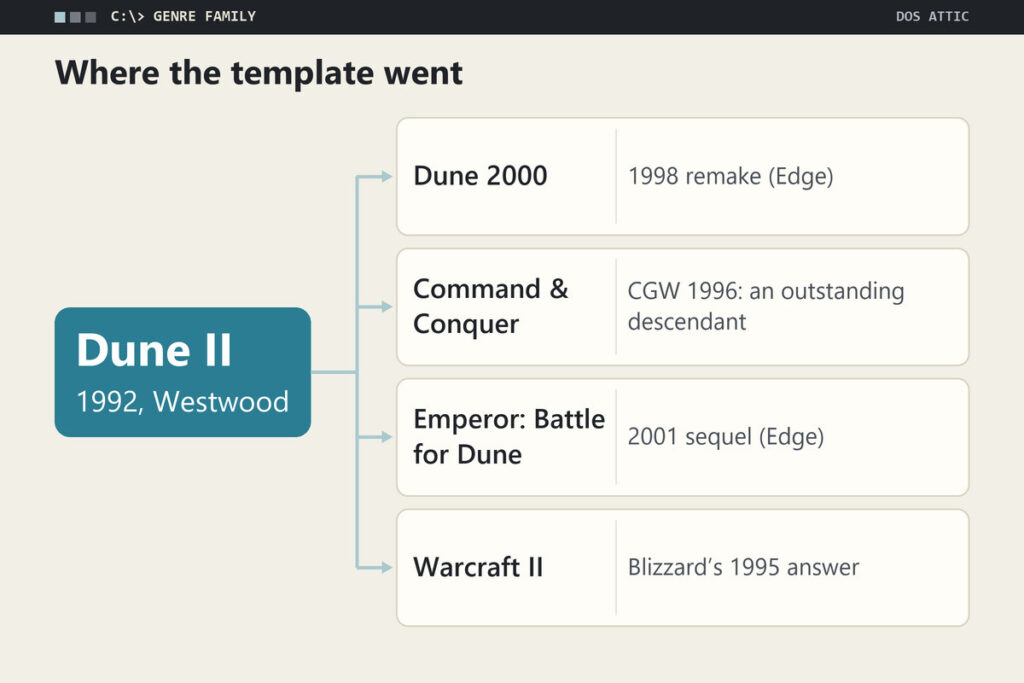
Descendants of the template
Computer Gaming World named the Westwood line as the heir in its 1996 awards, calling Command & Conquer an outstanding descendant of Dune II. Sperry describes the hand-off himself: as Dune II wrapped up he was already working on its successor, streamlining the interface further and moving to a modern setting, and that is how Command & Conquer was born. Edge calls that series the game’s true legacy and lists two direct sequels, the 1998 remake Dune 2000 and Emperor: Battle for Dune in 2001.
On the Blizzard side, the Warcraft II story shows how another studio answered with its own version of the loop. The longer DOS chronology follows the real-time strategy branch next to the first-person shooters.
Herzog Zwei, Dune II and Command & Conquer side by side
| Herzog Zwei | Dune II | Command & Conquer | |
|---|---|---|---|
| Year | By 1990 | 1992 | 1995 |
| Developer | Technosoft | Westwood Studios | Westwood Studios |
| Platform | Sega Mega Drive/Genesis | MS-DOS PC | PC |
| How it is described | A 1990 Mega Drive game that Sperry calls a lot of fun | The game Computer Gaming World named Strategy Game of the Year for 1993 | An outstanding descendant of Dune II, per Computer Gaming World |
| In Sperry’s account | One inspiration, next to the Macintosh interface | Point and click on a context-sensitive playfield | Sperry’s follow-up design, with the interface streamlined further |
Read left to right, the table follows a hand-off: a console game Sperry credits as an inspiration, a PC game Westwood built around the mouse, and a follow-up design that pushed the interface further.