The Game That Started the Gold Box Line
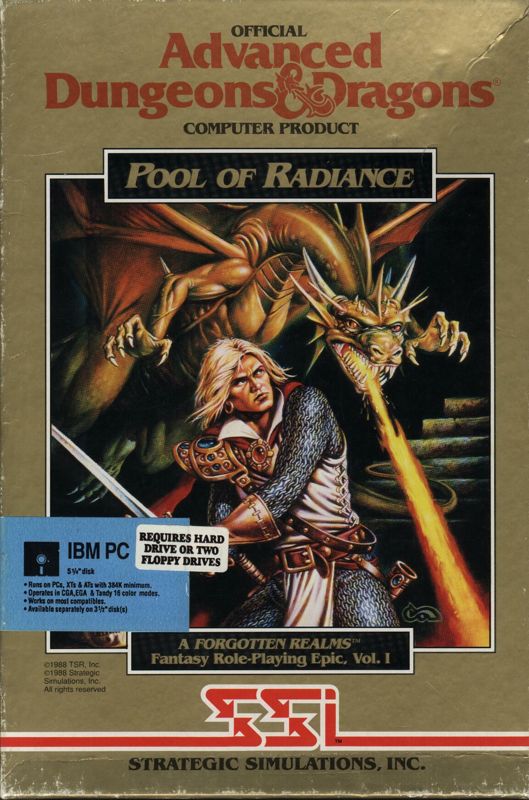
Pool of Radiance, released by SSI in 1988, was the first video game adaptation of TSR’s Advanced Dungeons & Dragons ruleset, and it became the launching point for the entire Gold Box series. Set on the northern shore of the Moonsea, it follows a party of adventurers hired to reclaim the monster-infested ruins of the city of Phlan.
Its success proved that AD&D’s tabletop rules could translate faithfully to a computer, and that proof mattered – it cemented SSI as the era’s premier publisher of licensed D&D games and spawned a long line of sequels that carried the Gold Box engine through the early ’90s.
Reclaiming Phlan, District by District
You create and control a party of up to six characters, exploring Phlan’s ruined districts on foot before dropping into grid-based, turn-based tactical combat against the city’s many threats. Character creation, spellcasting, and equipment follow AD&D’s rules closely, giving the game an unusually authentic tabletop feel for 1988.
Reclaiming the city district by district gives the campaign a satisfying sense of progress, and the turn-based combat system introduced here – later reused across the entire Gold Box line – rewards careful positioning and party planning over quick reflexes. Clearing a district also opens up new services and shops back in the safe zone, tying exploration directly to your party’s growth.
Combat itself takes place on a separate tactical grid once you engage an enemy group, switching from the exploration view to a more detailed battle map where facing, terrain, and spell range all come into play – a level of tactical granularity that few competing RPGs attempted at the time.
A Genuinely Foundational RPG
It’s hard to overstate how foundational this game is. Pool of Radiance is the reason “Gold Box” became shorthand for a specific, beloved style of tactical AD&D RPG, and its influence runs through decades of licensed D&D games that followed, right up through modern turn-based tactics titles that owe something to the formula it established.
The accompanying printed materials that shipped with the game, including the Journal and City of Phlan map, were part of the design too, serving as both copy protection and genuine world-building – a detail that’s easy to forget now that most players experience it purely through emulation. Digital re-releases have generally folded the necessary reference text into the game itself so modern players aren’t left hunting for scanned manuals.
How It Plays Today
Playing it today requires some patience – the interface is dated, and the difficulty curve is unforgiving by modern standards, with permadeath-adjacent consequences for a wiped party. But the tactical combat still holds up remarkably well, and there’s a real thrill in seeing where this specific, hugely influential style of RPG actually began.
I’d recommend it to anyone serious about CRPG history, with the caveat that it plays like exactly what it is: a nearly 40-year-old game that expects you to take notes, plan your turns carefully, and accept that not every fight is winnable on the first try.
Where the Series Goes From Here
If Phlan hooks you, the game connects directly into Curse of the Azure Bonds and the rest of the Gold Box line, all sharing compatible character export between titles – a feature that was genuinely novel for the time and let a single party’s story stretch across several separate games.
That continuity is a big part of why Pool of Radiance still matters to talk about today: it wasn’t just a one-off experiment, it was the opening chapter of a system built to carry your specific characters, warts and all, through years of subsequent releases.
Building Your First Party
Character creation follows AD&D’s rules closely enough that veteran tabletop players will feel right at home rolling stats, while newcomers get a reasonably clear breakdown of what each class brings to the table. A balanced starting party of fighters, a cleric, a magic-user, and a thief covers most of what Phlan throws at you early on, though the game is forgiving enough that unconventional builds can still work with a bit of extra caution.
Money and equipment matter more than you might expect going in – Phlan’s shops sell meaningfully better gear as you clear more of the city and unlock additional funds, so resisting the urge to spend everything on your first visit pays off once tougher districts open up.
Where to Get a Copy
Brand new to DOSBox? Our setup guide walks through the basics, and our roundup of the best free DOS games is a good place to look afterward if you want more classics without spending anything.
Setup Notes for DOSBox
Mount the folder containing the game as your C drive (mount c c:\path\to\game), switch to it with c:, and launch the EXE. As one of the earlier Gold Box titles, it runs well even on conservative cycle settings; our setup guide covers sound card configuration for the most period-accurate experience, including options for the AdLib-only setups common on machines from 1988.
A Video Look at the Game
You might also like: