
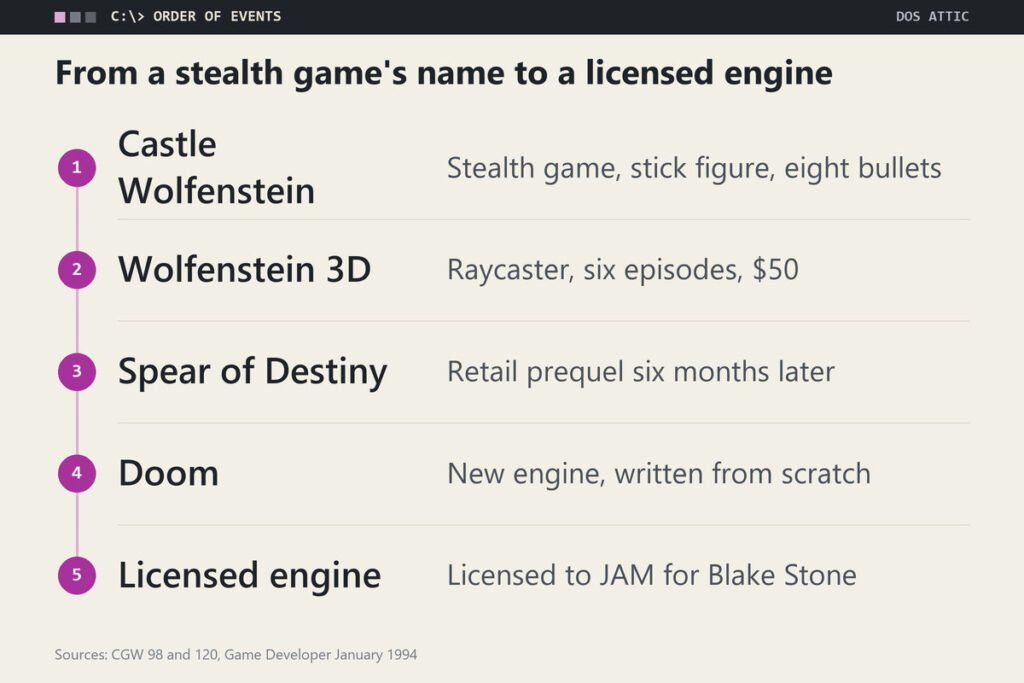
In Castle Wolfenstein, as a reviewer in Computer Gaming World’s September 1992 issue remembered it, you had a gun, eight bullets and a job of creeping from room to room, quietly disposing of guards. In id Software’s Wolfenstein 3D the same reviewer sprinted down hallways and machine-gunned an advancing SS trooper in bloody detail. The two games share a castle and a name and almost nothing else about how they play. That gap is the best way into the 1992 game, because most of what id built was a decision about what to throw away.
How id got the name
According to CGW’s 1994 profile of the studio, id wanted to fold what it had learned from an earlier experiment, Catacomb 3-D, into a fast action game about hunting mutants in a bio-research lab. Then the team reminisced about an old Apple II classic, Castle Wolfenstein, and decided that its setting, a captured American soldier escaping a Nazi fortress, would make a great game in three dimensions. They hunted down the original designer, Silas Warner, and found that he had sold the rights.
Accounts then diverge. CGW says the trail ran through three or four long-dead companies and ended with a man selling the original game out of his basement, and that because the copyright had lapsed id applied for it itself. A reference history of the game says instead that id bought the trademark from the last holder for about $5,000 in the spring of 1992. This article follows the CGW profile for the outline, because it was reported at id’s offices within two years of the event, and it leaves the price out because only one source gives it. Neither account has Silas Warner granting permission, which is how the story is sometimes retold.
Six episodes, one of them free
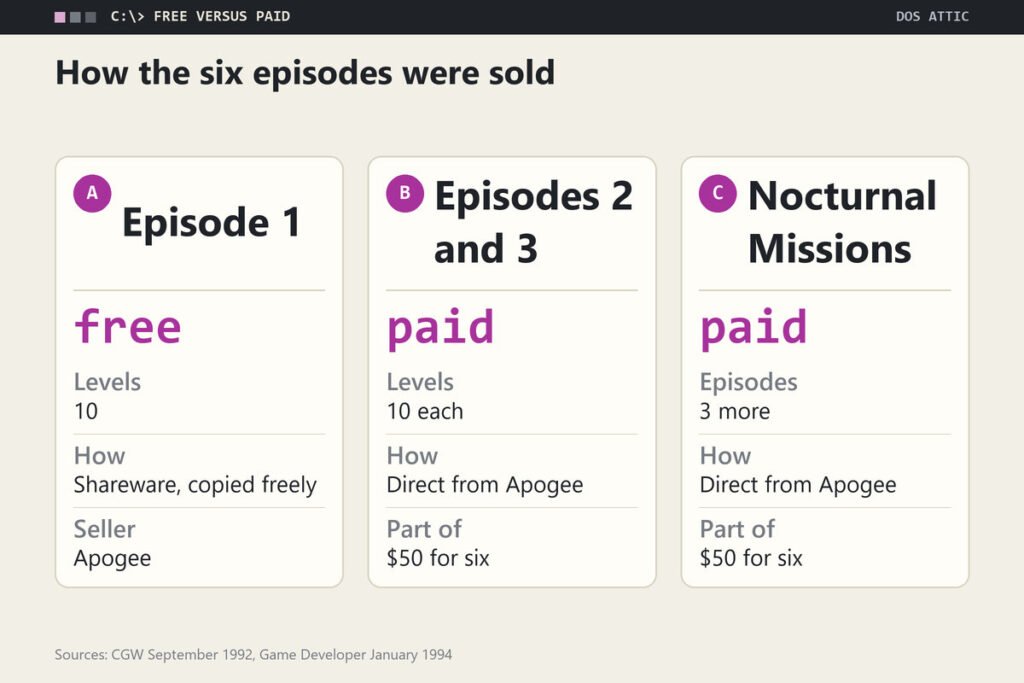
GOG’s listing gives May 5, 1992 as the release date, and the current Steam and GOG pages both describe six episodes with the Spear of Destiny expansion included. CGW’s review put the 1992 price at $50 for six scenarios. It noted that the first scenario was shareware, passed around on bulletin boards, and that the others were not shareware and were only available through Apogee. The reviewer, who admitted he had not met the model before, spelled out the rule for readers: copy it, play it, and if you keep it Apogee asks you to register and pay, and otherwise you erase it.
The January 1994 Game Developer feature on id puts the free part at the first 10 levels and says the additional levels were sold directly through Apogee. Each of the original three episodes has ten levels with a boss on the last, and a second set of three called the Nocturnal Missions was added later. CGW’s review names two of the scenarios, Operation: Eisenfaust and Die, Führer, Die!, and says that each has its own characters, scenery, music and story while ending in the assassination of some ultimate incarnation of evil. Spear of Destiny was a separate prequel sold at retail, which Game Developer dates six months after the original.
A raycaster for the lowest common denominator
How the screen was drawn
CGW’s reviewer called the world a free-scrolling, texture-mapped environment, less detailed than Ultima Underworld’s but much faster, so fast that he caught himself craning his head back and forth. Game Developer explained the method: id combined texture mapping with a raycasting engine written in assembly language so the game would run on what was then the lowest common denominator machine, a 286.
John Carmack’s comments in the release notes that came with the source code on id’s GitHub page fit that account. He wrote that the raycasting design was still reasonably appropriate for the game, that a BSP-based texture mapper could go faster but ray casting was a lot simpler to do at the time, and that the dynamically compiled scaling routines, the fastest possible way to scale walls on uncached machines, turn into a bad idea on modern processors.
What the grid could not do
Every level was a flat plane, and Game Developer notes that in Wolfenstein a cube had to look the same on all sides. The same release notes list taller walls and vertical motion as a project for hobbyists, with a warning that it should only be tried if the texture mapper is rewritten. Doom did not stretch this engine. According to Game Developer, Carmack started from scratch. How the game built on that new engine reached players is the story of Doom’s free episode and why it travelled so far.
Shouts, swing music and a 7 kHz budget
The CGW review spends nearly as long on sound as on graphics. Guards give a startled shout when they spot you and scream when they are hit, and the reviewer thought the digitized sound and the pneumatic pump of the machine gun brought the act of killing home. The soundtrack changes from floor to floor, mostly the hushed swing of spy-film percussion, sometimes a patriotic tune turned into a melody and, in one case, a Morse code message that someone online had decoded. Game Developer supplies the budget behind it: Wolfenstein’s samples were recorded at 7 kHz, and id said Doom’s would be recorded at 11 kHz. The review also notes the game’s opening screen, a mock-up of a film rating notice reading PC-13, for Profound Carnage. Its verdict was that Wolfenstein and Ultima Underworld were the first games technologically able to make a player feel threatened on a flat screen, and that readers should see it at least for a cheap look at where immersive entertainment might go.
The free ten floors and where they went
Mail order was where the money was. Game Developer says the complete game cost $50 and the cost of materials was under $5, while each retail copy of Spear of Destiny returned about $8 to id after the split with the retail partner FormGen. The free first episode was the advertisement, and it travelled.
Two sets of sales figures
The sources disagree on how far. Game Developer, writing in January 1994, says Wolfenstein and Spear of Destiny had each sold about 100,000 copies by late 1993. CGW’s July 1994 profile says the game logged 150,000 shareware registrations and Spear of Destiny sold 150,000 retail copies, and that id estimated worldwide distribution of the free episode at over a million. Both come from id, and the later number is larger, so the two can describe different moments rather than a contradiction. This article uses 100,000 for the end of 1993 and 150,000 for mid-1994, and treats both as id’s own reporting, not audited sales.
Overseas orders and a German ban
Game Developer reports that foreign orders were about 20 percent of Wolfenstein sales, and that the game was banned in Germany, which id said was because of violence, not Nazi content. Id expected the same ruling for Doom.
Cuts Nintendo demanded from id
The Super NES version shows how much the setting depended on the details. Game Developer says Nintendo had id remove the Nazi imagery and change the German shepherds into giant rats, then picked over small details for months until id dropped future Super NES work. CGW’s profile says the team vowed never to work for Nintendo again.
Engines for hire
Game Developer reports that id licensed the Wolfenstein technology to JAM Productions for Blake Stone, which made the engine a product as well as a game. Apogee’s own follow-up is the subject of the Wolfenstein sequel Apogee rebuilt as Rise of the Triad.
Buying it, and what the source release gives you
Wolfenstein 3D is on sale at Steam and GOG, and both pages list six episodes with the Spear of Destiny expansion included. GOG’s page says its version is powered by DOSBox, which means the DOS game itself; Steam’s page does not say which build it ships. The notes in id’s GitHub repository say you need the data from a released copy of Wolfenstein or Spear to run a build of the source, and that shareware data is enough, but the license in that repository is a limited-use agreement for educational purposes, so it is a reading copy, not a way to publish a port. No official free distribution of the first episode turned up on the store pages or in id’s repository, so this article does not link to one.
Castle Wolfenstein, Wolfenstein 3D and Doom side by side
| Castle Wolfenstein | Wolfenstein 3D (1992) | Doom (1993) | |
|---|---|---|---|
| View | A small stick figure seen from above | First-person, free-scrolling and texture-mapped | First-person, with the map broken into sectors |
| Typical play | Creep from room to room with eight bullets | Sprint, strafe and machine-gun SS troopers | Weapons with physical projectiles and monsters that interact with one another |
| Rendering idea | Not a 3D renderer | Raycasting in assembly on a flat grid | Engine rewritten from scratch, with only two assembler routines |
| Who sold it | Muse Software | Apogee, with id as developer | id itself, after choosing not to use Apogee for Doom |
Read left to right, the table is a record of subtraction and then addition. id removed the stealth, built the cheapest 3D that a 286 could carry, and sold the first ten floors for nothing. The wider timeline of where that sits in the DOS years is in the DOS gaming timeline from 1981 to 1995.