
Old does not mean free. Most pages that promise free DOS titles are hosting software somebody still owns, and the owner never agreed to hand it out. The reliable cases are narrow: a publisher or developer that has said, on its own site or through a project it works with, that this particular game costs nothing.
Seven games clear that bar today. Two come from Bethesda, two from Revolution Software, which carries them at no price in its storefront listings, and three sit on the freeware list kept by the ScummVM project. What follows says who gave each one away, what the zero price covers, and what it quietly leaves out. Where the evidence is a project’s list and not the owner’s own page, the text says so.
The label people reach for instead is abandonware, and it is the weakest of all. A game that is no longer sold has not left copyright; the word describes a gap in the market, not a permission. Everything on this page rests on the opposite kind of evidence, a statement from somebody entitled to make it.
Meanings Hidden Behind One Word
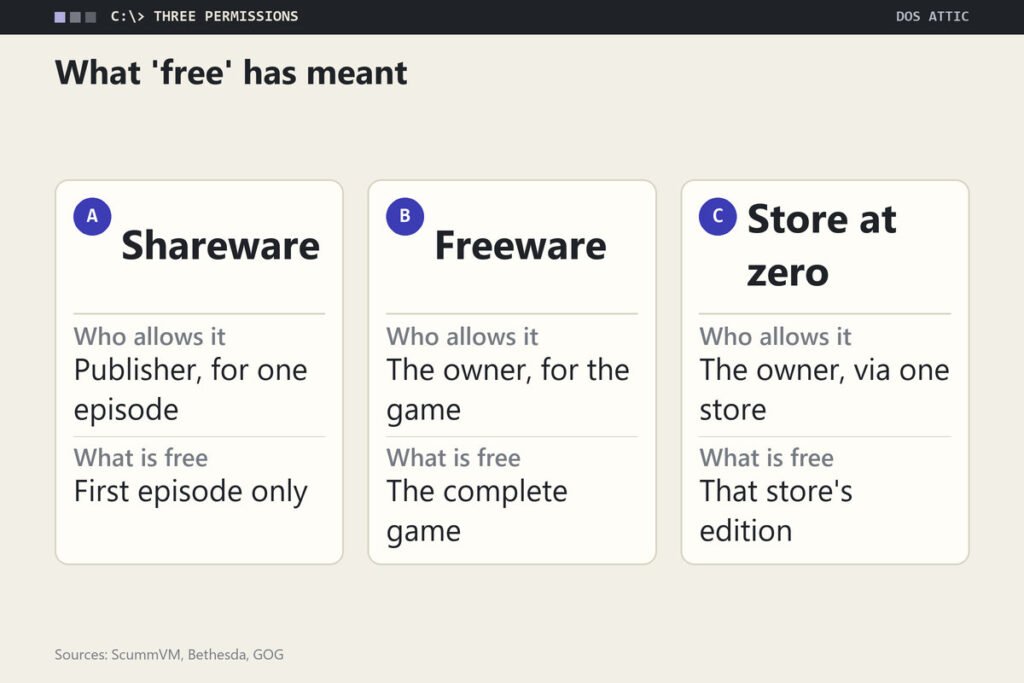
Before the games, a vocabulary check. People say free about three different permissions, and mixing them up is how a safe-looking page turns out to be a risky one.
Shareware, a first episode shared on purpose
Shareware was a sales method. Apogee and id Software let people copy the first episode and charged for the rest, a model explained in how Apogee sold the remaining episodes by mail. The permission to copy belonged to that moment and to those disks. No current statement from the rights holders covers the shareware files that sit on websites today, so Doom’s shareware episode and its neighbours stay off this list. Loved is not the same as licensed.
Freeware, the whole game given away by its owner
Freeware is the plain case: the complete game, nothing held back, offered by the party that owns it. Bethesda did this twice. Both Bethesda releases were timed to an anniversary of the series, which reads less like charity than like a living franchise lending its first chapters to newcomers. The wording matters either way, because a game can be old, out of print and still owned.
A store listing at a price of zero
The newest meaning is a storefront entry with no price. GOG shows Lure of the Temptress that way and Steam does the same for Beneath a Steel Sky; on both pages the company line reads Revolution Software, so the seller of record is the studio that owns the games. A zero price licenses you to get the game from that store. It does not turn the files into something you may post elsewhere, and that gap is what most dubious pages depend on.
Bethesda Lets Go of Its Oldest Games
Bethesda’s two entries share a pattern. Each was opened up for an anniversary, and each still has a page on the company’s own Elder Scrolls site with a button for the full game. That makes them the easiest cases to verify, because the owner’s statement and the current listing sit in the same place.
The Elder Scrolls: Arena
Bethesda gave Arena away in 2004 to mark the series’ tenth anniversary, a fact recorded in a UESP news item written when its successor followed. The company’s own Arena page carries the full-game button today, so the owner’s statement and the listing agree.
The Elder Scrolls II: Daggerfall
Bethesda followed with Daggerfall in July 2009 and, according to the same news item, linked a DOSBox guide, which suggests the DOS original is what went out. Bethesda’s Daggerfall page offers the full game today. The retail history and the size of the map get their own treatment in what the 1996 reviews said about Daggerfall.
Revolution’s Two Adventures
Revolution Software is the other owner on this list, and its two storefront entries show how a studio can keep a game in circulation without selling it again.
Lure of the Temptress
GOG lists Lure of the Temptress as a free game from Revolution Software, released on 12 April 1992, and says it is powered by ScummVM. ScummVM’s own list offers a freeware English version of 5.4 MiB, last updated in February 2008, with French, German, Italian and Spanish editions beside it.
Beneath a Steel Sky
On Steam, Beneath a Steel Sky is Free To Play, with Revolution Software Ltd named as developer and publisher. ScummVM lists two PC editions, a floppy version of 7.3 MiB and a CD version of 66.2 MiB. The game’s full story is in Dave Gibbons’ DOS adventure, and the list is a good reason to start there.
Adventures on ScummVM’s Freeware List
ScummVM’s games page says its list currently covers eleven freeware games, among them Beneath a Steel Sky, DreamWeb, Flight of the Amazon Queen, Lure of the Temptress and Dráscula. The project is an engine that runs adventure-game data files, and it ships none of its own, so the list is a way to get the data legitimately, not a bundle.
One caution on method: that list is the project’s statement, not the owner’s. For Bethesda and Revolution, an owner or its own store carries the offer. For the three below, only the project’s list does, which is why the safest habit is to read ScummVM’s page, and not a mirror, before trusting any copy.
Each entry is easy to read once you know the pattern. A floppy version is the smaller, older release. A CD version is far larger, which points to recorded speech and music, though the page does not itemise it. Language names mark translated editions, and the last-update date shows when somebody at the project last touched the file. Across the whole page those dates run from March 2004 to September 2026, so the list is maintained rather than frozen.
Flight of the Amazon Queen
The entry to take is the freeware CD version labelled unmodified original, 107.4 MiB. A floppy version of 6.8 MiB, last updated in March 2004, sits beside it, together with French, German, Italian and Hebrew editions.
DreamWeb
DreamWeb is the only entry whose list label says DOS outright: a freeware floppy DOS version of 9.7 MiB and CD DOS versions in English (UK and US), French, German, Italian and Spanish, all last updated in May 2014. The English UK CD version is 215.6 MiB, more than twenty times the size of the floppy.
Dráscula: The Vampire Strikes Back
The English freeware version is 31.3 MiB. Separate add-ons carry the music in MP3, FLAC or OGG form and the Spanish, German, French and Italian text, and the newest language add-on requires ScummVM 1.3.0 or later. Decide which add-ons you want before you collect files, because none of them is bundled with the base version.
With all seven in view, this table sorts them by what a reader might want and gives the reason the sources back each pick.
| If you want | Start with | Why the sources back it |
|---|---|---|
| One very long game | Daggerfall | Official Bethesda page and a DOS original; rough edges are covered in its own article |
| An evening’s adventure | Beneath a Steel Sky, floppy edition | 7.3 MiB, listed by ScummVM and Free To Play on Steam under Revolution’s name |
| The series from the start | Arena | Free since 2004 and still on Bethesda’s site |
| Something to browse | Flight of the Amazon Queen or Dráscula | ScummVM freeware entries with small base files; no owner page |
Limits of a Zero Price
Does a zero price let me pass the files on?
No. It lets you get the game from the party that set the price. If an unfamiliar site offers the same files, the question is whether the owner put them there, and the owner’s page is where that answer lives. A copy that happens to be identical is still somebody else’s copy.
Will these run on a current PC as they are?
The two Bethesda games are DOS programs, which is why the 2009 release came with a DOSBox guide. The adventures need ScummVM, which ships none of the games, so the data files come from the list above. Either way you are pairing a free game with free emulation software, and each half has its own terms.
Why are three of the seven only on ScummVM’s list?
Because for Flight of the Amazon Queen, DreamWeb and Dráscula the evidence is the project’s statement that the games are freeware, and no owner page or store listing turned up. That is enough to name them, and not enough to treat them as equal to a game whose owner publishes the offer. The distinction is the reason the entries are grouped under ScummVM’s name.
Is a zero price in a store the owner’s permission?
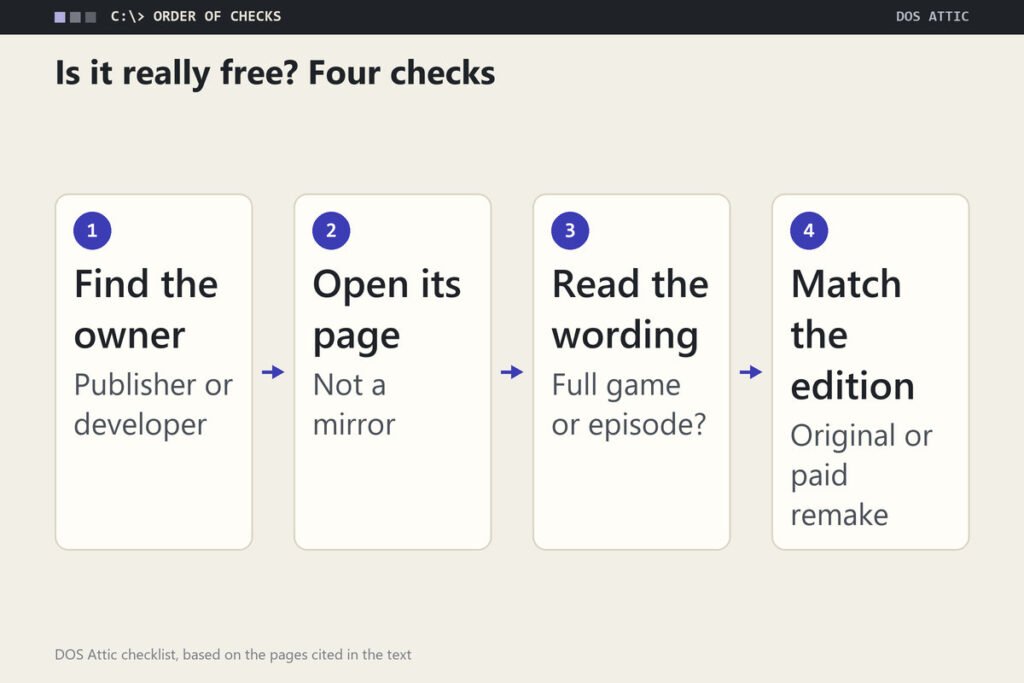
Here it is, because the company line on both store pages names Revolution Software, so the seller is the owner. A zero price on a page run by anyone else proves nothing. Prices also change, which is why the store page, read on the day you download, outranks any list, this one included.
Ranking the Seven by Evidence, Not Size
Rank the seven by the strength of the evidence and the order is plain: the Bethesda pair and the Revolution pair first, because an owner’s page or an owner’s own store listing is a stronger statement than a project’s list, and the three ScummVM-only entries after them, however good the games are.
Do not rank them by size. Lure is a complete game at 5.4 MiB, and the list offers DreamWeb at both 9.7 MiB and 215.6 MiB, so the number tells you which edition you are holding and nothing about quality.
The weakest reason to pick any of these is completeness. The strongest is that the owner has said yes, in writing, on a page you can open. By that test the shareware shelf, however loved, has not earned a place until its owners say so again.